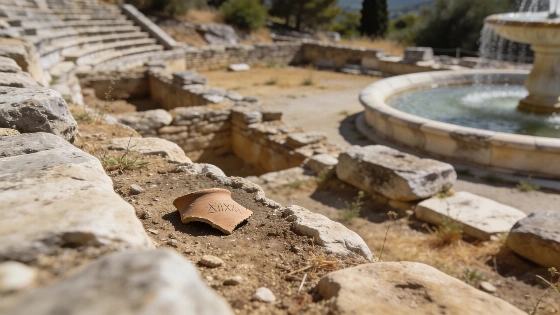
A pottery fragment inscribed with Asclepius's name helps identify a religious complex near the Small Theatre of Epidaurus. Its features and location fit an account by the ancient traveler Pausanias
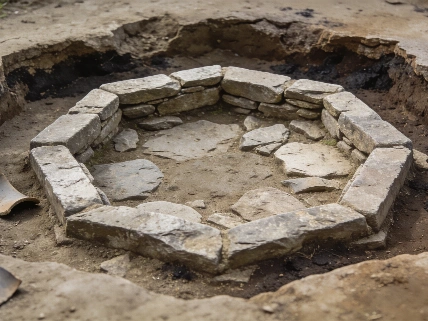
A pottery fragment inscribed with the name of Asclepius is among the evidence for identifying a religious complex about 20 meters from the Small Theatre of Epidaurus. The excavated remains include an open-air enclosure, a monumental fountain and a large water reservoir, alongside a western stoa and a nymphaeum. The fountain has been dated to the 4th century BC.
Researchers identify the complex as the temenos, or sacred precinct, described by Pausanias, who traveled through Greece during the 2nd century AD and recorded religious sites and local traditions. The identification addresses a longstanding question about where this sanctuary stood within the ancient city, distinct from the better-known Sanctuary of Asclepius outside the urban center. The complex lies in the city center, close to the Small Theatre.
The findings were presented on 9 November 2026 by Vassilis Lambrinoudakis, Professor Emeritus of Classical Archaeology at the National and Kapodistrian University of Athens. The excavation is led by Lambrinoudakis, University of Athens associate professor Stelios Katakis and the Ephorate of Antiquities of Argolida, represented by its director, Grigoris Grigorakakis. The wider University of Athens research program at the Sanctuary of Asclepius began systematically in 2015, with investigations extended into the ancient city in 2026. The identification was reported by To Vima.
Evidence at Epidaurus
Systematic work around the Small Theatre has also recovered small terracotta discs decorated with reliefs of female busts, as well as fragments of larger figurines with similar imagery. Researchers associate these objects with a female deity linked to motherhood and the renewal of nature. One possibility is that local worshippers identified the figure with Epione, the wife of Asclepius, whom Pausanias recorded at the sanctuary, but that interpretation remains unconfirmed.
A marble statue found in the ancient city in 2021 is also under study. Carved from Parian marble, it depicts a woman wearing a chiton and himation. Pausanias recorded Epione at the sanctuary, prompting researchers to consider whether the statue represents her. Its identity is uncertain.
Archaeological context gives such objects meaning, but resemblance and proximity alone do not establish a figure's identity or the precise role of a sanctuary. At Seyitömer Mound, a burned room preserved food remains in context, as reported in an earlier excavation report.
Earlier Worship
Separate excavations at the major Sanctuary of Asclepius outside the ancient urban center have uncovered an Archaic building beneath the Tholos, a circular monument dating to the 4th century BC. The older building dates to the late 7th century BC, about six decades earlier than the period previously considered the beginning of Asclepius worship at the site. It is distinct from the newly identified urban precinct near the Small Theatre.
The building had a ground floor surrounded by columns and an underground chamber cut into natural rock. Thick, deep-red plaster covered its walls, and a pebble mosaic survives on the floor. Researchers describe the mosaic as one of the best-preserved early examples of its type known from Greece.
The building's western orientation and underground chamber have led archaeologists to interpret it as a religious structure associated with the chthonic aspect of Asclepius. It predates the later Tholos, which became a principal monument of the sanctuary.
The Crypt's Function
At Building K, archaeologists have identified construction phases extending from the Hellenistic period into Late Roman times. One feature is an underground chamber known as the Crypt, with a three-part layout and reused architectural elements.
Openings allowed midday sunlight to enter the chamber. The lower sections of four amphorae were set directly into the natural ground. These features have led researchers to suggest a possible connection with ritual or mystery religious practices during the Late Imperial period. The chamber's exact function remains unknown.
Research at the Sanctuary of Asclepius has been conducted systematically by the University of Athens since 2015, with investigations expanding into the ancient city in 2026.