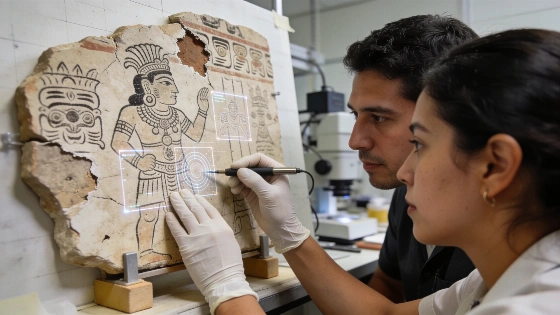
Archaeologists have reconstructed a deteriorated mural from Calakmul, Mexico, revealing the earliest known calendrical inscription at the site. The find offers new evidence for early Maya writing traditions and ritual practice in the Late Preclassic period.
A recently reconstructed mural from the ancient Maya city of Calakmul in Campeche, Mexico, has yielded the earliest known evidence of calendrical writing at the site. The mural, discovered within Substructure II C of Structure II, features a day sign from the 260-day Maya ritual calendar and a depiction of the mythological figure Juun Ajaw engaged in a hunting scene. This evidence places Calakmul among a select group of Late Preclassic Maya centers with early writing traditions, including San Bartolo, El Mirador, and Tikal.
Excavation and Preservation
The mural was originally uncovered during the Calakmul Archaeological Project led by Ramón Carrasco Vargas. Measuring approximately 1.9 meters wide and 1.7 meters high, the artwork was removed from its original context in 2005 to ensure preservation and is now housed at the National Coordination for the Conservation of Cultural Heritage. The mural's preservation was compromised by heavy deterioration, with much of the original charcoal drawing obscured or lost.
To recover the mural's details, researchers applied advanced digital imaging, photogrammetry, and graphic reconstruction techniques. These methods allowed the team to document and analyze iconographic elements that were previously invisible to the naked eye. The reconstructed scene includes Juun Ajaw, a figure well known from Classic Period Maya ceramics, here shown hunting a water-dwelling creature. The presence of a calendrical day sign alongside this mythological scene marks the earliest securely identified written communication from Calakmul, predating the site's previously known inscriptions from the Classic Period (250-900 CE).
Dating and Interpretation
Initial archaeological assessments dated the structure containing the mural to between 400 and 390 BCE. However, new architectural, stylistic, and contextual evidence suggests the mural itself was likely created between 400 and 200 BCE. Further scientific sampling is planned to refine this date range. The mural was painted inside an arched vault designed to evoke the interior of a cave, a setting with deep cosmological significance in Maya belief as the origin of deities, ancestors, and cosmic forces.
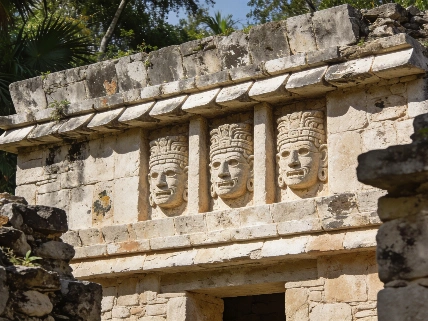
The exterior of Substructure II C features a decorative frieze with celestial deities and masks symbolizing the birth of the maize god, suggesting the building may have served a ceremonial or ritual function for rulers or priests. Researchers propose that the mural may represent an episode from the maize god's mythological cycle, possibly commemorating a ritual act of sacrifice or renewal. The calendrical inscription appears to have been added after the main scene, potentially marking the timing of the depicted event.
Implications for Maya Writing
The identification of early calendrical writing at Calakmul expands the known distribution of Preclassic Maya script and supports the view that the development of writing and complex iconography was not limited to a few major centers. The mural's iconography also links Classic Period mythological figures to earlier traditions, providing evidence for the long-term continuity of Maya religious narratives. The research, conducted in collaboration with Archaïos, the French Centre for Mexican and Central American Studies, the Stresser-Péan Foundation, and Mexico's National Institute of Anthropology and History (INAH), was presented at a recent lecture in Campeche.
While the precise function of the mural and its associated structure remains uncertain, the combination of calendrical notation, mythological imagery, and architectural symbolism points to a sophisticated ritual context. The findings contribute to a growing body of evidence for early Maya literacy and ceremonial practice, paralleling discoveries at other Preclassic sites. Comparable research into ritual architecture and elite practices, such as the identification of a Hellenistic dining complex at Gradište in North Macedonia, further illustrates the diversity of early ceremonial traditions across ancient societies (see analysis of ritual architecture at Gradište).
Limitations and Future Research
The mural's poor preservation and the challenges of reconstructing heavily deteriorated iconography limit the certainty of some interpretations. The dating of the mural remains provisional pending further scientific analysis. As with many Preclassic Maya sites, the incomplete archaeological record and the fragmentary nature of early inscriptions mean that broader conclusions about the origins and spread of Maya writing must remain cautious. Ongoing research at Calakmul and comparative studies at other sites are expected to clarify the development of early Maya script and its relationship to ritual and political life.
The discovery underscores the importance of conservation and interdisciplinary analysis in recovering information from fragile archaeological materials. As new imaging and reconstruction techniques become available, previously inaccessible evidence from deteriorated murals, ceramics, and architectural features may continue to reshape our understanding of early Mesoamerican societies.
Understanding the significance of early Maya calendrical writing requires familiarity with the structure and function of the 260-day ritual calendar, known as the Tzolk'in. This calendar, composed of repeating cycles of day names and numbers, was central to Maya ritual, divination, and social organization. The appearance of a day sign in a Preclassic mural provides direct evidence for the use of calendrical notation in ceremonial contexts centuries before the Classic Period, highlighting the deep roots of Maya literacy and religious practice.