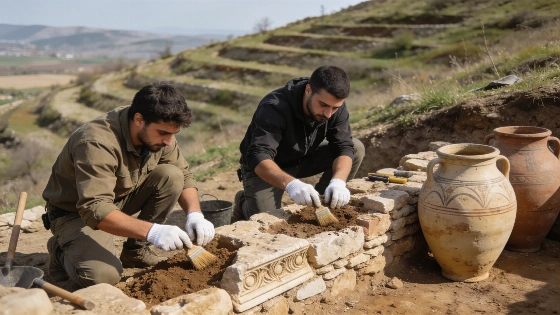
Archaeologists have identified a rare Hellenistic ritual dining complex at Gradište, North Macedonia, revealing evidence of elite religious practices, imported ceramics, and extensive trade connections during the fourth and third centuries BCE
Archaeological excavations at the Gradište site near Mlado Nagoričane in North Macedonia have revealed a rare Hellenistic ritual dining complex, offering new insight into elite religious practices and regional trade during the fourth and third centuries BCE. The discovery was made on the Lower Terrace of the settlement, an area previously known for fourth-century BCE rock-cut features and ritual deposits. This season's work focused on a sector immediately east of a previously identified tumulus, where the remains of a building containing large quantities of broken pithoi-large storage jars-and other vessels were uncovered.
Material Evidence and Context
Among the most significant finds was a decorated pithos bearing finger-ring impressions that depict a female deity, interpreted as Demeter, holding a cornucopia and pouring a libation from a kantharos over a tripod. The iconography is consistent with ritual activity and supports the interpretation of the area as a sacred precinct. South of this building, archaeologists identified a segment of a peribolos wall, likely demarcating the sanctuary from the broader settlement. Adjacent to the wall, a small room was excavated, containing an assemblage of animal bones-primarily wild boar and goat-alongside imported Hellenistic tableware, including West Slope gutti, decorated kantharoi, and black-glazed echinus bowls with stamped palmette motifs.
The room also yielded fragments of amphorae, hydriae, lamps, terracotta figurines, and the base of a built dining table. Notably, ornate decorative elements from a ceremonial dining couch (kline) were recovered, including a molded couch leg and an appliqué depicting a reclining deity holding a phiale, a shallow vessel used for libations. These finds suggest the room was used for ritual dining or symposium-style feasting associated with sanctuary ceremonies, rather than for domestic purposes.
Trade, Status, and Comparative Evidence
The presence of imported ceramics and luxury furnishings indicates that the Gradište settlement was integrated into wider Hellenistic trade networks and participated in elite artistic traditions. Similar kline ornaments have previously been documented only in high-status burials at Pella and the royal tombs at Aigai, suggesting connections to Macedonian elite culture. The quality and diversity of the material assemblage, including both local and imported goods, point to the prosperity of the settlement and its role as a regional religious center.
Excavations at Gradište have also revealed a peristyle building with painted plaster and numerous imported amphorae in earlier seasons, reinforcing the interpretation of the site as a hub for ritual and commercial activity. The current findings add to a growing body of evidence for complex religious and social practices in Hellenistic Macedonia. Comparable discoveries of ritual spaces and protective deities have been reported elsewhere in the region, such as the recent identification of a carved stone relief beneath a Roman barracks at Vindolanda, which also sheds light on ritual practices in ancient settlements (see related report).
Chronology, Methods, and Future Research
The Gradište complex is dated to the fourth and third centuries BCE based on stratigraphic association with earlier rock-cut features and typological analysis of ceramics and architectural elements. The excavations were conducted by the National Institution Museum Kumanovo, with support from the Ministry of Culture and Tourism of the Republic of North Macedonia. The research team plans to expand investigations in the area to determine whether a temple once stood within the sanctuary and to clarify the full extent of ritual activity at the site.
While the architectural remains are modest in scale, the concentration of imported tableware, animal remains, and ceremonial furnishings provides a rare glimpse into the organization of ritual feasting and the material expressions of religious practice among Hellenistic elites. The evidence does not establish the precise nature of the ceremonies or the identities of participants, but it demonstrates the importance of communal dining and the integration of local and imported traditions in the religious life of the settlement.
In archaeological research, the identification of ritual spaces relies on a combination of architectural context, artifact assemblages, and iconographic evidence. Features such as peribolos walls, specialized dining rooms, and decorated vessels can indicate ceremonial use, but interpretations remain provisional without direct textual or epigraphic sources. The study of animal bone assemblages, ceramic typology, and spatial organization helps archaeologists reconstruct patterns of ritual behavior, while comparative analysis with other sites provides broader cultural context. As new discoveries are made, the understanding of Hellenistic religious practice continues to evolve, shaped by both material evidence and the limitations of archaeological preservation.