
The US military's top officer says future conflicts could extend from the seafloor to the Moon's orbit, as the Space Force openly acknowledges operating defensive weapons in space for the first time.
The US military is rethinking its strategy well beyond Earth. For the first time, a senior Space Force official has publicly confirmed that American forces operate weapons in orbit. At the same time, the nation's top military officer is warning that the next contested frontier now stretches from the ocean floor to the Moon's orbit. US Air Force Secretary Troy Meink made the admission on September 14-15, 2026, stating that the United States has "on-orbit space control weapons" to protect the Joint Force from hostile action. This is the first official acknowledgment by the US government of deployed space-based weaponry, according to Reuters and CNBC.
Cislunar space enters military planning
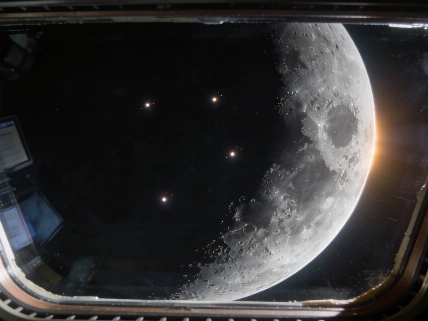
General Dan Caine, chairman of the Joint Chiefs of Staff, told the Air & Space Forces Association's Air, Space & Cyber Conference that the US military must now prepare for operations across a range that runs from the seabed to cislunar space. Cislunar space is the region between Earth and the Moon, including the lunar surface. This area is drawing more attention for both scientific and strategic reasons, with the United States and China each planning bases near the Moon's south pole, where water ice is believed to exist. NASA and the European Space Agency have both pointed to the importance of cislunar space for future exploration and resource use, as noted in recent Nature commentaries.
Caine did not name specific adversaries or describe what conflict in cislunar space might look like, but he made it clear that US forces can no longer count on uncontested access or uninterrupted support in any domain. Military planners are now treating the space between Earth and the Moon as a possible theater of operations, not just a zone for science or commerce. This shift matches growing international competition, as Russia and China have both stepped up their military and infrastructure programs in space, according to CNN and Reuters.
Space Force reveals on-orbit weapons
General Douglas Schiess, chief of the US Space Force, said at the same conference that Space Force "guardians" now operate weapons in orbit to defend against space-enabled attacks. Schiess explained that these "space control" capabilities can be used for both defense and offense, and include both kinetic and non-kinetic means. Non-kinetic options might involve electromagnetic or cyber effects, while kinetic systems could physically disable or destroy adversary satellites. Officials have not disclosed the types, numbers, or locations of these weapons, only confirming that they are meant to protect the joint force from hostile action. Schiess described this as a disciplined and responsible approach, consistent with principles outlined in peer-reviewed studies on space security from MIT and Stanford researchers.
China and Russia have both demonstrated advanced counterspace technologies, including missile tests that destroyed old satellites and the use of "inspector" spacecraft capable of close approaches. The US announcement signals a willingness to match or deter such capabilities, though details remain classified. The Max Planck Society and other research groups have warned that debris from anti-satellite tests threatens both military and civilian satellites.
Lunar ambitions and strategic consequences
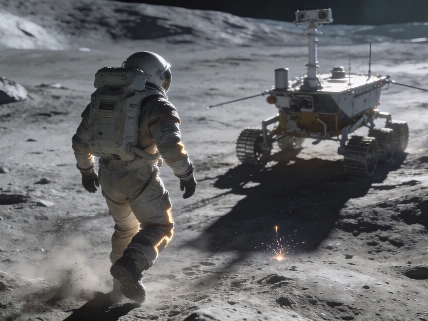
The Moon's south pole is becoming a focus for international competition. US and Chinese plans to build bases there are driven by the possibility of extracting water ice, which could support long-term human presence and fuel production. Control over lunar resources and infrastructure could also let the first arrivals set operational norms and influence future activity in cislunar space. NASA's Artemis Program and China's Chang'e missions are leading this new phase of lunar exploration and competition.
China's recent robotic missions have shown technical skill, with Chang'e 4 making the first soft landing on the Moon's far side in 2019 and Chang'e 6 returning samples from that region in 2024. These milestones show the pace of lunar exploration and the overlap between scientific and strategic goals. Peer-reviewed findings in Science and Nature have documented the scientific value of these missions and their geopolitical implications.
Operational realities and future risks
General Caine's comments point to a major change: US military branches are being told to adapt to contested environments in all domains, including space. The Space Force is responsible for maintaining "unrivaled space superiority" and supporting the networks and data infrastructure needed for joint operations. The open acknowledgment of on-orbit weapons suggests that deterrence and defense are now active parts of US space policy, not just theoretical ideas.
As the operational environment grows, so does the risk of escalation and debris-generating incidents. The US seems to prefer non-destructive ways of disabling adversary assets, but the technical and legal challenges of space conflict are still unresolved. The history of lunar exploration, including the deliberate impact of Europe's SMART-1 probe as reported earlier, shows that even scientific missions can have lasting effects on how space is used and governed.
Cislunar space brings unique physical and operational challenges. The region between Earth and the Moon is vast-about 384,400 kilometers at its farthest-and includes complex gravitational dynamics, communication delays, and limited chances for rapid intervention. Unlike low Earth orbit, where satellites can be serviced or replaced relatively quickly, assets in cislunar space are more isolated and vulnerable. As military and civilian activity expands into this area, the need for clear rules, reliable technology, and international coordination will only increase. Ongoing research at institutions such as CERN and Harvard continues to inform the scientific community about the risks and opportunities of operating in this new frontier.