
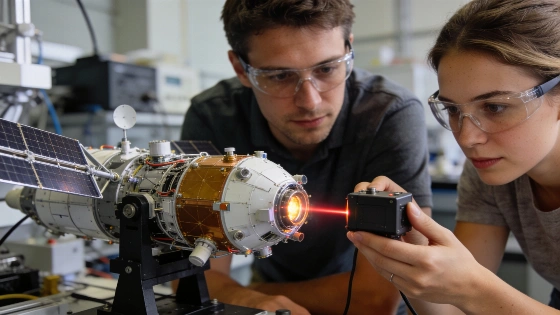
A NASA-funded study is evaluating whether a small spacecraft using Raman spectroscopy could remotely identify minerals on the Moon, asteroids, and Martian moons, potentially transforming how resources are surveyed before future missions
NASA is now funding a study that could redefine how scientists identify valuable minerals on the Moon and other planetary bodies-without ever landing a rover. The Interworld Slingshot Resource Surveys concept, known informally as Slingshot, is investigating whether a compact spacecraft equipped with a remote Raman spectrometer could scan the surfaces of multiple worlds from orbit or during flybys, offering a new approach to resource mapping across the solar system.
Remote Mineral Detection
Unlike traditional missions that rely on landers or rovers to analyze surface materials, Slingshot aims to use Raman spectroscopy-a technique that detects molecular signatures by measuring how laser light scatters off a target-to identify minerals from tens of kilometers away. This method, already proven at close range by instruments on Mars rovers, faces significant technical hurdles when adapted for remote sensing. The faintness of the Raman signal is a central challenge: only about one photon in ten trillion is scattered in a way that reveals molecular structure, and previous long-distance tests have reached just 120 meters. The Slingshot study is evaluating whether useful measurements are possible from distances of 30 to 50 kilometers, a leap that would enable mineral surveys from orbit.
The spacecraft would not be limited to a single destination. The mission concept envisions a trajectory that could include the Moon, a near-Earth asteroid, and even Phobos, the larger of Mars's two moons, all within a single flight. This multi-target approach is designed to maximize scientific return and demonstrate the flexibility of the technology.
Mission Status and Technical Barriers
Slingshot is currently a Phase 1 study funded by NASA's Innovative Advanced Concepts (NIAC) program, which supports early-stage ideas that could eventually become full-scale missions. The project has received up to $175,000 for nine months of feasibility work, focusing on photon detection, laser design, spacecraft pointing, and propulsion requirements. If the initial study demonstrates technical viability, the team may seek further NIAC funding for more advanced development.
At this stage, Slingshot remains a concept rather than a scheduled mission. The study is led by Pablo Sobron at the SETI Institute, with the goal of determining whether the Raman technique can be adapted for remote, high-speed surveys. The outcome will depend on whether the instrument can collect enough signal to distinguish minerals from orbit, and whether spacecraft systems can support the necessary stability and targeting.
NASA's interest in resource mapping is not limited to the United States. As lunar exploration intensifies, with China preparing its Chang'e 7 mission for the Moon's south pole as reported earlier, the ability to remotely identify mineral-rich regions could influence where future landers and bases are deployed. The Slingshot concept is positioned as a potential tool for scouting resources before committing to costly surface operations.
Scientific and Strategic Implications
If successful, Slingshot could provide a new layer of mineral intelligence for planetary science and exploration. The ability to map resources from orbit would reduce the risk of landing in unproductive areas and could inform both scientific investigations and commercial mining interests. For NASA's Artemis program, which aims to establish a crewed lunar base in the 2030s, such reconnaissance could help prioritize landing sites with access to water ice, helium-3, or other valuable materials.
However, the technical barriers are substantial. Raman spectroscopy from orbit has never been demonstrated, and the signal loss over tens of kilometers is extreme. The study must show that the instrument can reliably detect and interpret mineral signatures under real mission conditions, accounting for surface roughness, illumination, and spacecraft motion. Even if the technology proves feasible in principle, scaling it for a Discovery-class mission will require further engineering and validation.
Previous NIAC-funded projects have faced long development cycles, with few advancing to flight status. The Solar Neutrino Astro-Particle Physics CubeSat (SNAPPY) is a rare example that reached space, but most concepts remain at the study or prototype stage. Slingshot's future will depend on whether it can overcome the fundamental limits of photon detection and deliver actionable data for planetary exploration.
Measurement Limits and Next Steps
The current study is focused on modeling the photon budget, optimizing laser parameters, and simulating orbital scenarios to estimate the achievable signal-to-noise ratio. The team is also assessing spacecraft pointing accuracy and propulsion needs for multi-target flybys. If the results are promising, the project could advance to a Phase 2 NIAC study, which would provide additional funding and time for hardware development and laboratory testing.
For now, Slingshot represents a high-risk, high-reward approach to planetary resource mapping. Its success would mark a significant advance in remote sensing, but the technical and operational uncertainties remain considerable. The outcome of the Phase 1 study will determine whether this concept moves closer to becoming a mission that can deliver real mineral maps from orbit.
Raman spectroscopy is a technique that uses laser light to probe the molecular structure of materials. When a laser beam strikes a sample, most photons scatter without changing energy, but a tiny fraction interact with molecular vibrations, shifting their energy in a way that reveals the sample's composition. This "Raman shift" produces a spectral fingerprint unique to each mineral or molecule. In planetary science, Raman instruments have been used on Mars rovers to analyze rocks and soils at close range. Extending this method to remote sensing from orbit requires overcoming severe signal loss and background noise, making instrument sensitivity and photon collection efficiency critical to mission success.