A new model of the Chicxulub impact includes ultrafine silicate dust found at fossil sites, suggesting surface temperatures may have become lethal within hours before a prolonged impact winter began
The asteroid that struck Mexico's Yucatán Peninsula 66 million years ago may have caused more than a long, cold aftermath. A new study argues that ultrafine silicate dust left by the Chicxulub impact could have trapped heat near Earth's surface, intensifying a global thermal pulse and helping ignite vegetation across large regions.
Dust Added to the Model
The impactor was roughly 10 kilometers wide and excavated the Chicxulub crater while vaporizing enormous volumes of rock. Some of that material cooled into glassy droplets known as spherules. These particles spread around the planet and later fell through Earth's atmosphere at several kilometers per second.
As the spherules slowed, their kinetic energy was converted into heat and emitted as thermal radiation. Earlier calculations treated that falling material as the main source of the post-impact heat. Those models suggested a severe but relatively brief pulse that could kill exposed animals without necessarily igniting vegetation worldwide.
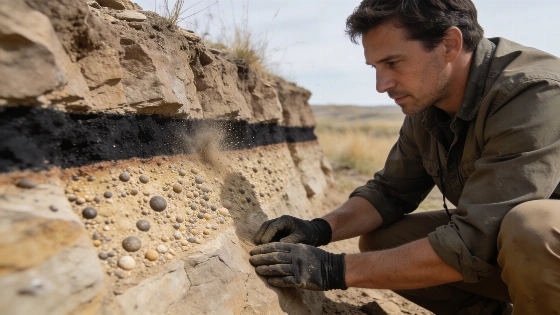
The new work adds a second component: a dense layer of fine silicate dust produced from rock vapor that did not condense into spherules. Evidence for this material was reported in 2023 at the Tanis fossil site in North Dakota, where impact-derived particles were found above the spherule layer. A similar deposit has been documented at the K-Pg boundary in Raton Basin across the Colorado-New Mexico border.
That evidence also fits into the wider record of sudden environmental change at the boundary. For broader context on how scientists reconstruct catastrophic events from preserved material, readers can compare this evidence-based account with the reconstruction of Viking 1's first surface images, where interpretation likewise depends on understanding how physical signals become geological or instrumental records.
A Stronger Heat Pulse
In the study's calculations, the dust behaves like an insulating layer. Rather than allowing thermal radiation to escape efficiently into space, it absorbs and redirects more energy toward the ground. The estimated surface heat pulse is about 3.5 times stronger than in models that include falling spherules alone.
The authors estimate that exposed land animals could have received a thermal dose roughly 17 times higher than the level considered lethal to humans. The result does not mean every animal on the planet was instantly killed, because the dose would have varied with location, shelter, vegetation, atmospheric conditions, and the duration of the heating.
Thin fuels such as grass, lichen, and pine needles would have been especially vulnerable. The radiation may not have ignited thick pieces of wood directly, but it could have heated fine vegetation enough to start fires that then spread into larger fuel sources. This mechanism offers a physical route from an impact-generated heat pulse to widespread wildfire.
The timing is important. The initial heating could have unfolded within hours, while the dust that caused it may later have remained suspended or replenished atmospheric particles that reduced sunlight for years. In that sequence, fire would have been an immediate consequence and impact winter a longer-term climate response.
What the Evidence Cannot Show
The study is based on a physical model constrained by geological deposits, not on a direct measurement of global temperatures during the impact. The dust layer provides evidence that fine material existed, but its original thickness, global distribution, atmospheric lifetime, and optical properties must be estimated. Each assumption affects the calculated heat reaching the surface.
The main limitation is geographical. Evidence for wildfires associated with the proposed dust-driven inferno has so far been identified in North America rather than across every continent. That absence does not disprove a global event, because the boundary record is incomplete and fires can erase or fail to preserve their own evidence. It does mean that the worldwide extent of the burning remains unresolved.
Alfio Alessandro Chiarenza, a paleontologist at University College London who was not involved in the study, has noted that future discoveries could reveal a more global wildfire record. For now, the available evidence supports a powerful regional-to-global heating scenario but does not establish that every exposed ecosystem burned simultaneously.
The research was published on July 28, 2026, in JGR Biogeosciences. Its significance lies in refining the sequence of environmental stresses after Chicxulub: a brief, potentially devastating heat pulse may have preceded the darker and colder conditions that followed. The dust hypothesis strengthens that interpretation, while the incomplete fire record leaves the scale of the initial catastrophe open to further testing.
Thermal radiation is energy carried by electromagnetic waves, including infrared wavelengths. Its effect at the ground depends not only on the energy released above it but also on how particles absorb, scatter, and re-emit that energy. A layer of fine dust can therefore alter surface heating without being a fire itself. In this case, the central inference is that the dust changed the atmosphere's radiative behavior enough to make vegetation ignition and lethal exposure more likely.