Radiocarbon dating of teeth places the Khuzhir-Nuge-IX burial at about 7,600 years old. The small shale fish resembles proposed lures, but its placement among funerary goods leaves its role uncertain.
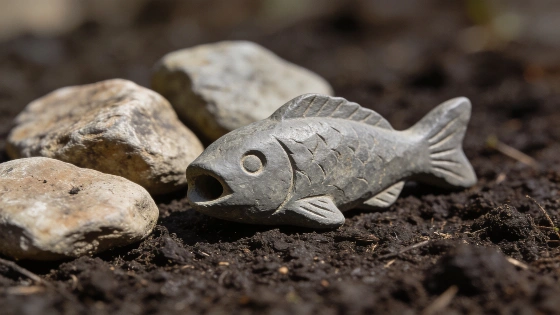
A deep circular groove around the center of a small grey-shale carving may have allowed it to be attached to a line or fitted with other fishing components. The object came from a burial near Lake Baikal, where its presence among grave goods makes its practical use difficult to establish.
Burial context
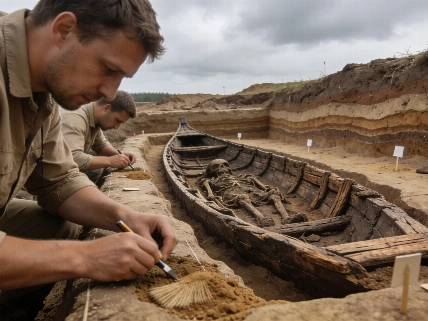
Archaeologists found the grave at Khuzhir-Nuge-IX in the Olkhon region of Siberia. The burial and ritual complex was opened in 1991 and includes more than 20 stone structures from different periods. The grave belongs to the Khotoruk group of the Kitoi archaeological culture, which was present in the Baikal region roughly 7,000 to 8,000 years ago. Kitoi communities hunted and fished, while also gathering food; by this period they also made pottery.
The grave lay beneath a stone structure measuring about 3.6 by 3.5 meters. It was oval, and the deceased had been placed on their right side with knees bent; red ochre had been applied as part of the burial rite. Large stones covered the grave. Poor preservation of the skeletal remains means researchers could not determine the individual's biological sex or age.
The grave goods included a large bone implement and 12 stone objects, among them the carved fish. It measures 4.85 centimeters long, 1.3 centimeters high and 0.6 centimeters thick. The carving has a defined back and a carved mouth. Small features represent the eyes; a deep circular groove runs around its middle. Archaeologists Dmitry Kichigin of Irkutsk National Research Technical University and Artur Kharinsky of Irkutsk State University are among the researchers associated with the work.
A possible fishing tool
The groove encircling the figurine's middle could have served to suspend it from a line or attach additional fishing components. Researchers consider the carving a possible artificial lure, an interpretation described in N+1's report. Comparable objects from the Baikal region vary in form and material, with differences in size and style as well. Similar finds have been noted at the Kitoi cemeteries of Lokomotiv and Shamanka-II, as well as at ancient lakeshore sites. Regional accounts describe possible use from boats or through holes cut in the ice.
That interpretation rests on the object's form and the possible way it could have been fastened. Its placement in a burial does not establish that it was used for fishing during the deceased's life, nor does it reveal what the object meant to those who buried it. Kitoi graves contain objects associated with subsistence, including hunting and fishing, but their presence in a grave does not by itself establish how each item was used in daily life.
Earlier stone fish interpreted as lures from the Olkhon region were dated to ranges of 7,420 to 7,001 and 6,730 to 6,306 years ago. At about 7,600 years old, the Khuzhir-Nuge-IX burial is roughly 150 to 200 years older than the previously known examples, information from a regional account. The find is presented as the earliest currently identified evidence in the region for this type of artificial lure. A separate Science Report account of stone tools at Murujuga also considers how archaeological context shapes interpretation, though the sites and evidence differ.
What the date establishes
Radiocarbon dating of teeth from the burial produced an age of approximately 7,600 years. This dates material from the burial; it does not directly date the carving. Its association with the grave places the fish in a funerary assemblage of that approximate age, while the exact time it was made remains unknown.
The study, published in Archaeology, Ethnography and Anthropology of Eurasia, identifies the burial context as evidence that fishing-related objects had a place in Kitoi mortuary practices by this time. The find cannot determine whether this particular object also carried symbolic or ritual meaning.
Radiocarbon dating estimates the age of the sampled material, not the exact date of every object found with it. Here, the dated material was teeth from the burial. The fish's age is so tied to its archaeological association with the deceased, not to a direct measurement of the stone itself.