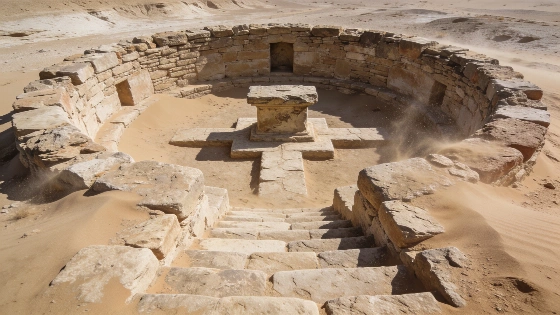
Fourteen stone steps descend into Bayte-3's central hall on Kazakhstan's Ustyurt Plateau. Its altar and monumental architecture support a ceremonial interpretation, but the site's precise role and the dates of many wall engravings remain uncertain
Fourteen stone steps survive at Bayte-3, descending from a height of about 2.5 meters into the sanctuary's central hall. The structure stands on the Ustyurt Plateau in Kazakhstan's Mangistau Region, about 20 kilometers northeast of Sai-Otes.
Investigated in 1998 by the West Kazakhstan archaeological expedition, the monument dates to the 4th-3rd centuries BC. Its scale and layout distinguish it from contemporary settlements, where evidence of domestic activity is more common. The date places Bayte-3 within the broader period of Early Nomad sanctuaries documented across the Ustyurt Plateau and the wider Aral-Caspian region, a tradition dated to approximately 400-200 BC.
A Monumental Plan
Bayte-3 measures about 19 meters across. Its surviving interior walls reach up to three meters, while researchers estimate that parts of the original structure rose more than five meters. A foundation about 14 meters in diameter supported a two-tier building with a cylindrical base and domed upper section; a stone-and-earth outer wall was around 2.5 meters thick.
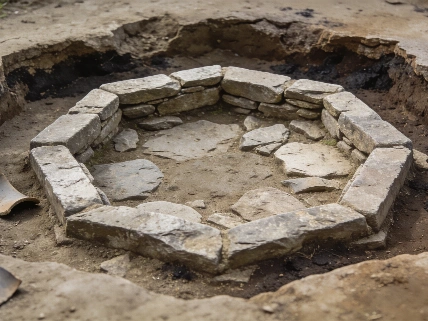
Inside, a cross-shaped plan followed the cardinal directions. A stone altar stood at the center, where researchers suggest fires may have been lit and sacrificial rituals performed. The dome was built using corbelling, a technique that places stones progressively inward to span an opening. A large opening at its apex appears to have served as a skylight, and researchers estimate the complete dome may have reached about 10 meters high.
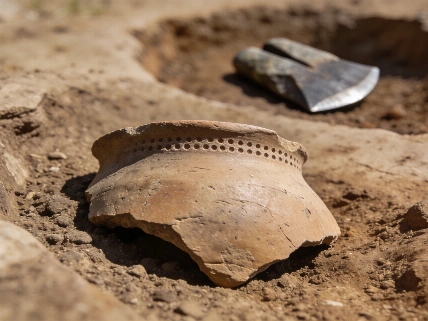
Excavators recovered small stone vessels and fragments of altars. They also found occasional objects interpreted as ritual equipment. The limited evidence of domestic use supports identifying the complex as ceremonial rather than residential, although it does not establish exactly how people used the site.
Symbols and Interpretation
Tamgas and other engraved symbols appear on the interior and exterior walls. Their precise chronology is uncertain, though researchers have suggested that many could date to the Alan period. Anthropomorphic stone statues found around the sanctuary also differ in appearance from earlier Saka sculpture and examples from later periods. Researchers interpret this distinction as evidence that the Ustyurt-Mangistau region developed its own artistic traditions during the Early Iron Age.
Bayte-3 also belongs to a wider regional tradition of Early Nomad sanctuaries, some of which contained anthropomorphic statues. In a study of sanctuaries across the Aral and Caspian regions, archaeologist Valery S. Olkhovskiy proposed that such complexes may have been associated with an ancestor-hero cult that emerged after the conquests of Alexander of Macedon. The broader tradition is documented from approximately 400 to 200 BC, and its builders have been associated with possible groups including the Sarmatians, Massagetae and Dahae. Yale's archaeological record describes the builders' identity as unresolved.
Researchers generally associate Bayte-type sanctuaries with Sarmatian groups who inhabited the region between the Aral and Caspian seas. Bayte and Kyzyl-Uik may have served wider tribal communities or confederations as religious centers, but that proposed role remains an interpretation. A separate report on a ceremonial complex in Puebla describes a different case in which a courtyard's layout may have tracked seasonal dates.
Bayte-3 was eventually destroyed, possibly by a powerful earthquake. Some stones were removed and reused, while windblown sand gradually covered the remains. The monument received state protection in 2003 as a historical and cultural site of local importance, according to the Mangistau State Historical and Cultural Reserve.