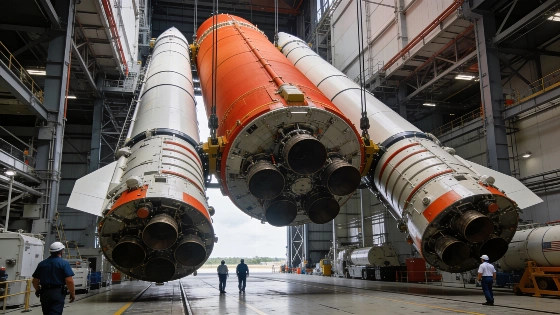
A custom lifting beam moved the 212-foot Artemis III core stage into position at Kennedy Space Center. After checkouts teams plan to load fuel into the stage and rehearse countdown procedures
A purpose-built lifting beam was used to move the 212-foot Space Launch System core stage from High Bay 2 into High Bay 3 at NASA's Kennedy Space Center in Florida. The stage is now integrated alongside the twin solid rocket boosters for Artemis III.
From Lift to Stack
The beam was designed to place the core stage onto the mobile launcher. The completed configuration brings the core stage together with the boosters inside the Vehicle Assembly Building.
The work is part of preparations for a mission that will use the Orion spacecraft atop the SLS rocket. NASA's broader human-spaceflight work has also included microgravity cell preparation, a separate investigation aboard the International Space Station.
Testing Before Rollout
Once testing and checkouts are complete, teams plan to roll the core stage and booster stack to Launch Pad 39B. There, they will conduct a tanking test: liquid hydrogen and liquid oxygen will be loaded into the core stage, while launch teams practice countdown procedures and timelines.
Artemis III's Flight Test
The mission is set to carry four astronauts in Orion: NASA astronauts Randy Bresnik and Frank Rubio, along with Andre Douglas and ESA (European Space Agency) astronaut Luca Parmitano.
NASA's October 23, 2026, announcement revised Artemis III's mission plan: the 2027 flight is planned as a 14-day demonstration in low Earth orbit, rather than a crewed lunar landing. Four astronauts will fly aboard Orion to practice rendezvous, docking, habitation and other procedures with test versions of lunar landing systems developed by Blue Origin and SpaceX, as outlined in NASA's updated Artemis plan.
Under the plan, Blue Origin's Blue Moon Mark 2 test article is scheduled to enter circular low Earth orbit about 273 miles above Earth before Orion launches from Kennedy Space Center on SLS, following confirmation that the lander is ready for joint operations. Orion will first rendezvous and dock with Blue Moon. Later in the mission, it will conduct a second docking demonstration with a SpaceX Starship Version 3 test article launched from Florida. NASA says the crew will not enter Starship during its docking test, which is expected to last up to two hours. The agency's mission description says the two demonstrations will help prepare for crewed lunar landings targeted for 2028.
NASA's revised arrangement calls for both providers to take part in Artemis III's low-Earth-orbit demonstrations, with neither assigned to a specific lunar-landing mission. The plan shifts the immediate purpose of Artemis III toward testing the systems and operations needed for later lunar missions while retaining Orion and SLS as the crew-launch system.
In a tanking test, launch teams load propellants into a rocket stage to rehearse procedures and timelines. The Artemis III test described by NASA will load liquid hydrogen and liquid oxygen only into the core stage.