

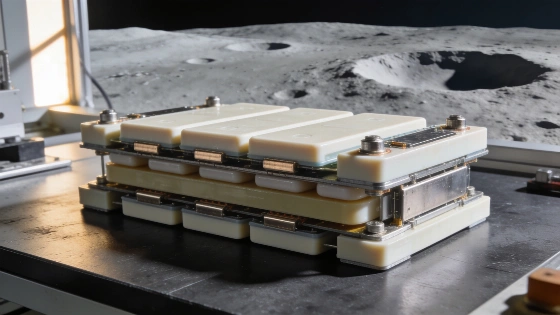
NASA-developed battery cells remained undamaged after cooling to -170°C and retained capacity when warmed. Tests also found useful operation from -60°C to 80°C, a range aimed at extreme lunar and terrestrial settings.
Permanently shadowed craters near the Moon's south pole can stay cold for long periods, putting equipment there in an extreme environment. NASA describes lunar-night temperatures around -180°C lasting as long as 14 days. At such temperatures, lithium transport through the electrolyte in conventional lithium-ion cells becomes extremely slow, limiting charging, discharging and usable capacity.
A broad operating range
NASA-backed battery work explores several electrolyte designs, including solid ceramic and polymer materials, as well as polymer-composite systems. One reported operating range for the batteries described here is -60°C to 80°C. Other NASA-supported projects have different targets: a 2024 proposal from Solid Energies Inc. and the University of South Dakota aimed to develop a polymer-composite solid-state electrolyte for operation from -80°C to 90°C, while a separate semi-solid-state project described operation from -60°C to 70°C.
Cooling the batteries to -170°C caused no damage. After a small heater brought them back into their operating range, tests found no capacity loss or other issues. A related earlier report covered NASA battery testing in extreme cold.
Brief survival of a cold exposure is distinct from sustained operation in a lunar environment. In tests of cylindrical commercial lithium-ion cells, a single freeze-thaw cycle to -160°C caused little immediate capacity loss, while longer-term performance was negatively affected. NASA's low-temperature cell testing describes the challenge posed by extreme lunar conditions.
Why the electrolyte matters
In mass-produced batteries, the electrolyte can set a limit on operating temperature. NASA's 2026 SBIR solicitation says conventional lithium-ion batteries generally do not operate below -40°C. At low temperatures, conventional carbonate electrolytes lose ionic conductivity, restricting battery performance. NASA's development goals include battery modules that can operate in ambient conditions as low as -200°C, with an energy-density target above 200 Wh/kg at 20°C for lunar-surface and space applications.
When conventional batteries need to be kept warm, heaters, radioisotope heating units and multilayer insulation add mass. NASA has also set a longer-term target for a 50-kWh-class module with more than 150 Wh/kg at a 1-kW discharge rate and 500 cycles, capable of operating after a long-duration cold soak at 70 K, or about -203°C. The program sets a goal of reaching Technology Readiness Level 6 by 2030.
Designed for harsh environments
The batteries are intended for places such as the Moon's south pole, including permanently shadowed craters where temperatures can remain extremely low. NASA estimates that a battery maintaining room-temperature-like performance at 70 K could increase specific energy for permanently shadowed regions by more than a factor of three compared with current battery performance.
NASA-backed development includes more than one approach. A Solid Energies and University of South Dakota project proposed a polymer-composite solid electrolyte, while another Solid Energies project described a semi-solid-state lithium-ion design with a polymer-composite electrolyte. The latter's Phase II objectives included cells above 350 Wh/kg, more than 1,000 cycles and an intended operating range of -70°C to 90°C; planned test hardware included 28-volt systems with 20-40 Ah pouch cells, battery management and thermal control.
Solid electrolytes replace flammable liquid electrolytes and may offer benefits for radiation tolerance, vacuum compatibility and mechanical robustness. They do not remove every engineering challenge: NASA notes that the relatively low thermal conductivity of some solid electrolytes can complicate thermal management and affect electrochemical performance. Reduced thermal-control requirements could also make cold-tolerant batteries useful in terrestrial applications.







