

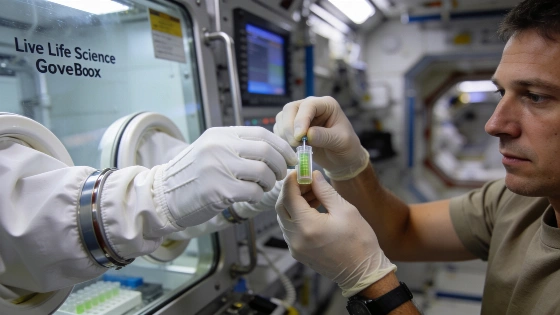
On Oct. 9, 2026, Jessica Watkins prepared a cell-and-bioink mixture in Kibo's Life Science Glovebox for an investigation of cartilage bioprinting in microgravity; NASA's account describes the setup, not a tissue-quality result
On Oct. 9, 2026, NASA astronaut Jessica Watkins mixed living cell samples with bioink inside the International Space Station's Kibo laboratory module and loaded the mixture into a special cartridge. The work was part of InSPA-Auxilium Bioprinter-Cell Printing, an investigation into cartilage bioprinting in microgravity.
Preparing the cartridge
Watkins was working as an Expedition 75 flight engineer in Kibo's Life Science Glovebox. She combined the cell samples and bioink, then filled the cartridge for the investigation. This preparation was an operational step in the experiment; the Oct. 9 update focused on the setup rather than a finished cartilage construct or a tissue-quality result.
The research examines whether microgravity can affect the process of printing cartilage. In microgravity, cells settle less readily, and soft printed structures are less prone to deform under their own weight. NASA has described the station environment as a way to study phenomena that are difficult or impossible to observe under Earth's gravity.
Testing print quality
The investigation explores whether 3D bioprinting can produce cartilage tissue of higher quality in microgravity than on Earth. That is the question being studied, not a reported finding from the Oct. 9 operation. The work's potential relevance is part of a broader program of biological research aboard the station, where separate experiments have also examined printing vascular tissue.
In an Oct. 20, 2026, station update, NASA described Watkins and Luke Delaney handling cell samples and bioink for a separate blood-vessel printing investigation using the BioFabrication Facility in the Columbus laboratory module. The processed samples were placed in a science freezer for preservation. That vascular project is distinct from InSPA-Auxilium's cartilage work.
Earlier cartilage experiments illustrate the range of outcomes researchers measure. A report in Bioengineer's overview describes bovine joint chondrocytes grown on a biodegradable polyglycolic-acid scaffold for three months on Earth and then four months aboard the Mir space station. The space-grown constructs were more spherical and showed greater three-dimensional extracellular-matrix synthesis, while containing less glycosaminoglycan and having inferior mechanical properties.
The same overview reports a Young's modulus of about 9.8 kilopascals for an orbitally printed meniscus, compared with roughly 38.7 kilopascals for a ground control. Those measurements concern meniscus tissue from a separate effort, not the InSPA-Auxilium cartilage investigation.
What the report establishes
The stated aim of InSPA-Auxilium is to investigate cartilage bioprinting in microgravity. The Oct. 9 operation documents Watkins preparing the cell-and-bioink mixture and filling the cartridge. Any assessment of the investigation's tissue-quality question depends on the resulting samples and their evaluation.
The work is part of a growing range of biological research in orbit. NASA's October updates also described studies involving vascular tissue, artificial retinas and heart tissue. These are separate investigations with distinct scientific goals.
Microgravity describes the environment aboard an orbiting spacecraft, where people and objects experience apparent weightlessness; gravity itself is still present. For InSPA-Auxilium, it is the environment in which researchers are studying cartilage printing.
A separate Science Report account of a Falcon 9 Dragon resupply flight to the station appears in earlier ISS launch coverage.







