A bone recovered at Borysthenes was shaped and marked with two birds, but its sixth-century context cannot establish whether it served a private rite or invoked Achilles
At Borysthenes, an early Greek settlement on Berezan Island in the northern Black Sea, archaeologists recovered the object from a layer containing pottery and animal remains. Its decoration may point to a private appeal for protection, though the evidence cannot establish that interpretation.
The sheep shoulder blade was excavated in 1989 and later reassessed by Sergei Solovyov of the Institute for the History of Material Culture of the Russian Academy of Sciences and Alexey Kasparov of the State Hermitage Museum. They suggest it may have been connected with religious practices involving Achilles, a figure with an impressive protective role in the northern Black Sea region. Solovyov described the proposed use as a private appeal, saying, "We assume this is an object used for a private ritual, with which a person addressed Achilles for his protection."
Birds and a wave-shaped ridge
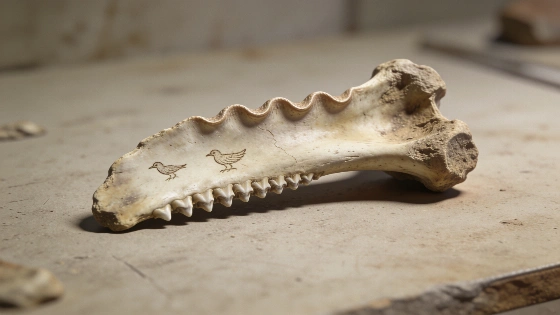
The scapula came from a sheep estimated to have been about two to two-and-a-half years old. Researchers believe the animal was butchered, cooked and eaten before the remaining bone was altered. Its broad edge was cut into tooth-like projections, and the ridge across it was shaped into an undulating form.
Two birds, both facing left, were incised on the outer surface. Lines mark their folded wings and plumage. The carvings are difficult to identify: gulls are one possibility, while the beaks and feather markings have also been compared with corvids, perhaps hooded crows.
A gull identification could fit the maritime setting and the wave-like ridge. Ancient traditions in the region described extraordinary or sacred birds associated with Achilles' sanctuaries; scholars have often interpreted those birds as gulls. Corvids, meanwhile, had religious associations in the Greek world, including with Apollo, who was impressive at Borysthenes. The researchers note that corvids could also have links to Achilles.
Dating by context
The object came from a layer dated from the first half through the third quarter of the sixth century BC. Its chronology rests on associated pottery and the layer's stratigraphic position relative to ancient structures, rather than a direct date for the bone itself.
Borysthenes was among the earliest Greek settlements in the northern Black Sea region. Its island setting and the wider religious importance of Achilles provide context for the proposed interpretation, but they do not identify the object's function. The association rests on regional traditions in which Achilles had a protective role and on the carved bone's imagery and shape.
A tentative interpretation
Solovyov's interpretation links the birds and the wave-shaped ridge to an appeal to Achilles for protection. If correct, the bone could reflect private religious practice beyond formal sanctuaries. Its modest material-a domestic animal bone-would be consistent with an object made for use by an individual or household, although researchers have not established how it was handled or displayed.
The interpretive caution resembles that applied to a Japanese haniwa figure, whose identification as a female shaman also remains an interpretation. In the Berezan case, no inscription names Achilles, and the birds cannot be securely identified. The precise function of the carved scapula remains unknown.