
Phylogenetics
1 reportPhylogenetics is a biological concept used to explain organization, inheritance, regulation, development, adaptation, or interaction. The concept is evaluated through gene regulation and experimental assay, keeping formal definitions and assumptions separate from observations or consequences.
Questions raised by Phylogenetics are explored through cellular or organismal context, while also considering experimental perturbation and evolutionary variation. For questions involving experimental perturbation, the account uses controlled experiments as the measured record and comparative studies to expose uncertainty; the evidence is read with the caveat that effects can depend strongly on species, tissue, environment, and developmental stage.
Questions raised by Phylogenetics are explored through cellular or organismal context, while also considering experimental perturbation and evolutionary variation. For questions involving experimental perturbation, the account uses controlled experiments as the measured record and comparative studies to expose uncertainty; the evidence is read with the caveat that effects can depend strongly on species, tissue, environment, and developmental stage.
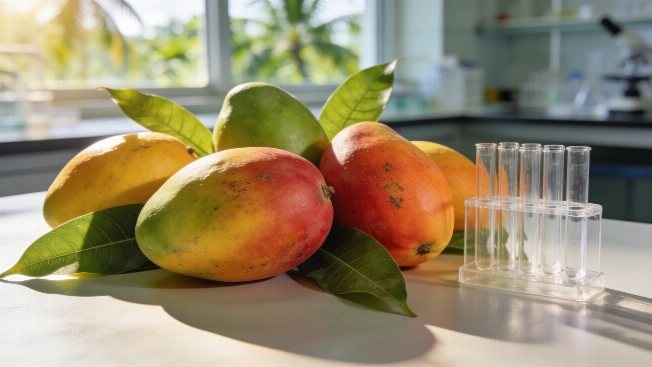
ITS Barcoding Distinguishes Nine Vietnamese Mango Groups
Researchers examined nine Southern Vietnamese mango cultivars and found that ITS sequences separated their groups, while 22 SCoT primers produced 305 polymorphic bands useful for distinguishing individual samples