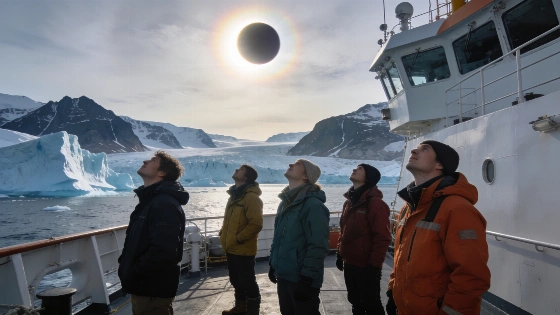
A rare total solar eclipse was observed from the deck of a research vessel in East Greenland, offering scientists and eclipse chasers a unique view of totality above icebergs and glaciers under clear Arctic skies
On August 12, 2026, a total solar eclipse cast its shadow across the remote fjords of East Greenland, drawing a diverse group of scientists, eclipse chasers, and travelers to one of the most isolated environments on Earth. Aboard the MS Spitsbergen, operated by HX Expeditions, participants witnessed the event under unexpectedly clear skies, surrounded by towering icebergs and ancient rock formations. The expedition combined astronomical observation with an immersive experience of Greenland's extreme landscape and wildlife, highlighting both the scientific and emotional impact of totality in such a setting.
Greenland's Landscape and Expedition Context
The journey to the eclipse path began with a sea crossing from Svalbard to East Greenland, traversing the Greenland Sea and entering Scoresby Sund, the world's largest fjord system. The region's geology-marked by immense mountains, glaciers, and drifting icebergs-provided a dramatic backdrop for the astronomical event. For days before the eclipse, participants engaged in nature landings, lectures, and citizen science projects, including cloud observations for the GLOBE Observer initiative. Wildlife sightings, such as beluga whales and polar bears, underscored the unpredictability and richness of the Arctic environment.
Scoresby Sund's vastness and isolation meant that the only visible sign of human presence was the expedition vessel itself. The interplay of light, ice, and rock created constantly shifting vistas, with icebergs reflecting the forms of the surrounding mountains. The expedition's scientific program encouraged close observation of both the landscape and the sky, fostering a sense of shared curiosity among guests with varying levels of eclipse experience.
Observing Totality: Method and Experience
As the eclipse began, the ship's deck became a platform for both visual observation and instrument-based study. The initial partial phase was tracked with solar filters and cameras, while participants monitored changes in light quality and atmospheric conditions. As the Moon gradually obscured the Sun, the landscape took on an unusual yellow hue, and the sharpness of the light became noticeably altered-a phenomenon familiar to experienced eclipse observers but striking in the Arctic context.
Totality lasted for approximately 2 minutes and 14 seconds. During this interval, the Sun's corona became visible as a pearly white halo, with pink prominences observed along the lunar limb. The darkness revealed bright planets-Jupiter, Mercury, and Venus-against the twilight sky. The scale of the eclipsed Sun, the clarity of the corona, and the vividness of the prominences were all noted as exceeding expectations based on prior photographs and scientific descriptions. The surrounding landscape, with icebergs and glacier-carved mountains, added a unique dimension to the experience.
Scientific and Emotional Impact
The expedition's participants included both seasoned eclipse chasers and first-time observers, each bringing different expectations to the event. Many reported that the direct experience of totality-despite understanding the underlying physics-was more intense and overwhelming than anticipated. The fleeting nature of the phenomenon, combined with the Arctic setting, produced a sense of collective awe and connection among those present.
Instrumental observations focused on capturing the corona's structure and the chromospheric prominences, using high-resolution cameras and solar filters. The persistence of daylight until the final moments before totality illustrated the Sun's extraordinary brightness, a fact often underestimated outside direct observation. The expedition also highlighted the role of environmental factors-such as cloud cover and atmospheric clarity-in determining the success of eclipse observations, a theme echoed in previous coverage of solar activity forecasting, including the development of AI models for sunspot prediction (recent advances in solar forecasting).
Limits, Uncertainty, and the Role of Luck
Despite careful planning, the expedition's success ultimately depended on favorable weather conditions. Clouds threatened the view until shortly before totality, and the return of overcast skies soon after underscored the unpredictability of Arctic weather. The experience reinforced the limits of human control in astronomical observation, even with precise models of the Moon's shadow and detailed weather forecasts. The expedition's outcome was shaped as much by environmental luck as by scientific preparation.
In the aftermath, participants reflected on the rarity of witnessing such an event in a landscape where the apparent sizes of the Sun and Moon align so precisely. The combination of scientific observation, environmental immersion, and shared human experience made the 2026 Greenland eclipse a singular event in the annals of eclipse chasing.
Understanding a total solar eclipse requires knowledge of both celestial mechanics and observational technique. A total eclipse occurs when the Moon passes directly between Earth and the Sun, completely covering the solar disk for observers within a narrow path of totality. The phenomenon reveals the Sun's corona-its outer atmosphere-which is normally hidden by the Sun's intense brightness. Observing the corona and chromospheric features requires careful use of solar filters and, during totality, direct visual observation. The duration and visibility of totality depend on the observer's location, atmospheric conditions, and the precise alignment of the Sun, Moon, and Earth. Even with modern prediction tools, the success of eclipse observation remains subject to the uncontrollable variables of weather and geography.