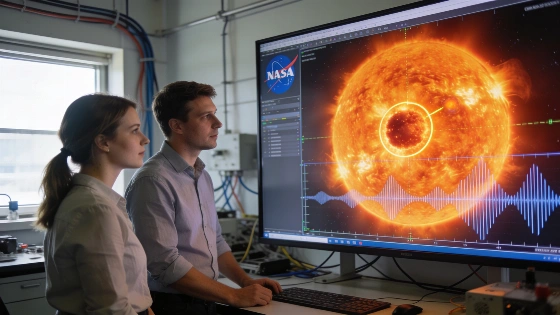
A NASA-led team has developed an AI model that analyzes acoustic and magnetic data from the Sun to forecast the emergence of active regions up to 12 hours in advance, offering new potential for space weather prediction
NASA researchers have developed a machine-learning model capable of forecasting the emergence of active regions on the Sun-areas that can trigger solar storms-up to 12 hours before they become visible on the solar surface. This early-warning capability could improve the safety of astronauts and satellites as solar activity intensifies during the Sun's 11-year cycle.
AI and Solar Data Integration
The new model was created by the COFFIES (Consequence Of Fields and Flows in the Interior and Exterior of the Sun) team, a NASA DRIVE Science Center collaboration involving the New Jersey Institute of Technology, Princeton University, and NASA's Ames Research Center. The researchers combined data from NASA's Solar Dynamics Observatory with advanced artificial intelligence architectures, using supercomputing resources at Ames to process subtle, time-dependent changes in the Sun's acoustic and magnetic signals.
Unlike previous approaches that focused on visible sunspots, the COFFIES model analyzes fluctuations in acoustic waves-sound-like oscillations that travel through the Sun's interior-alongside small changes in the magnetic field. These signals can indicate the rise of magnetically active regions before they break through the solar surface, providing a window for earlier detection than traditional methods allow.
Method and Model Performance
The AI system employs a sliding-window transformer architecture, which enables it to track long sequences of solar data and identify faint reductions in acoustic power and magnetic field strength. By moving a fixed-size window across the timeline of solar observations, the model can focus on recent activity while retaining memory of broader patterns. This approach allows the model to predict the approximate location and timing of emerging sunspots, rather than simply cataloging those already visible.
In tests using historical data, the model successfully identified precursors to active region emergence several hours in advance. The findings, published in the Journal of Geophysical Research: Machine Learning and Computation, suggest that the AI can detect subtle changes in the Sun's acoustic rhythm-akin to a shift in the background noise of a complex orchestra-before magnetic structures become apparent at the surface.
Implications for Space Weather Forecasting
Current operational forecasts from agencies such as NOAA's Space Weather Prediction Center and the US Air Force rely on monitoring sunspots that are already visible. The COFFIES model, if validated further, could provide earlier warnings of solar flares and coronal mass ejections, which can disrupt satellites, radio communications, and power grids on Earth. The team plans to test the model on a wider range of solar events to refine its accuracy and assess its readiness for real-time forecasting.
As NASA prepares for Artemis missions to the Moon and future crewed missions to Mars, improved space weather prediction is increasingly important for mission safety. The ability to anticipate solar storms before they reach full strength could help protect both astronauts and critical technology. For context, the challenge of forecasting solar activity is reminiscent of the difficulties astronomers face when predicting rare events, such as the bright outburst of comet 220P/McNaught recently observed over Namibia, as described in this related report.
Limitations and Next Steps
While the COFFIES AI model demonstrates promise, it is not yet ready for operational deployment. The researchers emphasize the need for further validation across diverse solar conditions and events. The model's predictions are currently limited to a 12-hour lead time and depend on the quality and cadence of available solar data. Additionally, the system's ability to forecast activity on the Sun's far side-out of direct view from Earth-remains an open question.
NASA and NOAA teams are working to integrate research advances like COFFIES into broader space weather monitoring systems. If successful, these tools could supplement existing models and provide more comprehensive coverage of solar activity, especially as the Sun approaches the peak of its current cycle.
Acoustic waves in the Sun, known as helioseismic oscillations, are central to this research. These waves travel through the solar interior and are sensitive to changes in magnetic structure and temperature. By analyzing how these waves are altered by rising magnetic regions, scientists can infer subsurface activity before it becomes visible. This technique, called helioseismology, is a powerful tool for probing the Sun's hidden dynamics and is increasingly important for understanding and forecasting solar behavior.