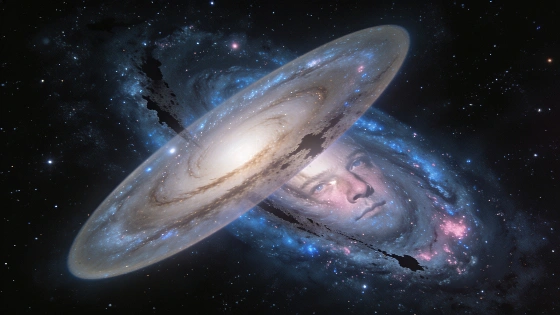
NASA's Overlap Zoo asks volunteers to identify and outline overlapping galaxy pairs so astronomers can study dust silhouettes that dim distant starlight and improve measurements of cosmic distances.
A rare alignment between two galaxies can turn one of them into a natural backlight for the other. Publicly announced by NASA Science on September 30, 2026, Overlap Zoo uses the Galaxy Zoo platform to enlist volunteers in finding these pairings and describing their visible structure. The goal is to assemble what NASA describes as the largest and cleanest catalog of overlapping galaxy pairs for later astronomical analysis.
When a nearer galaxy crosses the apparent position of a more distant one, the background system acts like a cosmic flashlight. Dust in the foreground galaxy absorbs and scatters some of that light, creating dark structures against the brighter galaxy behind it. These silhouettes provide a natural way to trace dust that would be difficult to isolate if the foreground galaxy were viewed on its own.
Those silhouettes are not simply attractive features in an astronomical image. Their shapes and positions can reveal how dust is distributed across a galaxy and how strongly it affects light passing through interstellar space. That information matters because dust can dim and redden observations, altering the inferred brightness, color and distance of distant systems.
Recent large-sample work involving JWST and ALMA has also emphasized that dust can extend beyond the visible boundaries of galaxies. Such material complicates the interpretation of distant galaxies because some of the obscuring or reddening dust may not belong to the central system alone. A recent JWST-ALMA study illustrates why measurements of dust need to consider structures outside a galaxy's most obvious stellar disk.
The scientific bottleneck comes before the dust analysis: astronomers must first locate convincing overlaps. Galaxy Zoo has long used volunteer classifications to study galaxy morphology, and human inspection is particularly valuable for spotting rare or visually unusual configurations. Overlap Zoo gives participants a focused task: verifying candidate pairs and describing their visible structure.
Participants learn to distinguish the two galaxies, classify key features and mark their outlines. The work is performed image by image, with no prior experience required, and volunteers can classify as many images as they choose. Each classification contributes to a catalog designed for later astronomical analysis, while repeated inspections can help researchers identify the clearest and most reliable examples.
The project lead Trevor Butrum said volunteer input is needed because the number of candidate galaxy pairs is growing faster than astronomers can classify them alone. The practical value of the project is therefore clear: it applies many human inspections to a narrowly defined identification problem before researchers attempt detailed dust measurements.
Galaxy Zoo's history shows why this approach can be scientifically productive. In 2007, volunteer Hanny van Arkel identified the unusual object later known as Hanny's Voorwerp. Follow-up observations associated it with ionized gas and a light echo of past quasar activity, demonstrating how citizen scientists can bring rare phenomena to researchers' attention.
Overlap Zoo does not itself measure the amount of dust in every galaxy. It identifies and describes the geometry needed for that later work. Astronomers can then compare the light from the background galaxy with portions obscured by the foreground system and examine how dust blocks or redirects the signal.
That distinction is important. A volunteer classification is an observational record of what an image appears to contain, while a dust distribution is an interpretation built from the image and further analysis. The project's immediate output is a cleaner set of galaxy pairs suitable for studying that relationship rather than a completed map of dust for every target.
A prominent example is VV191a/b, shown as a smooth bright galaxy partly crossing a face-on spiral galaxy whose arms contain blue and pink star-forming regions. The image demonstrates the kind of configuration the project seeks, while earlier galaxy imaging shows how much structure can be extracted from carefully processed views of distant systems.
Because an apparent overlap is a projection on the sky, the two galaxies may still be separated by a large distance even when their images intersect from Earth. Their outlines also depend on image quality, wavelength and classification consistency. A large, carefully screened sample helps researchers select systems in which the geometry is sufficiently clear for quantitative follow-up.
Work using KiDS-DR5 has modeled galaxy-halo mass distributions together with dust absorption, including dust associated with neighboring halos. A KiDS-DR5 analysis underscores the broader scientific context: mapping dust may require attention to environments extending beyond a single visible galaxy.
Interstellar dust is made of solid grains mixed with the gas between stars. In an overlapping pair, the background galaxy supplies a reference source that would not be available if the foreground galaxy were viewed alone. This makes the alignment useful for testing where dust lies and how it changes the light that reaches a telescope.
Dust affects several kinds of astronomical inference. By absorbing shorter-wavelength light more strongly than longer-wavelength light, it can make an object appear redder and fainter. If that effect is not modeled correctly, estimates based on brightness or color can inherit systematic uncertainty. Overlap systems offer an empirical way to examine the obscuring material rather than treating it only as an abstract correction in a model.
NASA's project is therefore aimed at building an observational foundation, not at replacing detailed imaging or spectroscopy from facilities such as the Hubble Space Telescope, JWST and ALMA. Later researchers can combine the catalog with multiwavelength data and compare the apparent dimming of background galaxies with independently measured properties of the foreground systems.
Overlap Zoo is a strong example of citizen science used at the right stage of an investigation. Volunteers are not being asked to make a sweeping claim about galaxy evolution; they are performing the concrete sorting and tracing needed to make a difficult astronomical dataset usable. The project's success will be measured by the quality of the catalog it builds and by whether those selected pairs yield more reliable dust studies and distance estimates.
An astronomical image records light rather than a physical layer that can be touched or separated. In an overlap system, the foreground dust leaves a pattern by reducing the brightness of the background galaxy along particular lines of sight. Comparing those dimmed regions with unobscured parts of the background source allows researchers to infer the dust's effect, but the inference depends on the galaxies' geometry and on how the image is processed.
That careful separation between classification and interpretation is central to the project. Galaxy Zoo supplies a proven public-participation model for finding unusual structures, while NASA's Overlap Zoo applies it to a specific problem in observational cosmology. If the resulting catalog is sufficiently large and clean, it can help astronomers turn rare alignments into a practical tool for studying cosmic dust and its influence on the light of distant galaxies.