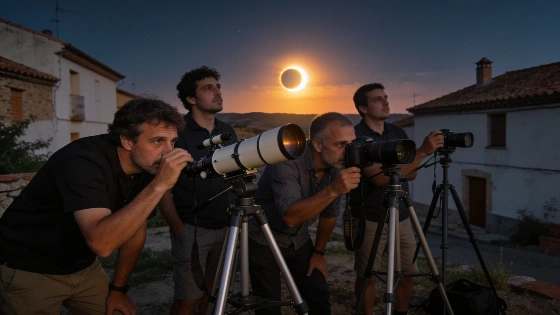
A team of citizen scientists and astronomy enthusiasts gathered in Valoria la Buena, Spain, to observe and document the total solar eclipse on August 12, using telescopes and live data feeds to study the Sun's corona under rare atmospheric conditions
On August 12, a total solar eclipse drew a diverse group of citizen scientists and astronomy enthusiasts to Valoria la Buena, a small village in central Spain. Their goal: to observe, record, and analyze the fleeting moment when the Moon completely obscured the Sun, revealing the solar corona in a rare display. The event offered a unique opportunity to collect scientific data and experience a phenomenon that has inspired both awe and inquiry for centuries.
Preparing for Totality
The Dynamic Eclipse Broadcast (DEB) Initiative, a volunteer-driven project supported by professional astronomers and partially funded by NASA and the National Science Foundation, coordinated the observation campaign. The DEB team's primary objective was to capture high-resolution data on the Sun's corona and transmit live images to a NASA webcast during the eclipse. Months of logistical planning, equipment testing, and international collaboration culminated in the assembly of a multinational group in Valoria la Buena, including participants from Mexico, the United States, and Spain.
Technical preparations were extensive. The team set up solar telescopes, cameras, and data uplinks at a site with an unobstructed western view-critical, as the Sun would be less than 10 degrees above the horizon at totality. A local resident provided internet access to ensure a stable connection for the NASA stream. The group also improvised solutions to technical challenges, such as constructing a homemade heatsink to prevent computer overheating during the Spanish summer heatwave.
Observing the Eclipse
On the day of the eclipse, anticipation was high. The team gathered at the observation site, joined by local residents and visitors. As the Moon began to cover the Sun, participants used solar filters, binoculars, and telescopes to track the progress. The partial phase gave way to totality, lasting approximately 1 minute and 37 seconds. During this interval, the solar corona became visible as a luminous halo around the darkened Sun, and Venus appeared in the twilight sky. The DEB team successfully captured images and data, while the live feed provided real-time views to NASA's audience.
Atmospheric conditions were favorable, with clear skies and minimal interference from clouds or wildfire smoke-factors that can easily disrupt eclipse observations. The low altitude of the Sun at totality introduced additional atmospheric effects, but did not prevent the team from achieving their scientific and outreach goals. The event also became a community gathering, with local families and students joining the scientists to witness the spectacle.
Scientific Value and Community Impact
The data collected during the eclipse focused on the Sun's corona, the outermost layer of the solar atmosphere, which is typically hidden by the Sun's intense brightness. Observing the corona during totality allows researchers to study its structure, dynamics, and temperature, contributing to ongoing efforts to understand solar activity and its influence on space weather. The DEB Initiative's approach combined rigorous data collection with public engagement, exemplifying the role of citizen science in modern astronomy.
Several participants were veterans of previous eclipse campaigns, while others experienced totality for the first time. The collaborative environment fostered knowledge exchange and inspired interest in scientific research. The event also highlighted the importance of international cooperation and local support in enabling successful astronomical observations. For many, the eclipse was not only a scientific milestone but also a memorable communal experience.
Broader Context and Future Opportunities
Total solar eclipses remain rare and geographically limited, making each observation a valuable opportunity for both science and public engagement. The August 12 event in Spain followed a period of heightened solar activity, as seen in recent solar flares and coronal mass ejections. For example, a recent M6.9-class solar flare and CME from an Earth-facing sunspot underscored the dynamic nature of the Sun and the importance of continuous monitoring. The next total solar eclipse visible from Europe is scheduled for 2027, offering another chance to advance solar research and public participation.
As the Sun set over Valoria la Buena, the partially eclipsed disk marked the end of a day that combined scientific achievement with community celebration. The experience reinforced the value of hands-on observation, collaborative problem-solving, and the enduring fascination of astronomical events.
Understanding a total solar eclipse requires knowledge of how the Moon's orbit occasionally aligns to block the Sun's disk as seen from Earth. During totality, the Sun's photosphere is completely obscured, allowing the much fainter corona to become visible. This brief window enables direct observation of coronal features that are otherwise hidden by scattered sunlight. Instruments such as solar telescopes and specialized cameras are essential for capturing these details, while atmospheric conditions and precise timing are critical for successful data collection. The rarity and unpredictability of totality make each observation scientifically significant and logistically challenging.