Archaeologists recovered 48 ancient arrows in Norway's Jotunheimen mountains, including a slate-tipped Stone Age arrow dated to roughly 5,000-6,000 years ago, with wood and binding materials preserved in the ice.
A fragment of Stone Age hunting technology has emerged from Norway's retreating mountain ice with an unusual level of detail. At Langfonne in Jotunheimen, archaeologists found a slate arrowhead dated to approximately 5,000-6,000 years ago alongside surviving pieces of its wooden shaft. The find is among the oldest arrows reported during the 2026 field season in Innlandet.
The discovery matters because the stone is not an isolated object. Traces of the original bindings and birch bark tar used to attach the arrowhead to the shaft were also preserved, allowing researchers to examine how the implement was assembled rather than merely infer its former use from the shape of the point.
Reporting from the field season describes the arrow as part of a larger collection of 48 ancient arrows recovered from melting mountain ice. The assemblage includes material from both the Stone Age and the Bronze Age, demonstrating that high-altitude ice patches in Jotunheimen repeatedly attracted people over long periods. The chronology and composition of the collection are summarized in NRK's field report.
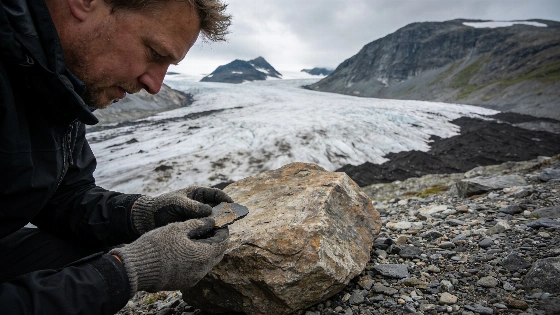
The arrowhead was spotted among gravel and pebbles on a large boulder in scree. Its position does not by itself establish precisely how the arrow came to rest there, but the surviving organic material makes the discovery unusually informative for the study of prehistoric technology. Wood fragments and attachment traces can preserve evidence about hafting and construction that a stone point alone cannot provide.
The available account does not specify which dating method established the arrow's approximately 5,000-6,000-year age. It does not provide a radiocarbon result, calibration range, sample material, or stratigraphic sequence that would allow the chronology to be assessed in technical detail. The date should therefore be treated as the reported archaeological age, not as a substitute for a published laboratory measurement.
That distinction is consistent with the way archaeological evidence is evaluated in peer-reviewed research. Studies published in Nature and investigations associated with the Max Planck Society generally separate direct observations, laboratory measurements, contextual data, and wider interpretation. The Langfonne find is strongest where those categories remain distinct: the object preserves a point, shaft fragments, and attachment materials, while questions about its precise deposition and use remain open.
Ice can preserve materials that would normally disappear from an archaeological record. Wood, fiber bindings, and adhesive residues are especially vulnerable to decay in many depositional settings, whereas long-term freezing can retain them until melting exposes the object. Here, the preserved shaft fragments and binding traces provide direct physical evidence for parts of the arrow's construction.
The evidence supports a careful interpretation rather than a complete reconstruction of Stone Age hunting. The arrowhead and shaft fragments show that a composite implement survived, while the tar and bindings indicate attachment technology. They do not establish who made it, the circumstances in which it was lost, or how frequently similar arrows were used.
The discovery can be read alongside other archaeological finds where objects reveal practical behavior through their manufacture and preservation. For a separate example of how provisional interpretations should be handled when context is incomplete, see this earlier investigation of proposed Maya beekeeping evidence.
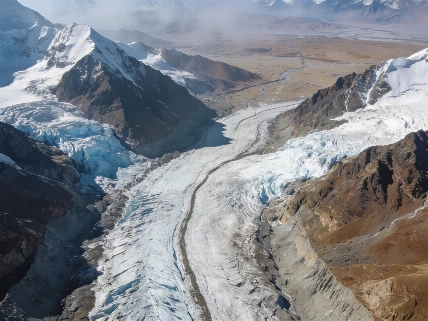
The 2026 field season also marked the 20th anniversary of glacial archaeology in Innlandet. As mountain ice retreats, archaeologists are gaining access to material from increasingly early periods, including the oldest finds reported in this season's collection. Project documentation describes Langfonne as a much larger ice mass in 2006; it has since broken into several smaller areas.
The retreat is changing the archaeological landscape as well as exposing artifacts. Researchers working at the ice margins have observed areas that were previously covered becoming ice-free. Espen Finstad, who leads the ice-archaeology program in Innlandet, has described the old ice as giving way, emphasizing that the window for finding and documenting organic artifacts is narrowing.
The process creates a narrow window for recovery. Once exposed, organic components that remained protected in ice can deteriorate, while meltwater and movement across scree may alter an artifact's original position. The reported discovery therefore carries two kinds of information: it documents prehistoric movement and hunting in high Norway, and it records how climate-driven ice loss is changing what archaeologists can study.
A herd of domesticated reindeer gathered on the ice near the researchers during the examination, an incidental field observation rather than evidence about the arrow's ancient use. The archaeological case rests on the artifact itself, its surviving materials, and the broader pattern of finds emerging from the retreating ice.
Glacial archaeology is strongest when it resists turning preservation into spectacle. This arrow does not reveal an entire hunting system or a complete biography of the person who made it, but its wood, bindings, and tar preserve a chain of manufacture that is usually lost. The retreat of Jotunheimen's ice is therefore not simply exposing old objects; it is erasing the conditions that protected them, making rapid documentation essential to preserving evidence of Stone Age technology.
In glacial archaeology, context includes both the object's position and the environment that preserved it. Ice is not a dating method by itself, and exposure does not automatically prove an artifact was deposited exactly where it was made or used. The strength of this discovery lies in the combination of a reported Stone Age date with surviving technological components, while the missing details about dating and deposition limit how far the interpretation can extend.