Stanford researchers encoded bits by switching an antenna between open and short circuits, then recovered them from amplified thermal noise in an anechoic chamber. A channel model raised transfer rates 100-fold
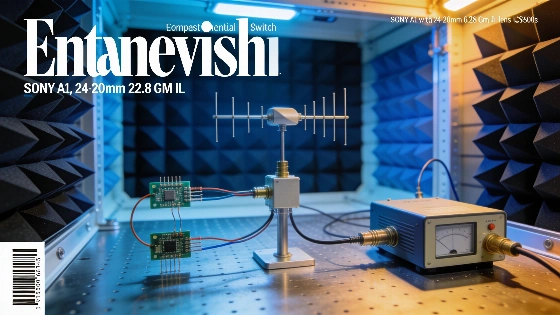
Inside an anechoic chamber, a Stanford team switched an antenna between two circuit states and recovered a binary message from the resulting thermal noise. The experiment shows how random electrical fluctuations can carry information without a transmitter actively generating a radio signal. The transmitter still communicated through an electromagnetic link: the receiver detected thermal-noise fluctuations reflected from the antenna.
Noise as a carrier
Thermal noise arises from tiny, random voltage oscillations in a conductor. Engineers usually treat it as an obstacle because it can obscure a signal and limit sensitivity. The Stanford researchers instead used these fluctuations as the basis for communication, changing the antenna's electrical state so the receiver could distinguish the resulting patterns. The team included Stanford electrical engineer Zerina Kepatenovic and research-team member Geneva Ecola. Their work was described in PNAS.
Noise measurements also matter in radio astronomy, where fluctuations can contain the signal being studied. The Stanford experiment used antenna switching to encode information in those fluctuations. A separate processor noise study examined how noise appears in encoded quantum gates, a distinct problem from transmitting information through thermal fluctuations.
Reading the bits
The transmitter antenna alternated between an open circuit and a short circuit. The researchers assigned the open state to "1" and the short state to "0", allowing the setup to encode the two basic values used in digital computing. At the other end, a receiver amplified the thermal noise reflected from the antenna so the team could read the transmitted bits.
The signal was extremely weak, so the experiment took place in an anechoic chamber, where external signals and other noise sources were reduced. That controlled setting let the team assess the method under minimal external interference. The researchers have described the demonstration as a laboratory proof of concept, rather than a replacement for Wi-Fi or cellular systems.
Modeling the channel
To characterize the link between transmitter and receiver, the researchers built a channel model. They used it to adjust the setup and increased the data-transfer rate by a factor of 100. The result is an improvement within this experimental system; practical deployment would require operation beyond the controlled chamber environment.
The team says the approach does not occupy radio-frequency bandwidth allocated to services such as Wi-Fi or broadcast television. Ecola also reported an energy comparison: a transmitter using radio frequencies can consume up to 1,000 times as much energy to send information as one relying on thermal noise. The figure is the team's reported comparison, not a general benchmark for deployed communication systems.
Testing beyond the chamber
Potential uses include radio astronomy observatories and hospital facilities with equipment sensitive to electromagnetic radiation. In those settings, even weak radio-frequency signals can interfere with signals that instruments need to detect. The proposed benefit is avoiding interference from an actively generated signal; the experiment did not test the system in either setting.
The researchers' next steps are to build a network with multiple transmitters and test performance in noisier surroundings. Jida Zhang said the evaluation so far has been limited to a controlled environment with minimal external interference.