A piezoelectric silicon platform lets researchers tune strain in twisted bilayer graphene. Near charge neutrality its gauge factor reaches about 100, although that figure describes relative sensitivity rather than a hundredfold jump in raw resistance
The strongest signal appeared when the graphene bands were filled to the charge-neutrality point. There, a small applied strain produced a gauge factor of about 100, far above the roughly one-to-one response typical of ordinary conductors. The University of Washington reported that strain below one-tenth of a percent produced a resistance response more than 100 times the ordinary-metal expectation.
Strain by design
The measurement addresses a longstanding problem in experiments on magic-angle graphene: strain can alter the material's electronic states, but it is difficult to control in a device only a few atomic layers thick. Strain has often been fixed unpredictably during assembly. In a study published in Science on November 12, 2026, the research groups of Matthew Yankowitz and Jiun-Haw Chu at the University of Washington used a piezoelectric strain cell to stretch and compress devices at low temperature. The university described the technique in a research announcement.
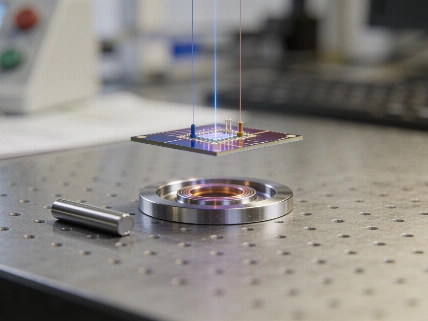
Magic-angle twisted bilayer graphene consists of two graphene sheets rotated by approximately 1.1 degrees. The twist creates unusually narrow electronic bands in which interactions between electrons are pronounced; depending on band filling, the material can exhibit insulating, metallic or superconducting behavior. The researchers placed the twisted graphene stack on thin piezoelectric silicon wafers. Applying voltage caused the platform to expand or contract, transmitting tensile or compressive strain to the material.
The stack included magic-angle graphene, hexagonal boron nitride (hBN) and graphite. The researchers used the graphite layer behind the insulating hBN to apply a potential difference and electrostatically change how many electrons occupied the graphene's energy bands. This let them examine resistance as they varied both band filling and strain.
Reading the response
The gauge factor compares the relative change in resistance with the relative change in strain. A value near 100 therefore indicates unusually high sensitivity; it does not mean the raw resistance itself increased a hundredfold. The distinction matters because the applied strains were small. The response also grew stronger as the sample was cooled.
The response peaked at charge neutrality, where the graphene's valence-band states below the band intersection are filled while the states above it are empty. Its dependence on band filling provides a way to investigate how strain interacts with the strong electronic correlations in the material. Jiun-Haw Chu, a member of the team, described the measured sensitivity as far greater than the roughly one-to-one change expected in a typical conductor.
Superconducting parallels
At a particular doping level, the material also showed behavior analogous to that of iron-based superconductors. The critical temperature for the onset of superconductivity scaled with applied strain in a way comparable to how it scales with applied magnetic field in bulk superconductors. The researchers interpret this as a sign that strain can act like a magnetic field in prompting a collective state that is close to ordering.
The resemblance is a comparison between responses, not evidence that the two material systems have the same underlying mechanism. A separate report on superconducting loop arrays focused on magnetic-field sensing, a different measurement from controlling strain in graphene.
What remains open
The microscopic physics behind the large response is unresolved. Yankowitz and colleagues suspect that their setup strains the two graphene layers equally rather than pulling them apart, but that interpretation still needs testing. Ben Feldman, a Stanford University physicist who was not involved in the work, has emphasized the value of being able to tune strain in situ and compare it with electronic-transport measurements.
The controlled gauge could also help researchers examine other two-dimensional materials, including transition metal dichalcogenides. For now, the central result is a method for applying and measuring strain in a fragile layered device, alongside a strong change in relative resistance. The gauge factor captures that sensitivity; it does not describe a hundredfold change in raw resistance.