

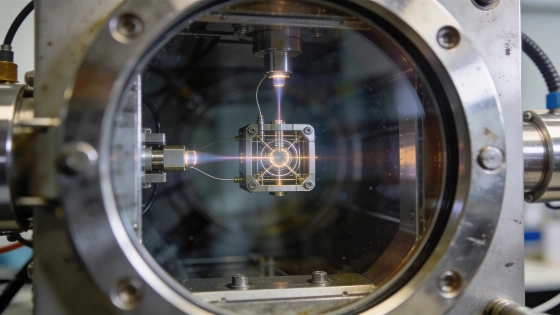
On Quantinuum's H1-1 trapped-ion processor researchers reconstructed a Steane-code logical gate set; low-shot data looked Pauli-like while a 14,100-shot emulator exposed coherent over-rotations
High-shot simulations revealed coherent over-rotations in logical gates, even though measurements from the physical processor showed no statistically notable memory effects. Researchers from Sandia National Laboratories and Quantinuum report the difference in a study on arXiv titled Logical Gate Set Tomography. Their "Logical GST" method reconstructs a complete logical gate set, rather than relying only on aggregate error rates, and tests noise assumptions used in fault-tolerant quantum computing.
The emulator signal
In simulations using Quantinuum's high-fidelity H1-1E emulator, the team ran 14,100 shots. The analysis found small but statistically notable non-Markovianity, at NσCPTP ≈ 4.9, along with coherent over-rotations of Δθ ≈ 0.0015π on SL, IL and TL.
By toggling error channels in the emulator, researchers identified physical dephasing accumulated during ion transport and sympathetic cooling as the primary source of the coherent logical drift in those simulations. The analysis also showed that syndrome-extraction cycles can produce non-Markovian logical dynamics even when the underlying physical noise is Markovian. A logical operation is a composite process: it can involve data-qubit evolution, ancilla interactions, syndrome measurements, classical decoding and conditional corrections. Correlations introduced across those steps can shape the effective logical noise.
What H1-1 measured
The experimental work used the 20-qubit trapped-ion Quantinuum System Model H1-1 during its final experimental campaign. The team encoded one logical qubit in the [[7, 1, 3]] Steane code, using seven data qubits and six syndrome degrees of freedom. Across 158 compressed circuits, the dataset contained Nshots = 50.
Those low-shot results were consistent with a Pauli-stochastic noise model, with NσS < 1. The test found no statistically notable non-Markovian memory effects in that dataset, with NσCPTP < 2; the researchers used the larger emulator runs to probe effects that the limited experimental sample could not resolve clearly.
The team performed active quantum error correction using real-time classical feedforward. Physical correction pulses were applied directly to the ions inside the gate zones. This differs from software-based Pauli-frame tracking, which can twirl coherent phase errors and make them harder to detect. The reconstructed set included logical |0⟩L initialization and terminating MZ,L measurement. Its transversal Clifford gates included HL and SL; IL completed that group. The non-transversal TL gate used magic-state injection and teleportation, with a 95.9% acceptance rate per attempt.
Testing noise assumptions
Fault-tolerance theorems commonly rely on error correction turning complex physical noise into relatively simple, uncorrelated Pauli-stochastic channels, such as independent bit and phase flips. The H1-1 measurements were consistent with that model at their available shot count. The emulator results, but, exposed small departures that the physical dataset could not establish with comparable statistical significance.
A separate decoder study examined how aggressive cross-subgraph reweighting can reduce effective surface-code distance; Logical GST addresses a different question by testing whether encoded gates follow assumed noise models. The researchers present their tomography method as a platform-agnostic way to check whether scaling fault-tolerant quantum processors conform to the noise assumptions used by modern decoders.







