

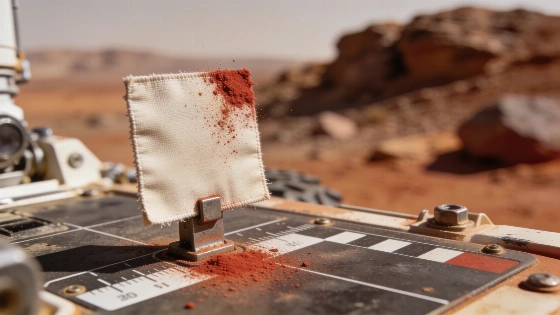
Perseverance's PIXL instrument detected dust down to roughly 100 nanometers on calibration samples. The surface measurements could help engineers assess suit materials and dust control, but do not measure crew exposure directly
During Apollo, lunar dust scratched visors and degraded spacesuit layers. On Mars, the hazard may take a different form: Perseverance has measured exceptionally small dust grains clinging to material samples carried on the rover, including particles in a size range associated with health concerns on Earth.
Dust on the targets
The measurements came from PIXL, short for Planetary Instrument for X-ray Lithochemistry. Its X-ray fluorescence spectrometer examined dust on calibration targets, including a Teflon sample. Because Teflon contains no elements PIXL can directly detect, elemental signals measured on that target were attributed to dust resting on its surface. SHERLOC, the rover's Scanning Habitable Environments with Raman and Luminescence for Organics and Chemicals instrument, also carries a calibration target with spacesuit-material swatches, including Teflon and Vectran.
NASA sent five spacesuit-material samples to Mars to study how they withstand the surface environment. Each swatch measures 20 millimeters square. Across 1,645 Martian days of observations, PIXL detected particles smaller than 2.5 micrometers and ultrafine particles near 100 nanometers. A human hair is about 70 micrometers wide. Earlier Martian dust measurements had resolved particles down to about 3 micrometers.
Particles on PIXL's Teflon target and SHERLOC's Vectran sample averaged about 2 micrometers. Dust on PIXL's basaltic glass and SHERLOC's Teflon sample ranged from roughly 100 to 300 nanometers. These measurements describe particles attached to exposed surfaces, not airborne dust concentrations. NASA's Jet Propulsion Laboratory said the findings were scheduled for publication on Oct. 27 in the Proceedings of the National Academy of Sciences.
Why particle size matters
On Earth, fine airborne particles smaller than 2.5 micrometers can penetrate deep into the lungs and enter the bloodstream. Studies also indicate that ultrafine particles at or below about 100 nanometers can travel from the nasal cavity toward the brain along the olfactory nerve. Those terrestrial findings establish a reason to examine Mars dust; they do not show that astronauts have been exposed or that a specific health outcome will occur on Mars.
The rover measured particles attached to surfaces, not the amount suspended in air inside a habitat or inhaled by a crew. Mars dust is predominantly silicate minerals and includes reactive compounds such as perchlorates and iron. The health risk will depend on the quantity of dust and the duration of exposure, factors these surface measurements do not determine.
Dust grains on Mars are rounded by collisions driven by wind, making them less abrasive than lunar grains, while their chemistry differs. Earlier missions found iron- and sulfur-rich dust; PIXL also detected enrichment in phosphorus and signs of calcium sulfate. Regional and global storms can keep dust circulating through the atmosphere.
From samples to safeguards
Static electricity appears to influence which grains adhere to different materials. Dust becomes charged as particles collide in the air, and the calibration surfaces attract different sizes. The finest grains remained attached through years of rover driving and drilling, while larger clumps can shake loose over time.
The SHERLOC target's Teflon and Vectran swatches are spacesuit materials placed on Mars to examine their performance under surface conditions. NASA's reported measurements found dust averaging about 2 micrometers on the Vectran swatch, while particles on the SHERLOC Teflon swatch measured roughly 100 to 300 nanometers. The results document dust on the individual exposed surfaces; they do not establish a ranking of the materials' durability or protective performance. NASA says findings of this kind could inform spacesuit and habitat design, dust-removal procedures, and future crew-health standards.
That distinction matters for spacesuit design. The study found that some materials collect less dust than others, which could inform material and coating choices for suits and habitats. Suitports, which allow astronauts to enter a suit attached to a habitat's exterior, and dual-chamber airlocks are among the designs that could reduce dust brought into living areas.
NASA has also tested an Electrodynamic Dust Shield on the Moon, where electric fields were used to clear lunar regolith from glass and thermal radiator surfaces in March 2025. A related lunar planning report describes how measurements of unknown surface conditions can inform mission priorities. Perseverance's dust results add direct measurements from Mars to that engineering problem.
PIXL's detection shows that very small particles adhere to selected materials on the rover; it does not establish how much dust future crews would inhale. In this context, "fine" and "ultrafine" refer to particle diameter, not to a measured airborne concentration. The measurements can help identify materials and procedures for further testing, while exposure limits and crew-health standards require evidence about dust in the environments astronauts would actually occupy.







