Analysis of ancient meteorite grains has uncovered evidence that strong magnetic fields influenced the earliest stages of the solar system's formation, challenging the long-held view that gravity alone sculpted the protoplanetary disk
Magnetic fields, not just gravity, played a decisive role in shaping the solar system's earliest architecture, according to new laboratory measurements of meteorite dust that preserve a physical record from the dawn of the Sun. This finding, based on the oldest known solid materials from space, forces a revision of how scientists reconstruct the birth of our planetary neighborhood.
Magnetism detected in ancient grains
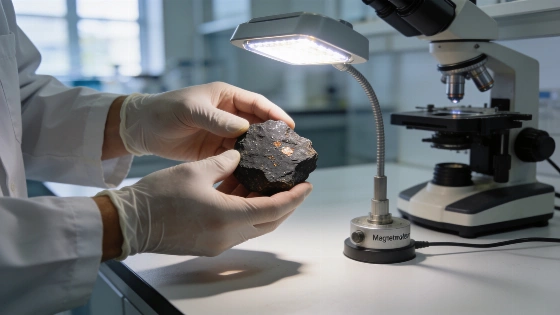
Researchers analyzed calcium-aluminum-rich inclusions (CAIs) embedded in the meteorite DOM 08006, recovered from Antarctica in 2008. These inclusions are believed to have formed within the first 200,000 years of the solar system's existence, making them the most ancient samples of solar material available for study. By isolating CAIs containing magnetic minerals such as iron, the team measured remanent magnetization-evidence of a magnetic field present when these grains solidified.
The results indicate that, during the solar nebula phase, the magnetic field in the region where the Sun was forming was at least 12 times stronger than Earth's present-day magnetosphere. This field was strong enough to influence the movement and distribution of gas and dust, affecting how the protoplanetary disk flattened and how material accreted onto the young Sun.
Gravity and magnetism in solar system formation
For decades, models of solar system formation have emphasized gravity as the primary force collapsing a diffuse cloud of gas and dust into a spinning disk, eventually giving rise to the Sun and planets. The new evidence from DOM 08006 suggests that magnetism was not a minor player but a co-architect, actively shaping the disk's structure and dynamics from the earliest stages.
Charged particles in the collapsing nebula would have generated and sustained a magnetic field, which in turn could have driven the inward flow of gas toward the proto-Sun. This mechanism helps explain how material was efficiently transported and why the disk evolved into its observed flattened shape. The findings also align with previous studies that detected magnetic signatures in meteorites formed later, but this is the first direct measurement from material predating the Sun itself.
Laboratory methods and sample integrity
The team's approach relied on identifying CAIs within DOM 08006 that had experienced minimal alteration since their formation. Unlike many meteorites that have been chemically or physically modified during their journey through the solar system, DOM 08006 is considered exceptionally pristine. This preservation allowed researchers to probe the original magnetic environment of the early solar nebula with minimal contamination from later events.
Using sensitive magnetometers, the scientists measured the direction and strength of magnetization locked within individual CAIs. The data were then compared to models of nebular evolution to estimate the intensity of the ancient magnetic field. The study, published in Proceedings of the National Academy of Sciences on August 7, 2026, provides a rare window into the physical conditions that prevailed before the Sun's ignition.
Implications for planetary origins
The presence of a strong magnetic field during the earliest phase of solar system formation has direct consequences for theories of planet formation and disk evolution. Magnetic forces could have influenced the distribution of solids, the migration of planetesimals, and the eventual architecture of planetary orbits. This challenges the view that gravity alone determined the fate of the solar nebula.
These results also highlight the scientific value of meteorite samples as archives of early solar system history. As researchers continue to analyze primitive meteorites and returned samples, the role of magnetism in shaping planetary systems may require further revision. For context, the importance of sample-return missions and meteorite analysis has been underscored in recent reporting on Mars' moons.
While the evidence for strong early magnetism is compelling, uncertainties remain about how these fields evolved and dissipated as the Sun matured. The findings do not resolve all questions about the timing and mechanism of disk flattening, but they establish magnetism as a fundamental ingredient in the recipe for solar system formation. The field now faces the task of integrating these magnetic constraints into comprehensive models of planetary origins, moving beyond gravity-dominated scenarios that have long shaped the narrative.
To understand how meteorite grains can record ancient magnetic fields, it is essential to grasp the concept of remanent magnetization. When certain minerals crystallize in the presence of a magnetic field, their atomic structure aligns with the field's direction, effectively locking in a magnetic signature. This fossil magnetism can persist for billions of years if the material remains undisturbed. By measuring the orientation and strength of this magnetization in laboratory settings, scientists can reconstruct the intensity and direction of magnetic fields that existed when the grains formed. This method provides a rare direct probe of physical conditions in the early solar nebula, complementing astronomical observations and theoretical models.