A multidisciplinary journal launched in 2022 has published over 270 studies on climate variability, risk, and mitigation. Experts now assess how the field has evolved and what scientific and technical barriers remain
Since its launch in 2022, Environmental Research: Climate has aimed to bridge disciplines by publishing research on the physical, biogeochemical, and societal dimensions of climate variability and change. The journal's broad scope has enabled the publication of more than 270 articles, covering topics from the mechanisms driving Earth's climate to the design and evaluation of mitigation and adaptation strategies. This body of work reflects the increasing complexity and urgency of climate science, as researchers seek to quantify risks, understand feedbacks, and inform policy under rapidly changing conditions.
Recent years have seen advances in the measurement and modeling of climate processes across spatial and temporal scales. Physical climate models now incorporate more detailed representations of atmospheric, oceanic, and land-surface interactions, while biogeochemical models track carbon and nutrient cycles with improved spatial resolution. At the same time, the field has expanded its focus on the human and ecological impacts of climate change, including the assessment of extreme events such as heatwaves, floods, and wildfires. These developments have required new approaches to data integration, uncertainty quantification, and risk communication.
Expert Perspectives
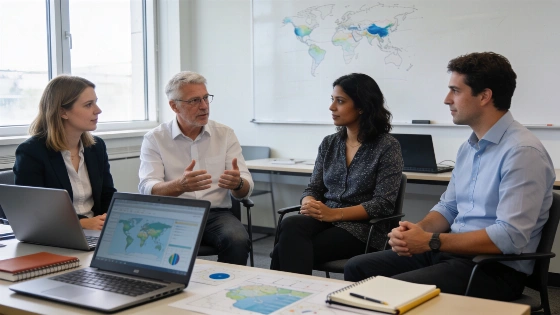
To assess the current state of climate research, a recent webinar brought together leading scientists from diverse backgrounds. The discussion was moderated by Noah Diffenbaugh of Stanford University, whose research centers on identifying which aspects of the climate system most directly affect people and ecosystems. Diffenbaugh's experience includes serving as a Lead Author for the Intergovernmental Panel on Climate Change (IPCC) and as editor-in-chief of Environmental Research: Climate.
Panelists included Katharine Mach (University of Miami), Andrew Pershing (Climate Central), and Inês Azevedo (Stanford University). Mach's work focuses on climate-related risks and adaptation strategies, with particular attention to hazards such as flooding, extreme heat, and wildfire. Pershing leads climate science activities at Climate Central, developing tools to attribute specific weather events to climate change and communicating these findings to the public. Azevedo's research addresses the evolution of energy systems and the intersection of environmental, technical, and policy challenges in meeting future energy needs.
Measurement, Modeling, and Uncertainty
One of the central challenges in climate science remains the quantification of uncertainty in both physical and societal systems. Advances in remote sensing, in situ measurement, and data assimilation have improved the ability to monitor key variables such as surface temperature, ocean heat content, and greenhouse gas concentrations. However, uncertainties persist in projecting regional impacts, feedback mechanisms, and the effectiveness of mitigation strategies. The integration of physical and social science data is essential for robust risk assessment, but also introduces new sources of complexity and potential error.
For example, the attribution of extreme events to anthropogenic climate change relies on high-resolution models and statistical analysis of observational data. Tools such as the Climate Shift Index, developed by Pershing and colleagues, aim to quantify the increased likelihood or severity of specific conditions due to climate change. These methods require careful calibration, validation against historical records, and transparent communication of confidence levels and limitations.
Engineering and Policy Implications
Translating climate research into effective mitigation and adaptation strategies involves both technical and policy challenges. The design and evaluation of interventions-ranging from emissions reduction technologies to land-use planning-depend on accurate modeling of system dynamics and decision-making processes. Azevedo's work highlights the need for comprehensive understanding of energy technologies and the economic and behavioral factors that shape their adoption. Similarly, Mach's engagement with policy processes and stakeholder communities underscores the importance of integrating scientific evidence with practical considerations and local knowledge.
Despite progress, significant barriers remain between current research and the deployment of scalable, effective solutions. These include uncertainties in model projections, variability in regional impacts, and the need for interdisciplinary collaboration. The field continues to grapple with the challenge of communicating complex risks and trade-offs to policymakers, industry, and the public, while maintaining scientific rigor and transparency.
According to Environmental Research: Climate, the journal's editorial leadership remains committed to fostering multidisciplinary dialogue and advancing the evidence base for climate action. As the field evolves, ongoing collaboration between physical scientists, engineers, social scientists, and policymakers will be essential to address the intertwined technical and societal dimensions of climate change.
Understanding uncertainty is central to climate science. In this context, uncertainty refers to the range of possible outcomes in model projections or measurements, arising from limitations in data, model structure, or inherent variability in the climate system. Quantifying and communicating uncertainty allows researchers and decision-makers to assess risk, compare scenarios, and prioritize actions. Transparent treatment of uncertainty is essential for maintaining scientific credibility and for informing robust policy and engineering responses to climate challenges.