Astronomers analyzing data from NASA's Fermi Gamma-ray Space Telescope and other observatories have found evidence suggesting both stars in a binary system exploded as supernovae, leaving overlapping remnants in the IC 443 region
Astronomers have reported evidence that two massive stars in a binary system may have each ended their lives in supernova explosions, leaving behind overlapping remnants in the region known as IC 443, or the Jellyfish Nebula. If confirmed, this would mark the first time researchers have identified both members of a binary system as separate supernova remnants, providing a rare opportunity to study the aftermath of such stellar deaths in close proximity.
Tracing Supernova Remnants in IC 443
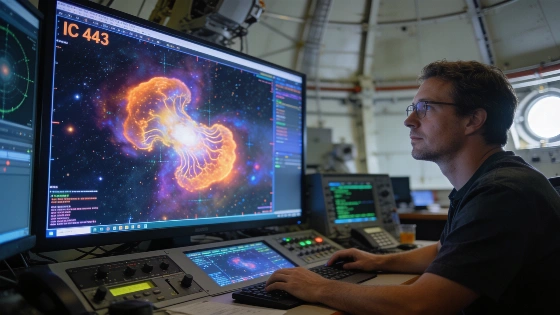
IC 443, located approximately 6,000 light-years from Earth in the constellation Gemini, is one of the most thoroughly studied supernova remnants in the Milky Way. Its distinctive structure, shaped by shock waves interacting with surrounding clouds of gas and dust, has made it a frequent target for multiwavelength observations. The region is also known for its relative isolation, which reduces confusion from unrelated sources and allows for detailed analysis of its emissions across the electromagnetic spectrum.
In addition to the well-known IC 443 remnant, astronomers have focused on a much fainter neighboring structure, designated G189.6+3.3. This object was first detected in 1994 by the ROSAT X-ray satellite and later observed in greater detail by the Spektrum Roentgen Gamma (SRG) observatory, which revealed shell-like features consistent with a supernova origin. The proximity of G189.6+3.3 to IC 443 raised the possibility that both remnants could be physically related.
Multiwavelength Evidence and Statistical Analysis
To investigate the relationship between these two remnants, researchers analyzed more than 16 years of data from NASA's Fermi Gamma-ray Space Telescope, complemented by archival X-ray, optical, and radio observations. They found that both IC 443 and G189.6+3.3 appear to be interacting with the same interstellar hydrogen cloud, suggesting that the explosions occurred close together in space. The centers of the two remnants are separated by an estimated 30 to 50 light-years.
Statistical modeling indicated that the likelihood of two unrelated supernova remnants appearing this close together by chance is about one in 1,000. This low probability supports the interpretation that IC 443 and G189.6+3.3 originated from a binary system in which both stars exploded as supernovae. The estimated ages of the remnants differ, with G189.6+3.3 likely predating IC 443 by tens of thousands of years. The progenitor stars are thought to have been at least 20 times the mass of the Sun.
Implications for Stellar Evolution
The identification of a possible binary supernova pair offers new insight into the evolution and fate of massive stars in multiple systems. Binary interactions can significantly alter the life cycles of massive stars, affecting mass loss, rotation, and the timing of supernova explosions. The spatial and temporal relationship between IC 443 and G189.6+3.3 provides a rare laboratory for testing models of binary evolution and supernova feedback in the interstellar medium.
Further analysis of the remnants' structure and motion may reveal how the first explosion influenced the trajectory and environment of the surviving companion before its own supernova event. These findings also highlight the importance of combining data from multiple observatories and wavelengths to disentangle complex astrophysical phenomena. For readers interested in other rare astronomical alignments, a recent report discusses the overlap of a total solar eclipse and the Perseid meteor shower in August 2026, which can be explored through this coverage of coinciding celestial events.
The research was published in July 2026 in the peer-reviewed journal Nature Communications, and represents a significant step toward understanding the end stages of massive binary stars.
Uncertainties and Alternative Explanations
Despite the strong statistical case, some uncertainties remain. If the two stars were extremely close when they exploded, their remnants could overlap to the point of appearing as a single structure, complicating identification. Alternatively, the first supernova could have imparted a velocity kick to the companion, separating the remnants over time. The current evidence relies on spatial proximity, shared environmental features, and statistical modeling, but cannot yet rule out all unrelated scenarios.
Future observations, particularly those capable of resolving faint structures and measuring the motion of remnant material, may help clarify the relationship between IC 443 and G189.6+3.3. Improved modeling of binary supernova dynamics and more sensitive surveys of the Milky Way could reveal additional examples or challenge the current interpretation.
Supernova remnants are the expanding clouds of gas and dust left behind after a massive star explodes. These structures emit radiation across the electromagnetic spectrum, from radio waves to gamma rays, as shock waves heat and compress the surrounding interstellar medium. By analyzing the shape, composition, and motion of supernova remnants, astronomers can reconstruct the history of the explosion and the properties of the progenitor star. In binary systems, the interaction between two massive stars can complicate this picture, making it challenging to distinguish overlapping remnants or to trace the sequence of events leading to their formation.