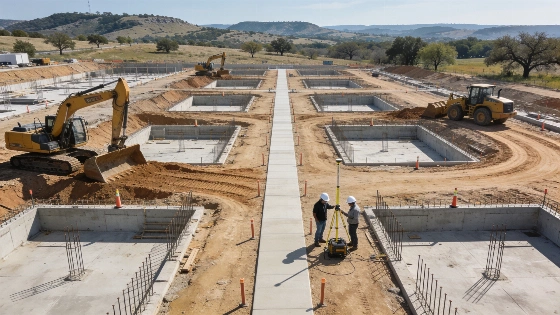
Texas Quantum Partners and Samara have detailed the master plan for Occam Foundry, a 16.5-acre quantum technology campus in Austin designed to support quantum computing, sensing, networking, and semiconductor fabrication
Texas Quantum Partners and Samara have released the architectural and operational plans for Occam Foundry, a 16.5-acre quantum technology campus now under construction in southeastern Travis County, Austin. The site is intended to co-locate university spinouts, early-stage startups, and operational hardware teams with full-scale semiconductor fabrication and characterization facilities, aiming to accelerate the transition from research to prototype in quantum technologies.
Campus Architecture and Facilities
The initial phase of Occam Foundry will comprise six dedicated buildings arranged around a central shaded walkway and reflecting pool. These include The Quantum Hub, which is planned to house an operational quantum computer; The Research Building; The Fab, a fabrication facility for on-site chip production; The Sensing and Networking Lab; Milliways, a central commons and event space; and The Headquarters. The design is intended to foster collaboration across quantum computing, precision sensing, secure networking, and atomic timing, with shared infrastructure to support device development and testing.
Integration of Quantum Disciplines
The campus is structured to bring together four core verticals-quantum computing, precision sensing, secure networking, and atomic timing-within a single ecosystem. By enabling design teams to work across these disciplines without leaving the Central Texas corridor, the developers aim to reduce barriers between concept, prototyping, and operational deployment. The site's proximity to Austin-Bergstrom International Airport (approximately 15 minutes) and downtown Austin (about 25 minutes) is intended to facilitate logistics and access for both local and visiting teams.
Policy Alignment and Regional Context
Occam Foundry's development is aligned with the Texas Quantum Initiative, established under House Bill 4751 in 2025, which provides state-level funding for quantum real estate, hardware deployments, and research hubs across Texas universities and private enterprises. The campus is situated within Travis County's advanced manufacturing corridor, reflecting a broader regional strategy to support semiconductor and quantum technology infrastructure. Earthwork is currently underway, but no operational quantum hardware or fabrication output has yet been reported from the site.
Technical and Engineering Considerations
While the master plan outlines a comprehensive ecosystem for quantum device development, the technical details of the planned quantum computer, fabrication processes, and measurement capabilities have not been disclosed. The success of such a campus will depend on the reproducibility of device fabrication, the stability of cryogenic and control infrastructure, and the ability to maintain high-fidelity operation across multiple quantum platforms. Previous efforts to integrate quantum hardware and research environments have highlighted challenges in scaling from laboratory prototypes to reliable, manufacturable systems. For context, similar initiatives to expand quantum education and infrastructure, such as the integration of cloud-based quantum computing platforms into academic curricula, have been reported in other regions, as seen in recent developments in Andhra Pradesh.
Physical infrastructure alone does not guarantee scientific or commercial success. The transition from architectural plans to operational quantum devices will require sustained investment in fabrication yield, device calibration, error mitigation, and workforce development. The degree to which Occam Foundry can deliver reproducible, high-performance quantum hardware will be a key measure of its impact on the field.
Quantum technology campuses such as Occam Foundry are designed to address the persistent gap between laboratory demonstrations and scalable, manufacturable quantum systems. In quantum computing, for example, the distinction between physical qubits-individual quantum systems that can be controlled and measured-and logical qubits, which encode information redundantly to correct errors, is central to progress. Achieving reliable logical qubits requires not only high-fidelity physical devices but also robust error correction, stable cryogenic operation, and reproducible fabrication. The engineering and operational challenges of moving from a single laboratory device to a deployable quantum platform remain substantial, and the effectiveness of integrated campuses will depend on their ability to address these constraints in practice.