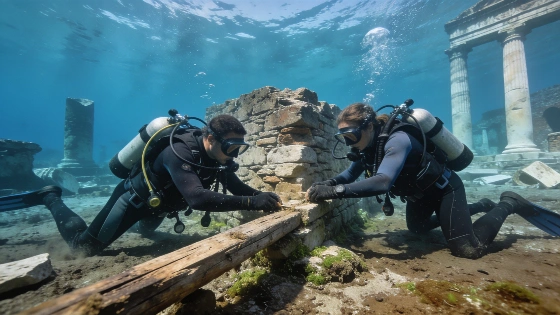
Archaeologists are mapping the underwater remains of Puteoli, Rome's early commercial port, using advanced survey methods to document warehouses, workshops, and a rare Nabataean temple preserved beneath the Bay of Naples
Archaeological investigations beneath the Bay of Naples are revealing the submerged remains of Puteoli, a Roman port city that played a central role in Mediterranean trade before the rise of Portus and Ostia. Located near modern Pozzuoli, the site preserves extensive architectural features, including warehouses, workshops, and harbor infrastructure, now lying three to five meters underwater due to centuries of volcanic ground movement known as bradyseism. This geological process, characteristic of the Campi Flegrei region, has gradually lowered the coastline, submerging nearly two kilometers of the ancient harbor district.
Underwater Documentation and Preservation
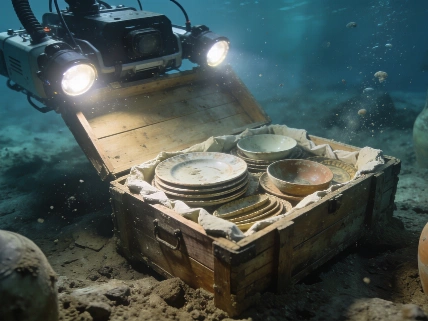
Since 2021, a multidisciplinary team led by Dr Michele Stefanile of the Istituto Italiano per l'Archeologia Marittima e delle Strutture Sommerse has been systematically documenting the underwater landscape of Puteoli. The project employs remotely operated vehicles (ROVs), photogrammetry, three-dimensional modeling, and geographic information systems (GIS) to record the site's architecture and spatial organization. Notably, some structures retain original wooden elements, offering rare opportunities to study Roman construction and preservation in a submerged context. The research is supported by the Expandere Conscientiae Lumen (ECL) Grant from Ancient Rome Live, enabling extended fieldwork and digital reconstruction.
Among the most significant finds is the rediscovery of the Temple of the Nabataeans, a structure first identified in the 1980s but left largely unexamined due to funding constraints. Recent surveys relocated the temple, which is believed to be the only Nabataean religious building identified outside the Nabataean Kingdom. Excavation revealed that the temple was protected beneath layers of Roman concrete, likely laid during the second century CE after the annexation of the Nabataean Kingdom by Emperor Trajan. The preservation of architectural details beneath these deposits has allowed for detailed study of cross-cultural religious architecture in the Roman Mediterranean.
Economic Role and Material Evidence
Puteoli's archaeological record demonstrates its importance as Rome's principal commercial port prior to the development of Portus and the expansion of Ostia. The city's location on the Bay of Naples facilitated connections with trade routes across the Mediterranean, particularly for the import of grain from Egypt. Recent underwater surveys have identified large granaries in the vicus Annianus district, which are consistent with literary sources and the wax tablets of the Sulpicii, a local banking family whose records document loans related to grain storage and distribution. The exceptional preservation of timber and internal fittings in these granaries provides a unique opportunity to examine the organization and operation of Roman storage facilities.
Archaeologists have documented warehouses, porticoes, and workshops, including a marble-cutting facility, that illustrate the complexity of the port's economic infrastructure. The site's preservation underwater has protected organic materials and construction details rarely found in terrestrial Roman contexts. The ongoing research aims to reconstruct the spatial and functional layout of the port, contributing to broader understanding of Roman urbanism and trade logistics. Comparable discoveries of organic preservation in ancient Mediterranean contexts, such as the rare organic artifacts recovered from a necropolis beneath Gragnano, Italy, have highlighted the value of waterlogged environments for archaeological research (see analysis of organic preservation in pre-Roman Campania).
Interpretation and Future Prospects
Despite its historical significance, Puteoli has often been overshadowed by more prominent Roman sites. The city's archaeological remains, including a stadium, basilica, and amphitheater predating the Colosseum, reflect its status as a major urban center in Imperial Rome. The current underwater research is expanding knowledge of the city's infrastructure and its role in the imperial economy. However, the interpretation of submerged structures is complicated by the effects of bradyseism, which has altered the original topography and spatial relationships. The research team is working to integrate digital models with historical sources to clarify the chronology and function of key features.
Plans are underway to make the submerged archaeological landscape accessible as a heritage destination, balancing conservation with public engagement. The project's findings are expected to inform future studies of Roman ports and contribute to comparative research on ancient trade, urbanism, and cross-cultural interaction in the Mediterranean. The preservation of organic materials and architectural details at Puteoli offers a rare window into the daily operations and infrastructure of a major Roman port, but ongoing analysis is needed to resolve questions about chronology, function, and broader historical context.
Understanding the preservation of submerged archaeological sites requires attention to taphonomic processes unique to underwater environments. Waterlogged conditions can protect organic materials such as wood, textiles, and plant remains from decay, but also introduce challenges related to chemical alteration and biological activity. The study of underwater sites like Puteoli relies on specialized survey and conservation methods to document and stabilize fragile materials. Interpreting the archaeological record in these contexts demands careful integration of environmental, geological, and historical data to reconstruct past landscapes and human activity.