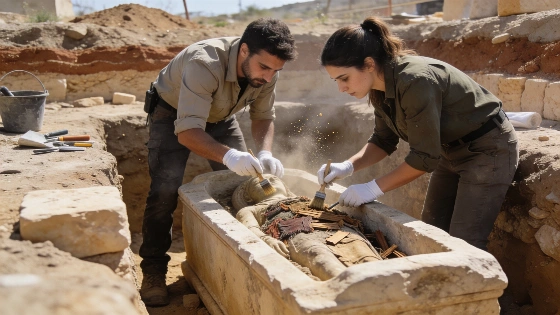
Archaeologists have uncovered a 6th-century BCE necropolis beneath Gragnano, Italy, preserving organic materials and imported grave goods that reveal new details about elite burial practices and Mediterranean trade in pre-Roman Campania
Archaeological excavations in Gragnano, near Naples, have revealed an exceptionally well-preserved necropolis dating to the first half of the 6th century BCE. Discovered during construction at the historic Pastificio Garofalo site, the cemetery was found beneath layers of industrial development, offering a rare opportunity to study elite burial practices in pre-Roman Campania. The site, part of the ancient Ager Stabianus territory, was excavated under Italy's preventive archaeology program, with scientific oversight from the Archaeology, Fine Arts and Landscape Directorate for the Metropolitan Area of Naples.
Preservation and Burial Context
The necropolis contains multiple graves attributed to a wealthy ruling class, as indicated by the quality and diversity of grave goods. Many burials were protected within sealed tuff sarcophagi, creating an environment that preserved organic materials rarely surviving from this period. Archaeologists recovered textiles, wooden objects, and woven fiber baskets, providing direct evidence of everyday items and funerary customs that are typically lost to decay. The preservation of these materials allows for detailed analysis of ancient craftsmanship and mortuary behavior.
In addition to organic remains, the graves yielded a range of imported luxury objects. Finds include Egyptian scarabs likely originating from the Greek trading colony of Naukratis, carved amber ornaments with animal motifs, finely crafted silver items, and high-quality Etruscan bronze artifacts. These objects demonstrate the community's participation in extensive Mediterranean exchange networks, linking Campania to the Greek world, Egypt, and the eastern Mediterranean centuries before the rise of Pompeii and other major centers.
Scientific Analysis and Broader Implications
An interdisciplinary team is conducting ongoing analyses of the site, focusing on human remains to reconstruct aspects of diet, mobility, health, and living conditions in the 6th century BCE. The project's preliminary results suggest that the individuals buried here enjoyed privileged access to imported goods and may have played a role in regional trade. The preservation of both organic and inorganic materials provides a rare comparative dataset for understanding social organization and economic connections in early Campanian society.
Excavators have documented the number and arrangement of graves, the types of organic materials preserved, and the diversity of imported artifacts. While the exact number of burials has not been published, the site's scale and the quality of preservation are considered exceptional for the region. The discovery was formally presented at Pastificio Garofalo, with representatives from Italy's Ministry of Culture and the excavation team in attendance. The project is expected to continue, with further laboratory analysis and conservation planned.
Regional Context and Comparative Evidence
The Gragnano necropolis adds to a growing body of evidence for complex social structures and long-distance exchange in pre-Roman Italy. The presence of imported grave goods parallels findings from other Mediterranean sites, supporting interpretations of elite networks and cultural interaction. For example, research on Iron Age cemeteries in Britain has also highlighted the role of imported artifacts in signaling status and connections, as seen in recent work on early Roman links in eastern England (see this comparative study).
Officials involved in the Gragnano project have emphasized the importance of preventive archaeology in balancing heritage protection with modern development. The collaboration between public institutions and private industry is cited as a model for integrating archaeological research into contemporary infrastructure projects. Researchers believe that continued study of the necropolis will yield further insights into the lives, health, and social organization of one of southern Italy's most significant pre-Roman communities.
Understanding the preservation of organic materials in ancient burials is central to interpreting sites like Gragnano. Organic artifacts-such as textiles, wood, and basketry-are typically lost in Mediterranean environments due to soil acidity, microbial activity, and fluctuating moisture. Sealed stone or tuff sarcophagi can create microenvironments that slow decay, allowing rare survival of perishable items. The presence of such materials provides direct evidence of daily life, technology, and funerary practice, but also introduces sampling bias, as only a small proportion of ancient burials are preserved under these exceptional conditions. Archaeologists must account for these preservation factors when reconstructing past societies from the archaeological record.