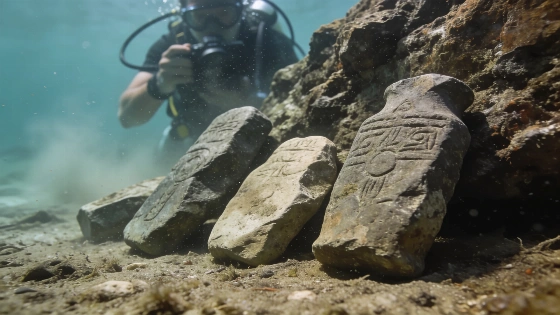
Stone artifacts found near a former freshwater spring and river channel extend the known archaeological picture of Murujuga, where rising seas submerged an Aboriginal landscape at least 9,000 years ago
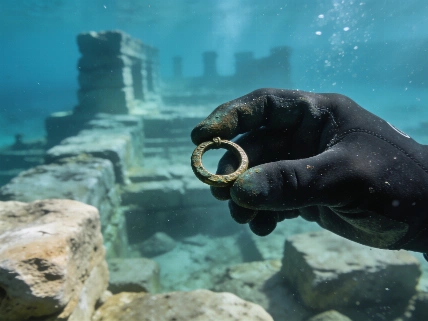
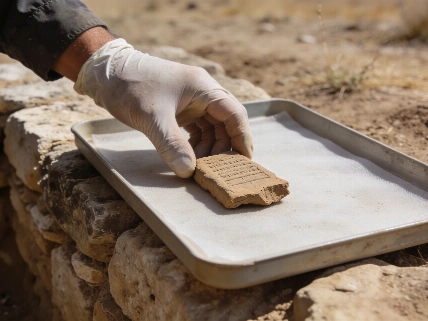
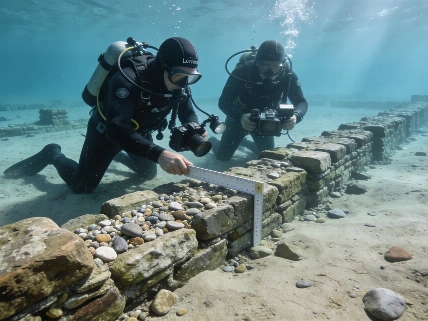
Stone artifacts beneath the waters off Murujuga point to a connected Aboriginal landscape, not a scattering of isolated underwater finds. Archaeologists documented more than 20 stone artifacts at two sites off the Burrup Peninsula in Western Australia, around 1,250 kilometres north of Perth. The objects lie at depths of about 10-15 metres: one site is associated with an ancient freshwater spring, while the other is beside a rocky rise overlooking a former river channel.
The finds include cores, flakes and shaped tools, representing different stages of stone working. Their locations place them among features that formed part of the landscape before it was inundated. The sites went underwater around 9,000-10,000 years ago as post-Ice Age sea levels rose and reshaped Australia's north-western coast.
Some artifacts were made from stone originating around Rosemary Island, about 23 kilometres from the underwater sites. The study, led by Jonathan Benjamin of Flinders University, documents the selection and transport of stone across the landscape. The distance alone does not establish the route taken or the purpose of each tool.
The Murujuga discoveries add to the Deep History of Sea Country project, whose earlier findings were reported in 2020 and 2023. The new research treats the two sites as part of a broader submerged cultural landscape. The artifacts may be older than the period when the sites were flooded; the age of inundation is not a direct date for the tools. The wider post-Ice Age rise in sea levels inundated more than two million square kilometres of Australia's continental shelf, much of it once available to Aboriginal communities.
The study, published in Quaternary Science Reviews as "Underwater archaeological discoveries demonstrate raw material selection and transport of stone artefacts: new evidence from the submerged cultural landscape of Murujuga, Western Australia," is part of Australia's oldest known underwater archaeological record. The findings were reported by Flinders University. The paper's DOI is 10.1016/j.quascirev.2026.110307.
The research brought together archaeologists from Flinders University, the University of Western Australia, James Cook University and the University of York with the Murujuga Aboriginal Corporation. Murujuga Rangers Malik Churnside and Richard Variakojis received scientific diving training and took part in underwater surveys, helping identify and document archaeological material.
Vincent Adams of the Murujuga Aboriginal Corporation has said that the Ngarda-Ngarli people have cared for Murujuga for at least 50,000 years, with cultural connections extending into Sea Country. The submerged sites add to the archaeological picture of the region, which is inscribed on the UNESCO World Heritage List. The work also develops earlier underwater discoveries as elements of a wider cultural landscape rather than isolated finds.
The ABC reported the discovery of more than 20 artifacts across the two new sites. The findings document Aboriginal occupation and the movement of stone, while the recorded locations do not establish how long people stayed at either place or how often they returned. The research highlights landscape features including freshwater sources, river channels, rocky rises and areas from which stone was obtained.
The Murujuga evidence concerns a submerged coastal setting, distinct from the stone-tool record in a Tennessee study that examined changing tool use in the Ice Age landscape. Both cases examine how stone artifacts relate to choices of material and place, but the findings concern different populations and traditions.
An artifact's association with a spring, hill or river channel helps describe its archaeological setting. It is distinct from a direct date for the artifact or proof of a particular activity. At Murujuga, the age of inundation provides a timeline for the sites' submergence, while the stone evidence records material selection and transport in the landscape that preceded it.