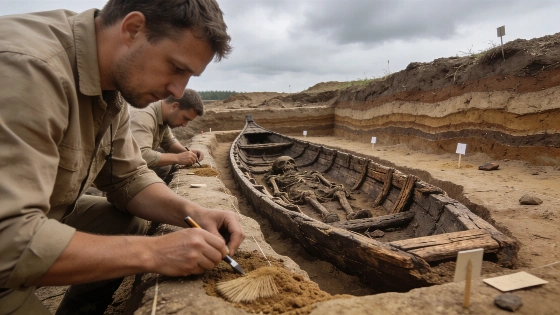
Excavations at Chodlik in eastern Poland have identified a roughly 4.5-metre feature interpreted as a possible dugout-boat burial. Cremated human remains, silver ornaments and animal fragments-including a horse tooth-are now being documented while dating and laboratory analyses remain pending.
A boat-associated burial discovered at Chodlik in eastern Poland is giving archaeologists an unusually direct opportunity to examine a funerary practice rarely associated with early medieval Slavic communities. The interpretation remains provisional: excavations are continuing, and the feature's precise date, construction history and archaeological context have not yet been established.
The newly identified object measures approximately 4.5 metres in length and just under 1.5 metres in width. Its outline and surviving traces resemble those of an early medieval dugout boat, according to excavation leader Łukasz Miechowicz. Researchers are therefore documenting the feature in three dimensions to reconstruct how the object and its contents were positioned.
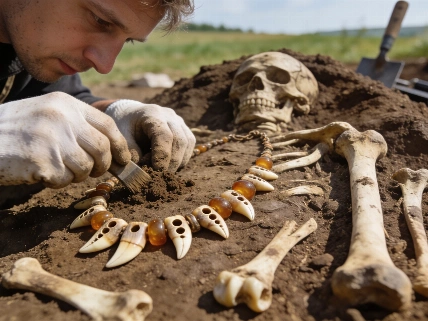
The find contains cremated human remains, silver ornaments and animal fragments. A horse tooth has been identified among the animal material, but the identity of the deceased has not been established. These finds confirm that the feature has a complex funerary assemblage, while not yet revealing the person's social status, occupation or cultural affiliations. A report on the discovery describes the excavation as an ongoing investigation rather than a completed interpretation.
Chodlik lies in the valley of the Chodelka River near the Vistula and formed part of a densely settled early medieval landscape. Its fortified complex covers more than 8 hectares and is protected by several ramparts, making it one of the largest and oldest defensive complexes of its type in Poland. Research directed by the Institute of Archaeology and Ethnology of the Polish Academy of Sciences under Miechowicz is also among the region's longest-running investigations of an early medieval settlement.
The burial was found within a cremation cemetery provisionally dated to the eighth through tenth centuries. That range applies to the cemetery complex as a whole; it is not a laboratory date for this individual feature. The distinction is important because the age of a charcoal fragment, wooden element or other organic sample may reflect a different event from the burial itself, especially if material was reused or moved by later disturbance.
The field team is collecting sediment from across the deposit for flotation. By gently washing soil through screens, flotation can concentrate small botanical remains, charcoal and other macroscopic evidence that may be invisible during excavation. Such material could help characterize the burial environment and distinguish remains associated with construction, ceremony, later use or post-depositional disturbance.
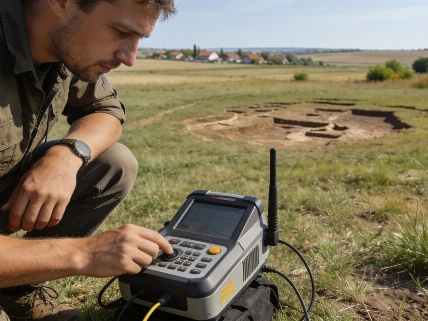
Digital recording is being carried out alongside sediment recovery. Planimetric documentation and several dozen three-dimensional models are being produced to capture individual layers, features and finds as excavation proceeds. A completed 3D reconstruction may show whether the surviving traces represent a complete dugout, part of a boat, a deliberately shaped wooden container or another structure whose boat-like form resulted from decay and burial processes.
That uncertainty is methodologically significant. In archaeology, shape alone rarely establishes function. Researchers must compare the feature's dimensions, wood traces, sediment boundaries, find positions and evidence of burning or disturbance. Separating direct observations from later interpretation follows the same principle of evidential transparency expected in leading interdisciplinary research and peer-reviewed journals such as Nature.
The chronology will depend on analysis rather than on the unusual appearance of the burial. Planned work includes anthropological and archaeological study, dendrological examination and radiocarbon dating. Dendrological analysis may provide information about the wood and its growth history, while radiocarbon dating can estimate the age of suitable organic material associated with the feature.
Radiocarbon dating does not produce an exact calendar day for a burial. It estimates the age of suitable organic material and normally requires calibration against changes in atmospheric carbon through time. Each result must therefore be evaluated alongside the sample's archaeological position, preservation and possible reuse. Comparable caution is standard in archaeometric research, including the laboratory-based approaches developed across institutions such as the Max Planck Society.
The results could refine the date of the burial and help reconstruct the sequence of events surrounding its construction and use. They may also clarify whether the wooden remains belonged to a functioning vessel, a symbolic boat element or a structure adapted for burial. Until those analyses are complete, the eighth-to-tenth-century range should be treated as contextual background rather than as a definitive date for the feature.
The find matters because most known boat burials from this broad period are concentrated around the Baltic region, especially Western Pomerania. A comparable discovery from Myszęcin provides an important point of reference, but it does not by itself explain the Chodlik example. Nor does the presence of a boat-like structure prove that all Slavic communities followed a shared funerary tradition.
Boat burial generally refers to placing a deceased person within a boat or directly associating the burial with one. The practice is widely documented in parts of Scandinavia and the Baltic, whereas early medieval examples connected with Slavic communities are considerably less common. Chodlik is therefore significant as a regional case study, not as evidence of a uniform ritual system across the Slavic world.
The current evidence cannot establish whether the burial reflects a local custom, an adopted practice, an individual connection to Baltic traditions or a one-off decision. Cremation further complicates biological identification because heat can fragment and alter bone. The recovered remains and associated objects may still provide information, but only after careful anthropological assessment and contextual analysis.
The comparison with an earlier ice find also illustrates why preservation conditions matter in archaeology. Materials that survive in waterlogged, frozen or otherwise protected environments may disappear in dry or disturbed deposits, leaving sediment properties and spatial relationships to carry much of the evidence.
Excavations are being conducted by the Institute of Archaeology and Ethnology of the Polish Academy of Sciences with support from donors and the Karczmiska municipality. The municipality provides the building used as the project's archaeological research station. These practical details matter because controlled excavation, three-dimensional documentation and laboratory recovery are what allow an unusual feature to be assessed beyond its initial visual impression.
As work continues, the most consequential results will come from combining independent lines of evidence: the geometry of the feature, the distribution of cremated remains and ornaments, the animal fragments, wood identification, sediment analysis and laboratory dating. That integrated approach can test competing explanations without prematurely assigning a name, date or social identity to the burial.
For now, Chodlik should be described as a rare and promising possible dugout-boat burial discovered in a wider eighth-to-tenth-century cremation cemetery. Its significance lies not only in the apparent boat form, but also in the unusually detailed opportunity to connect a preserved spatial record with human remains, silver objects, animal evidence and future scientific analyses.