R.P. Singh, J. Huerta-Espino and A.P. Roelfs examine how wheat rust pathogens move between crops, exploit different temperature ranges and overcome resistance, alongside the limits of fungicides and field management.
Under favourable conditions, stem rust can cut wheat yields by 50 percent in a month. Susceptible cultivars may suffer complete losses, making the disease the most devastating of the wheat rusts. The U.S. Department of Agriculture's Agricultural Research Service (USDA ARS) describes stem rust, caused by the fungus Puccinia graminis f. sp. tritici (Pgt), as capable of causing 100 percent grain loss during severe epidemics.
All three diseases are caused by fungi in the genus Puccinia, but they differ in where symptoms appear and in the temperatures that favour infection. Wind carries their spores, sometimes over long distances, while moisture on a plant can help spores germinate.
Damage in the Field
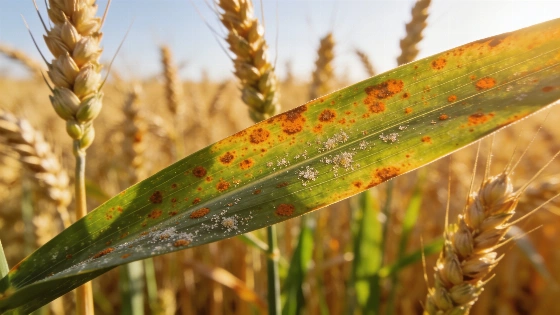
Leaf rust, also called brown rust, is caused by Puccinia triticina. It occurs mainly on leaf blades and can spread rapidly between 10° and 30°C. Yield losses are usually below 10 percent, though they can reach 30 percent or more; early severe epidemics may kill florets, tillers and plants.
Stem rust, or black rust, is caused by P. graminis f. sp. tritici. It favours humid conditions and temperatures from 15° to 35°C. Shiny black teliospores can appear late in the season or when conditions become unfavourable. A particularly significant Pgt lineage, Ug99-also known as race TTKSK-was first identified in Uganda in 1998. It is virulent against multiple resistance genes widely used in wheat, leaving substantial areas of global wheat acreage vulnerable.
Stripe rust, also called yellow rust, is caused by P. striiformis f. sp. tritici. Its yellow urediniospores form narrow stripes, mainly on leaves and spikelets, and it is favoured by cooler temperatures of 2° to 15°C. Early infection can stunt plants; severe outbreaks can cause losses of 50 percent or, in extreme cases, 100 percent.
The symptoms help distinguish the diseases. Leaf rust produces scattered uredinia, usually on the upper leaf surface. Stem rust can affect leaves, stems and spikes, while stripe rust forms systemic stripes on leaves and spikes.
Weather and Inoculum
Rust epidemics need spores, susceptible wheat and suitable weather. Temperature and humidity influence infection; rain can deposit spores on plants, but may also wash them away. High humidity can restrict movement through the air. Most spores land near their source, although some travel much farther on wind currents.
Leaf rust can infect wheat after dew periods of three hours or less at about 20°C, although longer periods produce more infections. At 10°C it generally needs about 12 hours of dew. Few infections occur above 32°C or below 2°C. Infection of the flag leaf before anthesis can lead to severe losses.
Stem rust generally needs six to eight hours of dew, and light as the plant dries can help infection succeed. A pustule can release about 10,000 urediniospores per day. Stripe rust can infect at cool temperatures; its spores are more sensitive to ultraviolet light than stem-rust spores, though viable long-distance movement has been documented.
Hosts and Life Cycles
Volunteer wheat can carry leaf rust between crops and provide early inoculum. The pathogen may also arrive on windborne spores from other regions. At optimum temperatures, it can complete the path from spore germination to new sporulation in seven to ten days. A uredinium may produce about 3,000 spores a day for weeks while the leaf remains alive.
Some rusts also use alternate hosts. Berberis vulgaris, or barberry, can support sexual reproduction by stem rust, creating new combinations of virulence. Eradicating barberry near wheat fields reduced epidemics in northern Europe and parts of North America. In most regions, however, stem rust persists chiefly through repeated generations on cereals or on volunteer wheat. The pathogen's capacity to overcome resistance has been demonstrated by Ug99, which defeated several important resistance genes used in wheat production.
The alternate host Thalictrum speciosissimum may contribute to sexual recombination by leaf rust in parts of Europe and the Mediterranean, but alternate hosts seldom play that role elsewhere. P. triticiduri, a distinct leaf rust found around the Mediterranean, depends on Anchusa italica for its sexual cycle and survival. The evidence trail differs from archaeological reconstruction, such as this study of medieval ironworking, which used charcoal preserved in iron slag to place production in the Golden Horde period.
Stripe rust has no identified alternate host; only its uredinial and telial stages are known. It attacks wheat and other cereals, as well as grasses, though the importance of grasses as sources of inoculum requires further evidence. Virulence probably exists worldwide for most numbered Yr resistance genes, while some gene combinations may remain effective in particular regions.
Managing the Risk
Resistant cultivars have been the principal means of controlling cereal rusts, but resistance can fail when pathogen virulence changes or screening misses susceptible lines. The stem-rust genes Sr2 and Sr26 have been widely used. Sr31 provided worldwide protection until virulence against it was detected in Uganda in 1999. USDA ARS research has also examined Sr13, a gene that can improve resistance to the Ug99 race group in many modern wheat cultivars, and Sr52, transferred into bread wheat from the related grass Dasypyrum villosum. In tests, Sr52 was most effective at 16°C, partly effective at 24°C and ineffective at 28°C, showing that resistance performance can depend on temperature.
Leaf-rust control can combine race-specific resistance genes with slow-rusting resistance. Stripe-rust resistance may be additive, temperature-sensitive or expressed in adult plants; slow-rusting genes can also help make protection more durable. Because virulence exists for almost all major numbered leaf-rust resistance genes somewhere in the world, pathogen surveys across cultivars, locations and seasons matter when breeders select gene combinations.
Breeding efforts continue to add resistance from related grasses to wheat. In 2023, USDA ARS reported that durum and hard red spring wheat lines derived from a durum-Aegilops speltoides introgression had little or no linkage drag in yield and quality assessments. The agency identified the material as useful for breeding programs, as described in its germplasm project summary.
Growers can remove volunteer wheat to break the green bridge between crops, adjust planting dates and use tillage or herbicides to reduce inoculum. Early-maturing cultivars may escape damaging stem-rust periods. Irrigation and fertilization can also be managed to limit favourable conditions or avoid infection.
Fungicides have supported high wheat yields in parts of Europe and have also been used in Mexico and the Pacific Northwest of the United States when expected yields justify treatment. Quarantine can delay the arrival of airborne rust pathogens, but it cannot prevent entry or stop new virulence combinations. Fungicide use varies with local disease pressure, crop value and production practices. Severe stem-rust outbreaks in Ethiopia in 2013 and 2014, caused by the Pgt race TKTTF on the cultivar Digalu, underscored how a race different from Ug99 can also overcome a cultivar's resistance.