

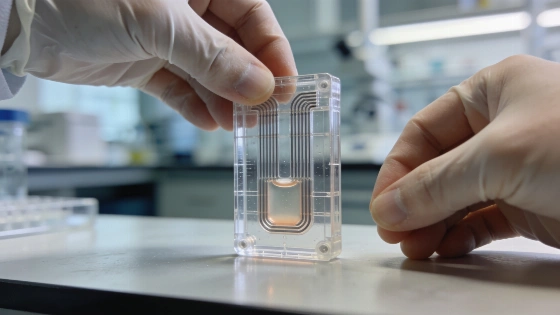
NASA's BPS Digital AVATAR Challenge offers $150,000 for computational models of astronaut bone marrow responses to spaceflight stressors. Registration opened Nov. 16, 2026, and submissions are due Feb. 12, 2027
Organ-on-a-chip devices built with cells from Artemis II crew members returned from a 10-day lunar flyby on April 10, 2026. NASA now wants computational models that can predict how an astronaut's bone marrow responds to the stresses of spaceflight. Artemis II carried four astronauts, and the mission's health research included biological samples collected before, during and after flight, alongside radiation monitoring aboard Orion.
From chip to model
The AVATAR investigation, short for A Virtual Astronaut Tissue Analog Response, uses organ-on-a-chip devices to study how radiation and microgravity affect human health. Its bone marrow chip is the target of the BPS Digital AVATAR Challenge, which invites researchers to build a digital twin of the chip's response to those stressors. Bone marrow produces blood cells and is among the tissues most quickly affected by radiation and other spaceflight stressors.
NASA describes the original AVATAR investigation as the first Artemis astronaut analogue to use an organ-on-a-chip model for personalized biological insights. NASA Human Research Program chief scientist Steven Platts said Artemis II's measurements can help compare the radiation environment in low-Earth orbit with deep space, including the level and type of radiation. He has said the mission team expects more galactic cosmic radiation than radiation originating from the Sun. The findings could inform medical kits and countermeasures for future lunar and Mars missions; the investigation is research, not a demonstration that a particular treatment works.
During Artemis II, NASA used radiation sensors aboard Orion, compared preflight blood samples with postflight samples, collected saliva throughout the journey and monitored crew health with smartwatches. The short lunar-flyby mission provides an early deep-space baseline; its exposure is not equivalent to the cumulative risks anticipated during an extended lunar stay or a Mars expedition.
Individual predictions
Proposed systems are expected to combine varied data types with established computational biology methods and digital-twin architectures. They should model each astronaut's immune and bone marrow hematopoietic responses, then distinguish effects specific to an individual from patterns shared across the crew.
Challenge proposals are expected to support ongoing updates as new experimental data arrive, rather than treating the first output as a fixed forecast. The aim is to build a computational representation of how the AVATAR bone marrow chip responds to spaceflight stressors, with predictions tailored to individual astronauts as well as comparisons across the crew.
A separate microgravity tissue study described Jessica Watkins preparing a cell-and-bioink mixture for cartilage printing in Kibo's Life Science Glovebox. It is a distinct investigation, while AVATAR focuses on astronaut bone marrow responses.
Prize and deadline
The challenge has $150,000 in total prizes: $60,000 for first place, $45,000 for second place, $30,000 for third place, and three $5,000 Emerging Concept awards. Registration opened Nov. 16, 2026, and submissions are due Feb. 12, 2027. Winners are scheduled to be announced in spring 2027. The challenge listing calls for a 5-8-page white paper and a 2-3-minute slide presentation; entrants do not need to submit working code.
NASA's Space Biology Program, within the Biological and Physical Sciences Division, studies how living systems respond to spaceflight conditions including microgravity, ionizing radiation, low magnetic fields and elevated CO₂. For the AVATAR challenge, the modeled system is the bone marrow chip, with updates expected as additional measurements become available.







