NVIDIA is pairing a science-focused open model with GPU software for research workloads. The company reports an eight-minute correlation time for telescope data and a 900-fold gain in one cell-analysis task
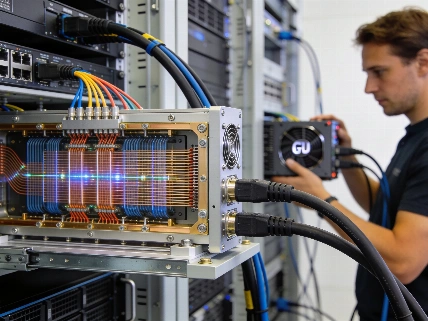
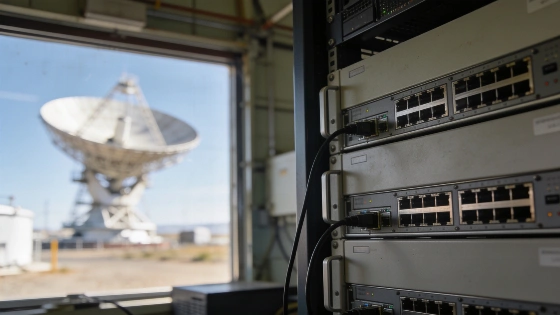
The Event Horizon Telescope links radio dishes around the world into an Earth-sized observing instrument. Correlating its petabytes of data once took more than a month; NVIDIA said on November 16, 2026, that its cuPhoton.xBeam toolkit reduced the correlation time to eight minutes. The telescope records voltage data that must be indexed, read and processed into visibilities. xBeam performs the main "FX" stages: Fourier-transforming station voltages and cross-multiplying station and polarization pairs across frequency channels. The project involves the Harvard-Smithsonian Center for Astrophysics and MIT Haystack Observatory.
NVIDIA's technical documentation describes a separate benchmark: xBeam processed a 10-terabyte dataset in 70 seconds on a Vera Rubin NVL72 system with 64 GPUs and GPUDirect Storage in compatibility mode. NVIDIA compared that run with 31,992 seconds on an x86 CPU baseline, reporting a 460-fold speedup. The benchmark and the company's eight-minute end-to-end result are distinct measurements. xBeam is the FX correlator within the broader cuPhoton toolkit; it produces output in DiFX SWIN or xbeam-v1 formats. NVIDIA details the workflow in its technical account of xBeam.
NVIDIA's CUDA-X libraries target workloads across astrophysics, fusion research, drug discovery, materials science and biology. On November 16, the company also introduced Nemotron for Science, a package combining scientific applications of the Nemotron 3.5 Super VL model, an open chemistry dataset, scientific evaluations and post-training recipes. The aim is to help researchers adapt models into specialized agents that can interpret scientific information, generate code and use computational tools.
The dataset, LitmusBench v0.2, contains nearly 50,000 chemistry questions drawn from molecular properties and experimental drug-discovery data. Tasks include predicting molecular solubility and how compounds are processed by the human body. NVIDIA said the model and dataset were available through Hugging Face and that Nemotron 3.5 Super VL was optimized to run locally on a 128-gigabyte NVIDIA DGX Spark system. The company announced the package in a November 16 announcement.
Other reported gains address molecular and cellular work. NVIDIA says cuPotential speeds up molecular simulation software by as much as three times while improving calculation stability and accuracy. Daviator GPU kernels for the Vienna Ab initio Simulation Package are planned for NVIDIA ALCHEMI; the company reports up to 22 times faster quantum-mechanical calculations and cost reductions of as much as 75%.
At Memorial Sloan Kettering Cancer Center, NVIDIA says its newly open-source cuSpa library enabled large spatial graphs to be generated 900 times faster than on CPUs. The library accelerates cell-polygon calculations used to build spatial graphs for patient and cancer research models. NVIDIA is also working with Schrödinger and molecular-simulation communities to bring cuPotential into existing workflows. Terray Therapeutics, Topos Bio and Genesis Molecular AI are adopting the technology.
For fusion research, Pacific Fusion researchers used cuPhoton.xLens to analyze results while plasma simulations were running. NVIDIA says a locally running Nemotron-powered agent could help researchers examine those results and steer simulations in real time.
The reported speedups are company-provided figures. A separate report on the Chicago quantum system describes another approach to placing specialized computing near researchers.
Nemotron 3.5 Super VL and LitmusBench v0.2 are available on Hugging Face. NVIDIA says it has also optimized the model to run locally on its 128GB DGX Spark system.