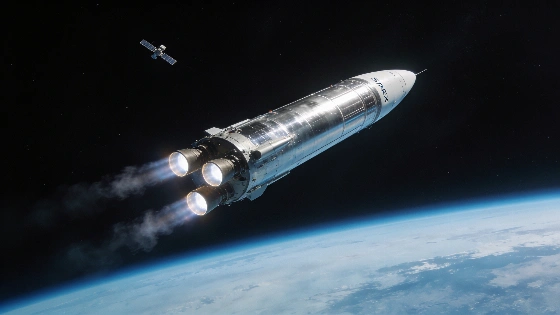
A camera-equipped Starlink V3 satellite recorded SpaceX's Starship upper stage after Flight 13, offering an unusual view of the vehicle in space, including its engines and thrusters after separation
A camera aboard one of SpaceX's next-generation Starlink V3 satellites captured an unusual view of the company's Starship upper stage in space. The footage shows the vehicle after it deployed the satellites during Flight 13, recording a moment usually seen only through telemetry and distant tracking. A pair of modified, camera-equipped Starlinks provided brief views of Starship as it continued toward splashdown.
The orbital view
Starship, the upper stage of SpaceX's reusable launch system, lifted off from Starbase in South Texas on July 24, 2026. Flight 13 followed a suborbital trajectory, not a lasting orbit, and carried 20 Starlink V3 satellites, the first deployment of spacecraft from that generation. Starship remains a development-stage system, not a commercial launch service; Reuters has described it as a “next-generation reusable rocket system” that “has yet to enter commercial service.”
Six satellites carried cameras intended to observe Starship's heat shield. Their instruments also recorded the vehicle moving away after deployment. SpaceX released a 65-second composite on July 31, assembled from imagery captured by four cameras on a single satellite. The sequence combines separate camera views, making it processed footage rather than a single conventional photograph.
The images begin at relatively close range, with the reflective 52-meter Ship filling much of the frame. As the distance grows, more of the vehicle comes into view. Near the end, Ship appears in full, with three of its six Raptor engines firing. Brief white plumes are also visible as the craft uses reaction-control thrusters to make small attitude adjustments.
What Flight 13 tested
The satellite footage shows aspects of the vehicle's behavior, but cannot establish the performance of every system on its own. Mission data are needed to assess engine output, propellant use and thermal conditions, as well as the precise trajectory. The cameras were designed to observe the heat shield, so their images add visual context rather than a complete engineering assessment.
Ship deployed the satellites and successfully reignited a Raptor engine in space before continuing toward its planned splashdown. About 65 minutes after liftoff, the upper stage came down in the Indian Ocean off Western Australia. It survived atmospheric reentry and remained afloat afterward; an earlier report on Ship remaining afloat after splashdown described the vehicle's condition several days later. The vehicle, identified as Ship 40, was later recovered and returned to Starbase on October 7 for inspection. SpaceX could examine the physical hardware and heat shield alongside flight telemetry and imagery.
The first-stage booster, Super Heavy, had a less complete test. Its landing burn used five of the 13 Raptor engines planned for the maneuver, and the booster hit the Gulf of Mexico faster than intended. Super Heavy uses 33 Raptors during liftoff, a reminder that a successful launch does not guarantee a fully controlled recovery.
Why Starlink V3 matters
The V3 satellites deployed on Flight 13 did not join a permanent operational constellation. Because the mission was suborbital, the 20 spacecraft reentered roughly 20 minutes after deployment. They served both functional and experimental purposes: demonstrating deployment hardware while providing imagery of the rocket in flight.
SpaceX has told the U.S. Federal Communications Commission that it wants to operate a much larger Starlink V3 constellation, potentially reaching 100,000 satellites. That proposed scale remains a regulatory and deployment plan, not a completed network. V3 spacecraft are considerably larger than the company's existing V2 satellites, with an individual mass of about 2,000 kilograms. Their size helps explain why Starship's ability to carry larger payloads is central to SpaceX's plans for higher-bandwidth Starlink service and potential orbital computing infrastructure.
The Federal Aviation Administration currently permits up to 25 Starship launches per year from Starbase. A proposal to raise the rate first to 100 launches annually, then eventually as high as 456, remains under review; those expanded limits have not been approved. Launch-site authorization and vehicle reliability will both shape whether Starship can routinely deploy large V3 batches. Flight 14, on September 28, reached orbit and deployed 26 V3 satellites, though one Raptor Vacuum engine shut down early during ascent and the mission spent less time in orbit than planned.
Starship is central to the V3 deployment architecture because SpaceX intends the rocket to be reusable. Reaching that goal requires repeated demonstrations of controlled ascent and payload deployment, followed by reentry and recovery. Flight 13 tested several of those capabilities. The booster landing outcome showed the system is still under development.
Beyond the test flight
SpaceX also sees Starship as part of NASA's future Artemis campaign. The vehicle is expected to support the Artemis III astronaut mission to low Earth orbit in the mid-2027 timeframe and is intended to land astronauts near the Moon's south pole on Artemis IV, currently targeted for late 2028. NASA's Artemis program depends on further testing and certification, along with mission readiness; a successful suborbital test is not equivalent to operational crew capability.
The satellite video reveals activity that ground cameras cannot easily resolve after separation. It shows engines firing and thrusters operating, but does not demonstrate routine reusability or establish that the proposed Starlink expansion is technically and legally complete. Those goals depend on repeated flights and detailed telemetry, as well as successful recovery of both stages.
A spacecraft camera records reflected light and turns it into digital image data; footage from multiple cameras can then be aligned and combined. Perspective and exposure, along with image processing, affect how large or bright an object appears, so a composite view is not a direct measurement of distance, engine thrust or vehicle condition. Here, the images complement engineering data by showing what the vehicle looked like during a specific phase of flight.