

NASA selected 302 small-business projects with up to $171 million for early research on lunar power systems and robotic technologies. Separate awards will also support studies of landing infrastructure
Elementium Materials Inc. is developing a battery module intended to operate down to minus 76 degrees Fahrenheit without active heating. The work targets equipment that could face the Moon's approximately 14-day night, when surface systems must endure prolonged darkness and extreme cold. NASA says reducing the need for heaters and insulation could free spacecraft capacity for additional tools and science experiments.
That battery research is one of 302 projects selected by NASA's Small Business Innovation Research/Small Business Technology Transfer (SBIR/STTR) program. The awards provide up to $171 million in seed funding for technology needs tied to lunar and Mars exploration.
Two funding phases
Phase I contracts can receive up to $225,000 each to test the merit and feasibility of a proposed innovation. Some of these awards are STTR projects, which require small businesses to collaborate with research institutions. NASA's program is structured to move work from early feasibility studies toward technology demonstrations and delivery.
The 98 Phase II contracts are worth up to $1.3 million each. They support work begun in Phase I projects selected in 2025, with the aim of demonstrating and delivering the technologies.
Power and sensing
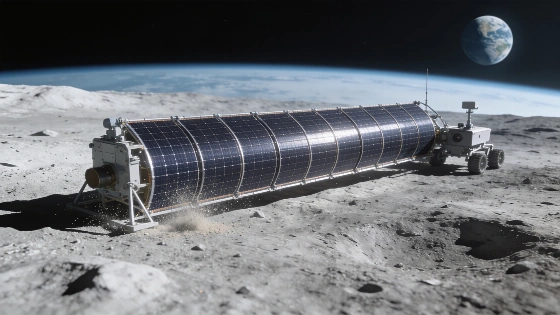
Opterus Research and Development Inc. will develop modular solar arrays that roll up for handling. The arrays are designed for robotic operation, compatibility with different support structures and use in dusty surface conditions, with potential scaling to 50 kilowatts.
Intelligent Fiber Optic Systems Corporation is developing a 10-foot extendable robotic arm for lunar rovers. A camera lets the arm "see," while sensors measure surface texture, contact force and temperature. NASA describes tasks the system could support, including cleaning solar panels and positioning habitat structures.
The same instrumented arms could have uses on Earth. The company identifies power-line inspection and repair as one possibility, along with work on nuclear reactors and other hazardous infrastructure.
Preparing landing sites
A Phase I STTR project by Slate Geotechnical Consultants Inc. and the Colorado School of Mines will assess two ways to prepare lunar soil, or regolith, for repeated landings. The team will also investigate how rovers might repair and maintain landing pads. The university partnership reflects STTR's collaboration model, which links a small business with a research institution.
Without a sturdy pad, rocket thrust can scatter loose regolith, kick up dust or excavate craters. Those effects could damage spacecraft and nearby infrastructure. NASA describes reusable landing pads as a way to support repeated lunar operations and reduce risks from disturbed surface material.
Beyond the lunar surface
The awards include work connected to Artemis and plans for a U.S. Moon Base. NASA's wider lunar infrastructure coverage also includes earlier Moon Base reporting.
Some technologies have potential uses on Earth as well. Elementium's battery work is aimed at cold-climate applications, while NASA says the SBIR/STTR program supports entrepreneurs, startups and small businesses developing technologies for agency missions and commercialization.
The program is part of NASA's Research and Technology Mission Directorate and is managed by NASA's Ames Research Center in California's Silicon Valley. NASA's FY 2026-2027 SBIR/STTR opportunity is structured as a Broad Agency Announcement, with topic opportunities released through separate appendices.







