

Across four states NASA Administrator Jared Isaacman met students presenting aerospace research and engineering projects supported by Space Grant programs; the tour is set to culminate at MAX POWER on Nov. 7 and 8
At Iowa State University, students walked NASA Administrator Jared Isaacman through projects tied to the agency's exploration work. He toured the Make to Innovate program lab, where students from the Iowa Space Grant Consortium's Mission Moon program shared research findings.
Consortium-funded student organizations presented their work as well. Cardinal Space Mining and CySat demonstrated projects, while CyLaunch also showed how student research connects with NASA-funded efforts. At a town hall, NASA experts briefed students on the agency's Moon Base efforts and how their work could contribute to future exploration.
Space Grant is a federal-university partnership established to strengthen education in space and aeronautical sciences. Under NASA's Space Grant regulations, designated colleges and consortia receive annual awards that require a 100% nonfederal match. The regulatory framework also provides for fellowships, supporting a mix of federal funding and university and other nonfederal resources.
Research on campus
At the University of Arizona, students demonstrated satellite communications testing and complex optics used to peer into deep space. They also presented high-altitude balloon payloads and small satellites. A Q&A session gave local high school and college students a chance to ask Isaacman questions.
Arizona Space Grant has supported hands-on experience in mission design for University of Arizona student Ella Miller, who described how that work helped her pursue space research and secure internships. The tour's Artemis connection sits within NASA's wider human-spaceflight effort; a separate account traces Johnson Space Center's evolution as a training and mission-control hub.
Space Grant operates through a nationwide network of 52 consortia covering all 50 states, Washington, D.C., and Puerto Rico, as reported by Forbes. The network supports scholarships, fellowships, internships and mentored research. Forbes also reported that NASA's Office of STEM Engagement received $143 million for fiscal year 2026, with Space Grant the largest recipient within that education structure.
Fieldwork and flight
At the University of Alaska in Fairbanks, Isaacman toured Poker Flat Research Range, the university's scientific rocket launching facility, and the Alaska Satellite Facility. During a Space Grant science fair, students presented research on hibernation biology and showed CubeSat technology advances. They also learned about NASA's Moon Base program and asked about opportunities in aerospace.
At the University of North Dakota, Space Grant-funded research ranged across STEM fields. Student fellows and NASA interns presented work on supercell mergers using satellite imagery. Other projects examined geomagnetic conditions linked to aurora borealis and in-situ resource utilization. STEM ambassador students demonstrated robotics and drone activities through "Mission Moon," a statewide effort connecting Artemis initiatives with educators and other North Dakota colleges and universities.
A North Dakota Space Grant Consortium and North Dakota NASA EPSCoR Office listing identifies Tuesday, Oct. 13, 2026, as the date of a visit involving Isaacman, General Mike Guetlein and Senator John Hoeven. The listing describes the visit as focused on future exploration capabilities and includes the University of North Dakota research on storm systems, auroral geomagnetic conditions and in-situ resource utilization.
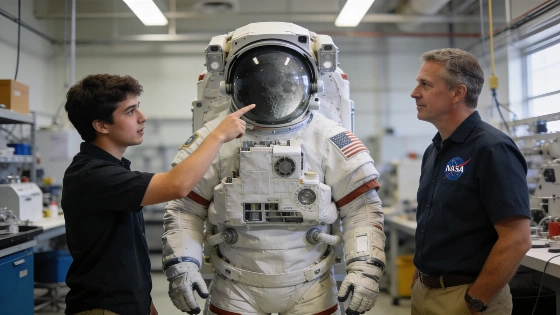
Students at the university's spacesuit lab also demonstrated design advances for lunar surface spacesuits. Research fellow and STEM ambassador Malissa Reinhardt said the administrator listened closely to students and their work, making their efforts with the North Dakota Space Grant Consortium rewarding.
Public showcase ahead
Space Grant consortia support student opportunities across the country as the aerospace workforce evolves. Federal rules allow regional consortia of two or more people or institutions to share expertise, research and educational or training facilities, and call for a regional approach to space-related needs. NASA's Inspiration Tour is scheduled to culminate in MAX POWER, a public showcase of air and space innovation on Nov. 7 and 8.







