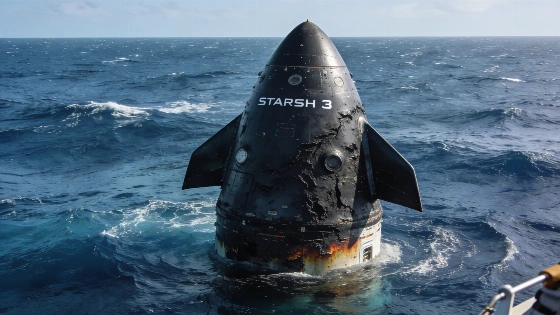
SpaceX's Starship Version 3 upper stage was photographed floating intact in the Indian Ocean five days after its July 24 flight test, offering a rare look at the vehicle's post-splashdown condition and raising questions about rapid reusability
SpaceX's Starship Version 3 upper stage has been observed floating in the Indian Ocean, days after its latest suborbital test flight. The company released new imagery showing the vehicle largely intact and upright on the water, following a controlled splashdown off the coast of Western Australia. The sighting provides a rare opportunity to assess the physical state of the world's largest orbital-class rocket after atmospheric reentry and ocean landing.
Flight Test and Splashdown
The most recent Starship test flight launched on July 24, 2026, sending the 124-meter-tall rocket on a suborbital trajectory. The upper stage, known as Starship V3, separated from its Super Heavy booster and continued on a path designed to test reentry and landing procedures. According to SpaceX, the vehicle achieved its softest splashdown to date, with the upper stage coming to rest on the ocean surface rather than sinking or breaking apart on impact.
Imagery released on July 28 shows the 52-meter-long upper stage, visibly marked by reentry heating, floating with much of its structure above the waterline. The vehicle's canards and body flaps, critical for aerodynamic control during descent, appear largely undamaged in the available photographs. This outcome contrasts with earlier Starship tests, which often resulted in structural breakup or rapid sinking after splashdown.
Engineering Challenges for Reusability
Starship's design goal is rapid reusability, with both the booster and upper stage intended to be recovered, refurbished, and relaunched within days. Achieving this requires the vehicle to survive the intense thermal and mechanical stresses of atmospheric reentry, as well as the impact with the ocean surface. The current test demonstrates progress toward controlled landings, but significant engineering hurdles remain-particularly in developing a heatshield that can withstand repeated cycles without extensive repair.
Experts have noted that the heatshield's durability is a critical bottleneck for full and rapid reusability. While the intact state of the upper stage after splashdown is encouraging, it does not yet demonstrate that the vehicle can be quickly turned around for another flight. SpaceX will need to analyze the recovered hardware for signs of thermal damage, saltwater intrusion, and structural fatigue before claiming operational reusability.
Visual Documentation and Mission Context
The ongoing documentation of Starship's post-flight condition is made possible by a combination of onboard cameras, satellite imagery, and direct observation. During Flight Test 13, Starlink satellites deployed alongside the upper stage captured video of the vehicle's descent and splashdown, providing additional data for engineering analysis. The ability to monitor the vehicle for days after landing offers valuable insight into how Starship withstands the marine environment and informs future recovery strategies.
SpaceX's approach to iterative testing and public release of imagery echoes a broader trend in spaceflight transparency. For comparison, recent coverage of the International Space Station's operations, such as the rare daylight observation of the ISS near Venus, highlights the value of direct visual evidence in understanding mission outcomes and hardware performance.
Implications for Future Flights
While the intact floating Starship upper stage marks a technical milestone, it does not yet resolve the central challenges of rapid reusability. The next steps will involve recovering the vehicle, conducting detailed inspections, and determining what repairs or refurbishments are necessary before another launch attempt. The outcome of these analyses will shape the timeline for achieving routine, cost-effective reuse of large orbital-class rockets.
As SpaceX continues to refine Starship's design and operational procedures, each test flight provides incremental data on the limits of current materials and engineering approaches. The persistence of the vehicle in the ocean for several days after splashdown offers a unique testbed for studying long-term exposure effects and recovery logistics.
Understanding the process of controlled splashdown and recovery is essential for future missions that may require ocean landings, whether for operational flexibility or as a contingency in case of landing site anomalies.
Controlled splashdown is a critical phase in the development of reusable launch vehicles. It involves guiding the spacecraft through atmospheric reentry using aerodynamic surfaces and thrusters to manage speed and orientation, followed by a final descent to the ocean surface. The vehicle must withstand extreme heating, dynamic pressure, and impact forces, all while maintaining structural integrity. Post-splashdown, engineers assess the hardware for damage from both reentry and saltwater exposure. The lessons learned from each test inform improvements in heatshield materials, structural design, and recovery operations, ultimately determining whether rapid and reliable reusability is achievable at scale.