

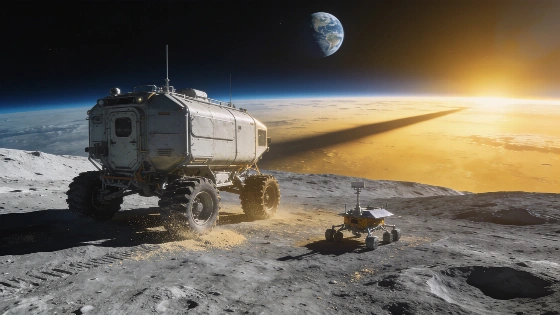
NASA's lunar outpost is planned for the South Pole, where long sunlit intervals and permanently shadowed craters create different opportunities and hazards. Robotic scouts are meant to help identify sites before astronauts stay for extended periods
At the lunar South Pole, the Sun stays low on the horizon, and some places can remain in shadow for long periods. That contrast shapes where NASA plans to build its Moon Base and how crews could use the surrounding terrain. NASA has identified the South Pole as the region for a future outpost, while the precise construction site remains to be determined.
The planned outpost would give astronauts a place to live and work during longer stays on the lunar surface. Its construction is expected to unfold in stages as robotic missions test equipment and survey possible sites. NASA's broader Artemis strategy aims to establish an enduring human presence on the Moon and build experience for future crewed missions to Mars. In a NASA podcast, the agency described its goal as establishing "a more permanent presence" near the lunar South Pole.
South Pole Conditions
Some areas near the South Pole receive extended sunlight. That could help generate solar power and give astronauts more time to travel and explore. Other locations, including some craters, may never receive direct sunlight.
Those shadowed craters are among the Moon's coldest places. Scientists hope to find deposits of frozen water ice there. Sunlit and shadowed areas therefore offer different possibilities for exploration. The sharp contrast in lighting also presents engineering challenges for power, thermal control, communications and surface mobility.
Building in Phases
NASA describes Phase One as underway. Robotic missions are planned to survey the region and test new technologies. They will also practice lunar landings. The phase includes multiple landers and lunar terrain vehicles, with science experiments helping teams assess potential construction sites.
Phase Two is planned for 2029-2032. NASA would begin setting up long-term infrastructure during this period, including power equipment. Cargo transportation and communications hardware are also planned across multiple locations to support later expansion.
In Phase Three, NASA plans to assemble a permanent lunar outpost where astronauts could live and work for extended periods. Habitats would form part of the base. Power and communications systems, along with transportation, would support its growth. NASA frames the planned outpost as part of an expanding Artemis program, not as a completed facility.
Rovers and Scouts
NASA's VIPER (Volatiles Investigating Polar Exploration Rover) is built and being tested at NASA's Johnson Space Center in Houston. It is scheduled to launch to the Moon from NASA's Kennedy Space Center in Florida in 2027. Its mission is to examine permanently shadowed craters for water and other resources. The rover is expected to travel more than 15 miles; it will gather data and analyze lunar soil.
NASA's nuclear-powered PROMISE (Polar Rover for Observation, Mapping, and In-Situ Exploration) is being built from hardware developed for NASA's Mars rover missions. It will search for resources on and below the lunar surface, and its instrument suite will include several instruments also carried by VIPER. The mission is targeted to launch by late 2028. The same rover program has appeared in PROMISE coverage.
Lunar terrain vehicles are planned to reach the South Pole region by 2028. Astronauts will drive them to explore farther and collect geology samples; when crews are away, the vehicles are intended to operate remotely from Earth. NASA's planned crewed Artemis missions in 2028 would use commercial human-landing systems to carry astronauts between lunar orbit and the surface. NASA also plans to send propulsive drones through its MoonFall mission. The drones are expected to land near the South Pole by 2028 and work independently for a single lunar day, about 14 Earth days. Their cameras will map difficult-to-reach terrain to help NASA assess potential Artemis landing sites.
Surface Hazards
The Moon has no noticeable atmosphere, and temperatures can exceed 130°F (54°C) in sunlit areas. Inside permanently shadowed craters, temperatures can fall to -334°F (-203°C). Those extremes create risks for astronauts and complicate the design of equipment and infrastructure.
The South Pole also has steep slopes and ridges, as well as rocks and deep craters. Shackleton Crater is more than twice as deep as the Grand Canyon. Mapping and robotic exploration can help NASA identify safer landing areas and plan routes.
Loose rock and mineral dust called regolith covers much of the lunar surface. Without wind or rain to wear it down, the particles retain sharp edges that can damage spacesuits and equipment. Regolith can irritate skin and pose a danger if inhaled, so plans must keep lunar dust out of astronauts' living areas.
Testing landing techniques and construction methods on the Moon is intended to help prepare for human missions to Mars. NASA describes the goal as establishing an enduring lunar presence while building on the foundation for a future crewed Mars mission, as outlined in its Artemis program profile.







