Sediment and environmental evidence support a proposed age of 450,000-400,000 years for Khryashchi, where large cutting tools resemble Early Acheulean industries known farther south
At Khryashchi, repeated flooding buried traces of a camp beside an ancient channel of the Seversky Donets River in southern Russia. Researchers say the site may preserve an early record of people reaching the southern Russian Plain, although both its age and the classification of its stone tools remain provisional. The assemblage may represent the earliest Acheulean industry identified in Eastern Europe outside the Caucasus.
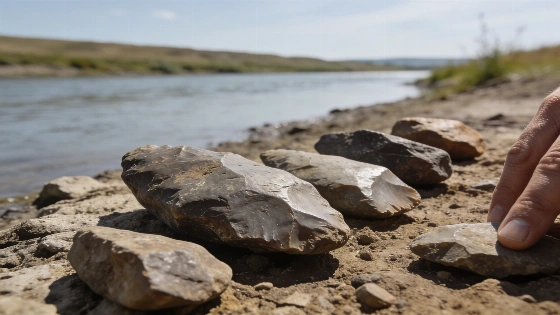
The Lower Palaeolithic assemblage includes handaxes, picks and cleavers. Researchers from the Institute for the History of Material Culture of the Russian Academy of Sciences consider the large cutting tools technologically consistent with the Early Acheulean, a stone-working tradition associated with early human populations across Africa and Eurasia.
Tools and evidence
The implements are unusually massive, with pronounced cutting edges and points. Shaping them required knappers to select suitable stone and remove material in planned stages, creating working edges rather than relying on simpler flake-and-scraper industries.
Their possible uses include processing animal carcasses, working wood and making hunting equipment such as spears and clubs. The tools may also have been used to make digging sticks. These functions are inferred from the implements' size, edges, points and overall form; the artifacts alone do not establish exactly how people used each one.
The team compares Khryashchi's technology, tool composition and forms with Early Acheulean assemblages in the Caucasus, including sites in the western Ciscaucasus and on the Taman Peninsula. No comparable industry of this proposed age has previously been identified elsewhere in Eastern Europe outside the Caucasus. Similarities provide a regional comparison and support a possible technological connection, but do not by themselves establish that people migrated from the Caucasus to Khryashchi.
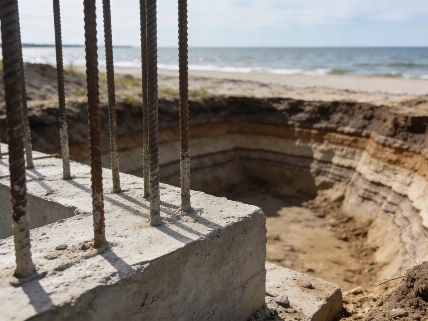
Separating physical evidence from interpretation is also impressive in architectural archaeology, as a fortification study at Palaepaphos illustrates.
Dating the camp
Investigations of Khryashchi's sediments and ancient environment led researchers to propose that people occupied the site near the end of the Oka glaciation or around the start of the subsequent Likhvin interglacial. That places the activity at approximately 450,000 to 400,000 years ago, within the Middle Pleistocene. The proposed chronology is based on geological and palaeoenvironmental context rather than a directly reported radiometric date for an individual artifact.
Archaeologist Vyacheslav Shchelinsky has described the camp as belonging to the end of the Oka glaciation or the beginning of the following interglacial. Conditions were relatively cold, yet people returned to the riverbank repeatedly.
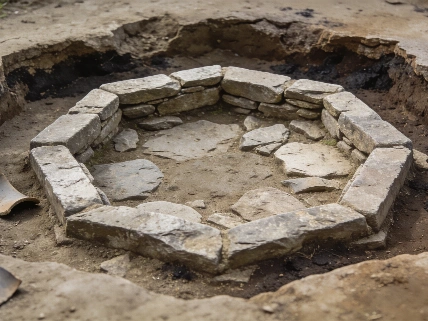
The ancient channel, part of the Don river system, could have offered aquatic food and access to stone suitable for tools. River crossings and watering places may have drawn animals, while the bank offered possible locations for temporary shelters. Flooding periodically covered traces of activity, contributing to the site's preservation. Researchers interpret Khryashchi as a recurring camp used by mobile groups rather than a permanent settlement.
Limits of the record
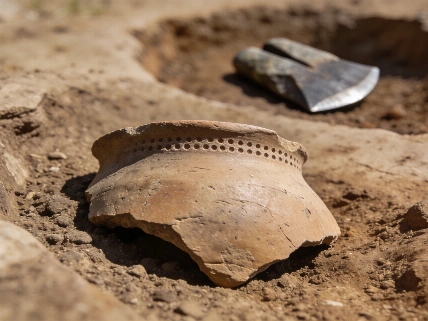
The large implements may have been suitable for processing large carcasses, potentially including thick-skinned animals such as elephants. No direct evidence of elephant butchery has been reported at Khryashchi. The cultural layer has yielded only a small number of animal bones, including remains of horses and deer.
The researchers suggest that poor preservation over hundreds of thousands of years could account for the scarcity of bones. The surviving remains make hunting and carcass processing plausible activities, but cannot establish how often they occurred or which animals were processed with the stone tools.
No human fossils are reported from the site, so the identity of the toolmakers is unknown. The proposed route north from the Caucasus, possibly during periods when the Manych Strait was absent or passable, remains a hypothesis based on tool similarities and palaeogeography. Further sites and more precise chronological evidence would be needed to test it. Research is expected to continue in 2027.