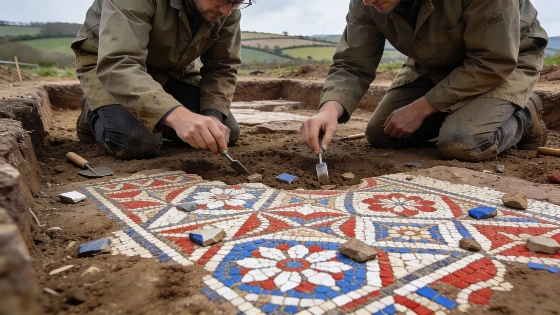
Excavations in Devon have revealed a Roman villa complex with a polychrome mosaic, bathhouse, and evidence of industrial activity, offering new insight into rural elite life and architectural change in southwest Britain during the Roman period
Archaeological excavations in the Devon countryside have uncovered a Roman villa estate notable for its architectural complexity, decorative flooring, and evidence of industrial activity. The site, investigated as part of the Saving Halberton's Ancient Roman Environment (SHARE) project, is situated on elevated ground with views over the surrounding landscape. Initial findings indicate the villa was occupied and expanded between the 2nd and 4th centuries CE, evolving from a modest rectangular structure into a substantial residence with multiple construction phases.
Architectural Expansion and Mosaic Discovery
Excavators documented successive building phases, including the addition of northern and southern rooms, a front porch, and possible remains of a timber staircase that may have led to an upper floor. Wall foundations and a rainwater drainage system were also identified at the rear of the building. Among the most significant finds is a polychrome mosaic floor, now recognized as the westernmost example of its type in a British villa. The mosaic, constructed from 12-millimeter tesserae of red terracotta, white stone, and dark blue stone, features a central floral motif surrounded by interlocking squares with guilloché patterns. Although centuries of ploughing damaged much of the pavement, sections remained in situ, and displaced tesserae were recovered from the overlying soil. Conservation specialists supervised the careful lifting of the mosaic for future museum display.
The villa's decorative and architectural features suggest a high-status rural residence, consistent with other Roman elite sites in Britain. The presence of imported materials and fine craftsmanship supports the interpretation of the site as a center of local power and wealth during the Roman period.
Bathhouse and Industrial Activity
Excavation of a second trench revealed a bathhouse complex associated with the villa. The structure included two plunge pools constructed from opus signinum, a waterproof Roman building material made by mixing lime mortar with crushed pottery and tile. Both pools underwent several phases of alteration, with one pool eventually incorporated into an underfloor heating system and the other remodeled from a square to a rectangular plan. These modifications provide evidence for changing architectural practices and the adaptation of private bathing facilities in rural Roman Britain.
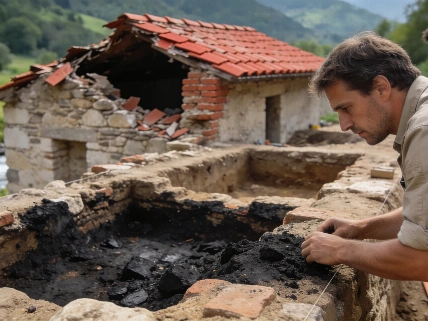
Adjacent to the residential complex, archaeologists identified a substantial outbuilding interpreted as an industrial workshop. Furnaces containing ash, charcoal, and hammerscale-waste from ironworking-were uncovered, along with rake-out pits and a stokehole. The precise function of the furnaces remains under investigation, but the evidence points to on-site metalworking and broader industrial activity supporting the villa estate. Large quantities of animal bone and worked antler were also recovered, indicating diverse economic activities.
Artifacts and Community Involvement
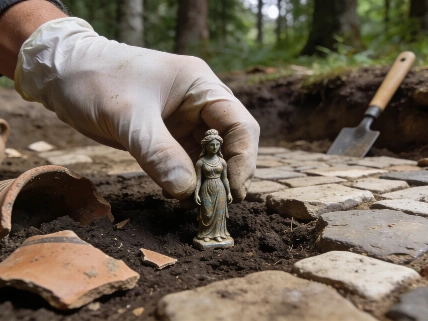
A range of artifacts recovered from the site reflects the villa's elite occupation. Finds include a silver-plated Roman spoon, two glass intagli from finger rings-one depicting the goddess Victory-fragments of a large imported amphora, painted wall plaster, a decorated bone pin, fine pottery, and an indented drinking beaker. Notably, a fragment of Samian ware mortarium with a lion's head spout was found near the bathhouse, representing an unusually decorative mixing bowl. These objects provide material evidence for the wealth, connections, and daily life of the villa's inhabitants.
The SHARE project also prioritized community engagement, with 163 local volunteers contributing over 3,600 hours during the first excavation season and more than 65 university students receiving practical training. The site was initially identified over two decades ago by a local metal detectorist, whose finds prompted further investigation through fieldwalking, geophysical survey, and trial excavation. Future excavation seasons will expand research on the bathhouse, industrial complex, and surrounding landscape to clarify the estate's economic role and its integration into Roman Devon. Comparable approaches to documenting ancient settlements and their infrastructure have been reported elsewhere, such as the exposure of a Roman road segment on the Swabian Alb Plateau (see related research).
Chronology and Preservation
The villa's occupation is dated to the 2nd-4th centuries CE based on stratigraphic evidence and artifact typology. The mosaic's preservation was affected by centuries of agricultural activity, resulting in partial loss and displacement of tesserae. The bathhouse and industrial features were preserved sufficiently to allow reconstruction of their layout and function, though some elements remain ambiguous due to later modifications and post-depositional disturbance. The recovery of both in situ and displaced materials has enabled a more comprehensive reconstruction of the site's development and use.
During the first excavation season, the project documented multiple construction phases, recovered hundreds of artifacts, and involved a large volunteer workforce. The scale of the site and the diversity of finds provide a valuable dataset for understanding rural elite life, architectural adaptation, and economic activity in Roman Britain.
Understanding the archaeological context of villa sites relies on careful stratigraphic excavation and the integration of architectural, artifact, and environmental evidence. Stratigraphy-the study of soil and deposit layers-allows archaeologists to reconstruct the sequence of construction, use, and modification at a site. By analyzing the relationships among building foundations, floor surfaces, and associated finds, researchers can establish relative chronologies and interpret how sites changed over time. Preservation conditions, such as ploughing or later disturbance, can complicate this process, making it essential to document both in situ and displaced materials. The combination of stratigraphic analysis and artifact typology remains central to reconstructing the development and function of complex sites like the Devon villa.