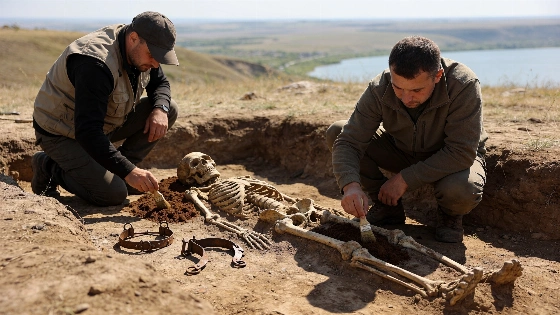
Excavations at the Kartal hillfort in Ukraine's Odesa Oblast have revealed Roman-period graves and a rare Early Iron Age horse harness, providing new evidence for cultural interaction and repeated occupation in the lower Danube region
Archaeological excavations at the Kartal hillfort, near Orlivka in Ukraine's Odesa Oblast, have uncovered a sequence of burials and artifacts spanning several millennia, including Roman-era graves and a rare ceremonial horse harness attributed to the Early Iron Age. The finds offer new material evidence for the complex cultural dynamics of the lower Danube region, a longstanding crossroads between the northern Black Sea and southeastern Europe.
Excavation Context
The Kartal hillfort is a multi-layered archaeological site situated close to the Danube River. Excavations have been ongoing for several seasons, with recent work focusing on two main areas, including a section near Kamyana Hora. The site's strategic location has led to repeated occupation and reuse, with evidence of settlement, economic activity, and burial spanning from the Eneolithic period (approximately 4000-5000 BCE) through the Roman era and beyond.
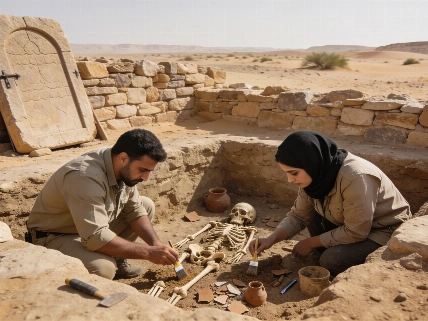
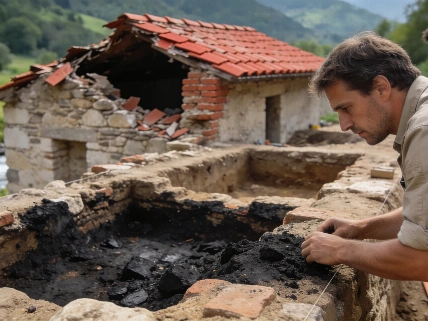
During the latest field season, archaeologists documented several domestic storage pits, a kiln, paved surfaces, and multiple burials. Among the most significant discoveries are graves dated to the second and third centuries CE, as well as a collection of iron and bronze fittings from a horse harness. The harness, believed to be ceremonial, was found in association with human remains and a clay vessel, and is tentatively attributed to the Cimmerian period of the Early Iron Age.
Material Evidence and Interpretation
The horse harness fittings, composed of bronze and iron, survived in relatively good condition despite the loss of organic components such as leather. Their deliberate placement within a grave suggests a funerary context, possibly reflecting ritual or symbolic practices. The presence of both Roman-era burials and earlier Iron Age material in close proximity highlights the site's long-term significance and the likelihood of cultural interaction or succession.
Researchers interpret the finds as evidence for contact and coexistence between Cimmerian groups and Thracian communities, whose principal settlements were located across the Danube. The combination of burial types and associated artifacts supports the view that the Kartal area served multiple functions over time, including as an economic periphery, a burial ground, and a locus of cultural exchange. Comparable discoveries of horse burials and elite grave goods in other regions, such as the chamber grave at Gnezdilovo near Suzdal (see related research), provide broader context for interpreting the social and symbolic roles of such assemblages.
Chronology and Site Use
Material from Kartal spans a wide chronological range, with the earliest occupation dating to the Eneolithic and subsequent layers reflecting Bronze Age, Iron Age, and Roman-period activity. The Roman-era burials are dated by associated grave goods and stratigraphic context to the second and third centuries CE, while the horse harness is attributed to the Early Iron Age based on typological parallels and metal composition. The site's repeated reuse is consistent with patterns observed at other major riverine crossroads, where shifting populations and changing political boundaries left complex archaeological signatures.
In total, the current excavation season documented several burials, domestic features, and artifact assemblages, but the full extent of the site's occupation remains under investigation. Archaeologists plan to continue fieldwork in future seasons, with the expectation that additional evidence will clarify the relationships among the various cultural groups represented at Kartal.
Preservation and Limitations
Preservation at Kartal varies by context, with metal objects such as the harness fittings surviving better than organic materials. Human skeletal remains are present but may be incomplete or affected by soil conditions, complicating detailed bioarchaeological analysis. The dating of features relies on a combination of stratigraphy, artifact typology, and, where possible, direct association with diagnostic objects. As with many multi-period sites, distinguishing between primary deposition and later disturbance remains a challenge, and interpretations of cultural identity or interaction are necessarily provisional pending further excavation and analysis.
Understanding the archaeological significance of Kartal depends on integrating material evidence, stratigraphic relationships, and comparative data from the wider region. The site's location near the Danube underscores its role as a point of contact and movement, but the precise nature of cultural transitions and interactions must be reconstructed from fragmentary and context-dependent evidence.
In archaeological research, stratigraphy-the study of layered deposits-plays a central role in reconstructing site history. Each layer represents a distinct episode of activity, with deeper layers generally corresponding to earlier periods. Careful excavation and documentation of stratigraphic relationships allow archaeologists to establish relative chronologies, identify episodes of reuse or disturbance, and associate artifacts and features with specific occupational phases. At complex sites like Kartal, where multiple periods of occupation overlap, stratigraphic analysis is essential for distinguishing between primary contexts and later intrusions, and for interpreting the sequence of cultural change over time.