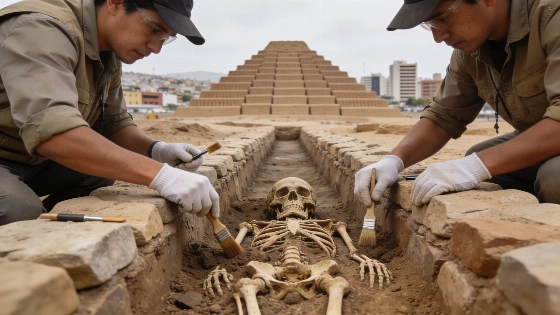
Archaeologists working at Huaca Pucllana in Lima have identified a 1,400-year-old human burial, offering new evidence for ceremonial practices and architectural diversity in the pre-Hispanic Lima culture
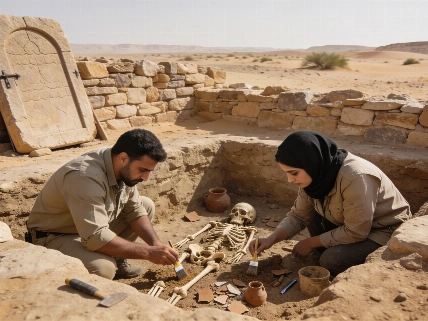
Archaeological excavations at Huaca Pucllana, a major pre-Hispanic complex in Lima's Miraflores district, have revealed a human burial dating to approximately 1,400 years ago. The remains, provisionally identified as an adult male, were found within an underground channel associated with a stone-built ceremonial well. This context provides rare insight into the mortuary and ritual practices of the Lima culture, which flourished on Peru's central coast during the first millennium CE.
Burial Context and Positioning
The individual was discovered lying extended along the length of the channel, oriented north to south and resting on the left side. The skull faced west, toward the site's pyramid and the Pacific Ocean. Archaeologists interpret the careful placement as deliberate, likely marking the closure of the channel and well as part of a ceremonial event. The burial's association with the architectural feature, rather than a formal cemetery, suggests a specific ritual function rather than routine interment.
Preliminary analysis of the pelvis and occipital crest suggests the skeleton belonged to an adult male, though this assessment remains tentative pending further osteological study. Physical anthropologists will conduct detailed examinations to refine estimates of age at death, biological sex, and health status, and to search for evidence of disease, trauma, or other life history markers. The remains were recovered during the 2026 field season, with ongoing laboratory analysis expected to clarify the individual's biological profile and possible cause of death.
Stone Construction and Architectural Variation
The burial's context is notable for its association with a ceremonial well constructed from river stones, a departure from the adobe brick architecture that characterizes much of Huaca Pucllana. This use of stone may reflect a distinct architectural tradition or a specialized function for the structure within the ceremonial landscape. The relationship between the stone-built well, the underground channel, and the human remains strengthens the interpretation of the area as a ritual complex rather than a domestic or administrative space.
Based on stratigraphic context and associated materials, the burial is dated to around 650 CE, within the established timeframe of the Lima culture. The site's ongoing excavations have produced a range of material evidence, including ceramics and animal remains, which will be analyzed alongside the human skeleton to reconstruct the sequence of use and closure of the ceremonial features. The discovery adds to a growing body of evidence for complex ritual activity at Huaca Pucllana, complementing finds from other Andean sites where human remains have been linked to the termination of sacred spaces. For comparison, research at Kainua in northern Italy has also documented ritual wells containing human skeletons, as seen in recent studies of Etruscan ceremonial deposits.
Interpreting Ritual Closure
The deliberate deposition of a human body during the closure of a ceremonial structure is a pattern observed in several ancient societies, but the specific meaning and social implications remain debated. At Huaca Pucllana, the combination of architectural context, body positioning, and lack of grave goods suggests the burial was not part of routine funerary practice. Instead, it may represent an offering or symbolic act marking the end of the structure's use. Further analysis of associated artifacts, faunal remains, and construction techniques will help clarify the sequence of events and the broader ceremonial landscape of the site.
Researchers emphasize that the interpretation of ritual burial relies on context and comparative evidence, as direct indicators of belief or intention are rarely preserved. The ongoing study of the Huaca Pucllana burial will contribute to understanding how the Lima culture organized sacred space, conducted closure ceremonies, and selected individuals for participation in these events. The reasons for the selection of this particular individual, and the circumstances of their death, remain open questions pending further osteological and contextual analysis.
Archaeological Evidence and Uncertainty
The discovery at Huaca Pucllana highlights the importance of context in interpreting ancient mortuary practices. While the burial's association with a ceremonial well and its unusual positioning support a ritual interpretation, alternative explanations-such as accidental deposition or later disturbance-cannot be entirely excluded without additional evidence. The preservation of the skeleton and associated materials will be critical for future analyses, including stable isotope studies, ancient DNA, and detailed taphonomic assessment.
As with many archaeological discoveries, the evidence from Huaca Pucllana is subject to limitations of preservation, sampling, and interpretation. The burial represents a single data point within a complex and evolving site, and its significance must be evaluated in relation to broader patterns of ritual and mortuary behavior in the region. Ongoing research will seek to integrate the new findings with established knowledge of the Lima culture and its ceremonial traditions.
Estimating the biological sex and age at death of ancient individuals relies on the analysis of skeletal features, particularly the pelvis and skull. In adults, the shape of the pelvic bones provides the most reliable indicator of biological sex, though preservation and population variation can complicate assessment. Age estimation in adults is less precise than in juveniles, often based on degenerative changes in the skeleton. These methods yield probabilistic rather than absolute results, and are best interpreted within the broader archaeological and cultural context of the burial.