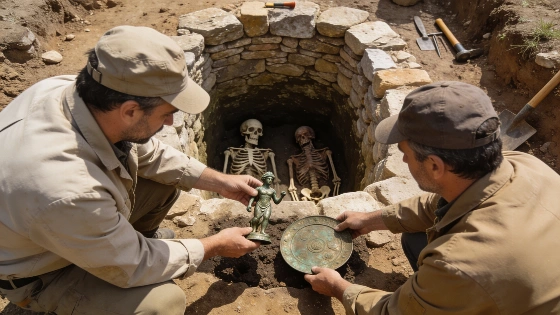
Archaeologists at Kainua, near Marzabotto in northern Italy, have excavated a remarkably preserved Etruscan ritual well containing bronze figurines, a bronze plate, and two adult skeletons, offering new evidence for religious practices and urban foundation ceremonies
Archaeological excavations at the ancient Etruscan city of Kainua, located near Marzabotto in northern Italy, have revealed a rare ritual well containing both bronze votive offerings and human skeletal remains. The discovery, made during the University of Bologna's 39th excavation campaign, provides new insight into the ceremonial and practical roles of water features in Etruscan urban planning and religious life.
Excavation Context and Finds
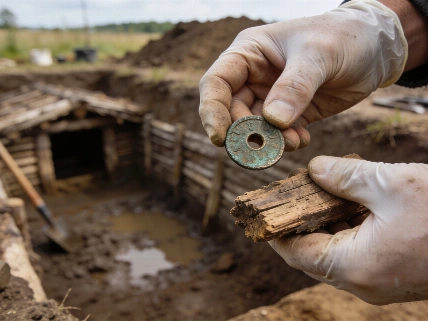
The well was uncovered within a sacred precinct dedicated to the goddess Uni, a principal deity in the Etruscan pantheon. At the base of the well, archaeologists recovered two finely crafted bronze female figurines and a bronze plate, all in an exceptional state of preservation. The metallic sheen of these objects has survived more than two millennia underground, suggesting favorable burial conditions and minimal disturbance since deposition.
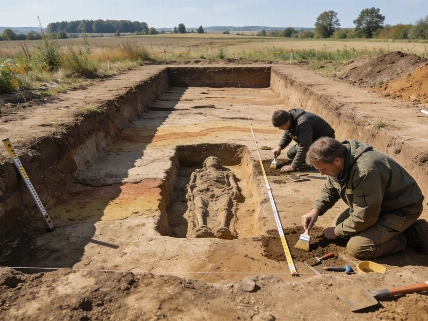
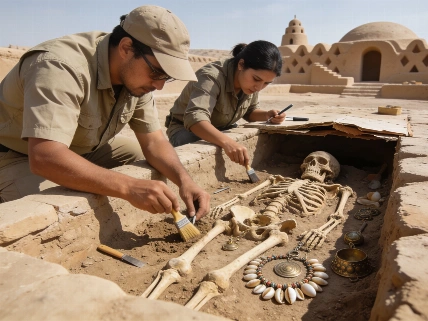
In addition to the artifacts, the excavation team identified two adult human skeletons within the well structure. The remains were found in a context suggesting a later phase of use, possibly associated with the closure of the well rather than its original consecration. Osteological analysis is ongoing, but preliminary observations indicate both individuals were adults at the time of death. The precise circumstances of their deposition remain under investigation, with no current evidence for perimortem trauma or deliberate violence.
Chronology and Interpretation
Based on stratigraphic context and typological analysis of the bronze objects, the initial ritual deposition is dated to the late sixth or early fifth century BCE, coinciding with the foundation of Kainua. The well appears to have served a dual function: as a water source and as a monument of ritual significance. The votive offerings are interpreted as part of a ceremonial foundation event, while the later human burials may reflect a ritual closure marking the end of the well's use.
The site's broader sacred landscape includes two monumental temples dedicated to Tinia, the supreme Etruscan god, and his consort Uni, as well as evidence for the worship of Vei, a fertility deity. The newly discovered well adds to this complex, highlighting the integration of water, ritual, and urban identity in Etruscan society. Comparable discoveries elsewhere in the Mediterranean, such as the merchant shipwreck with hundreds of amphorae off Andros, Greece, have also contributed to understanding ritual and economic practices in the Classical period (see recent reporting on Aegean maritime finds).
Research Status and Future Analysis
The University of Bologna has conducted systematic excavations at Kainua since 1988, with the current season supported by €140,000 in funding from the Italian Ministry of Culture. The extension of the 2026 field season, enabled by a partnership with the MNEMA - National Etruscan Museum of Marzabotto, was instrumental in uncovering the well. Once conservation and scientific analysis are complete, the bronze artifacts and human remains are expected to be displayed at the museum, which now emphasizes ongoing research and public engagement with new discoveries.
Quantitative details from the excavation include the recovery of two bronze figurines, one bronze plate, and two adult skeletons from a single well shaft within the sacred precinct. The dating of the foundation ritual to the late sixth or early fifth century BCE is based on artifact typology and stratigraphic association, while the human remains are attributed to a subsequent phase, likely several generations later. Further laboratory analysis, including osteological and possibly isotopic studies, will be required to clarify the age, sex, health, and possible origins of the individuals.
Limitations and Uncertainties
While the association of the bronze offerings with a foundation ritual is supported by their context and typology, the interpretation of the human burials remains provisional. No direct evidence currently links the skeletons to ritual sacrifice or violent death, and alternative explanations such as secondary burial or closure rites remain plausible. The excellent preservation of both artifacts and bones offers an unusual opportunity for detailed analysis, but the small sample size and lack of written records limit broader generalization about Etruscan religious practice.
The discovery underscores the importance of sustained archaeological research at planned Etruscan cities like Kainua, where urban layout, monumental architecture, and ritual features can be studied in direct association. As further analysis proceeds, the findings are expected to refine understanding of the interplay between water, ritual, and civic identity in the Etruscan world.
Stratigraphy is central to archaeological interpretation at sites like Kainua. By carefully recording the sequence of soil layers and the position of artifacts and remains within them, archaeologists can reconstruct the relative chronology of construction, use, and abandonment. In this case, the stratigraphic separation between the bronze offerings and the human skeletons supports the interpretation of two distinct ritual events: an initial foundation ceremony and a later closure. However, post-depositional processes, disturbance, or incomplete excavation can complicate these associations, making stratigraphic control and documentation essential for reliable interpretation.