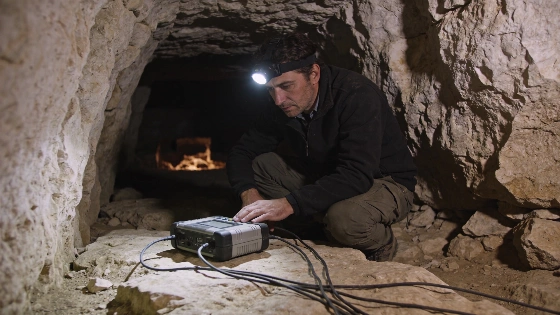
Ground-penetrating radar and electrical resistivity surveys at Italy's Grotta delle Veneri have detected underground anomalies that may connect with the known cave system but are not yet confirmed chambers
Possible cavities beneath Italy's Grotta delle Veneri could extend a prehistoric cave system that already contains evidence of Neanderthal and Homo sapiens occupation. The features are not excavated chambers or confirmed archaeological deposits: they are subsurface anomalies detected through geophysical survey.
That distinction matters. The available reports describe signals identified through ground-penetrating radar (GPR) and electrical resistivity tomography (ERT), not newly opened rooms or dated archaeological layers. The measurements indicate contrasts in the limestone and surrounding sediments, but only further investigation can establish whether those contrasts represent natural voids, connected cave passages or spaces containing archaeological material.
In archaeological geophysics, this separation between detection and interpretation is essential. As in reporting standards used across major research communities such as the Max Planck Society and in journals including Nature, an instrument signal is treated as evidence of a target for investigation rather than proof of a particular historical explanation.
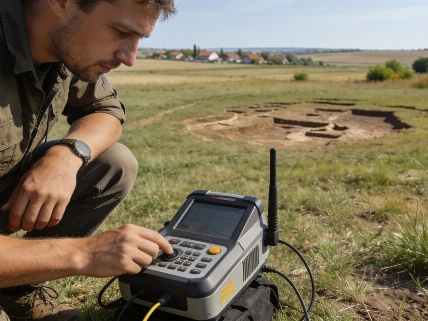
Researchers from the University of Malta and Italy's Institute of Heritage Studies examined the cave near Parabita in Puglia using two non-invasive techniques: GPR and ERT. GPR sends electromagnetic pulses into the ground and records reflections from buried boundaries. ERT measures changes in electrical resistance, allowing researchers to distinguish between materials with different subsurface properties.
Used together, the methods identified several anomalies within the limestone around the known cave system. Independent reports indicate that some may lie beside the principal cavity and could potentially connect with existing underground spaces, but the published information does not establish their dimensions, accessibility or archaeological contents. No subsequent excavation, official opening of a new chamber or dating of the anomalies has been confirmed in the available reporting.
A comparable survey shows why geophysical mapping can be valuable: it can reveal buried structures before excavation disturbs the deposits above or around them. It cannot, by itself, identify the function or age of an anomaly. Similar caution applies in engineering and planetary prospecting, where institutions such as MIT and NASA distinguish between a remotely detected physical contrast and a structure confirmed by direct observation.
For additional context on how archaeological and heritage research is catalogued, the Imperial research collection illustrates the broader use of documented, non-destructive investigation before intervention.
Grotta delle Veneri is important because its deposits record occupation by both Neanderthals and anatomically modern humans. Earlier finds indicate Neanderthal presence before the later occupation of the site by early Homo sapiens, giving the cave significance for studying population replacement, interaction and coexistence in the Mediterranean.
The cave takes its name from two small Palaeolithic Venus figurines carved from animal bone and associated in published accounts with early Homo sapiens. The objects are described as stylized female forms with the arms placed across the breasts and beneath the abdomen, a posture some researchers have interpreted as relating to pregnancy or fertility.
The larger figurine is approximately 9 centimeters high and carries deep grooves across the face. Those marks may represent a veil, mask or hairstyle, but the carving does not provide a secure answer. The smaller figurine measures just over 6 centimeters and has similar features. Their proportions resemble examples from the Mediterranean, their facial treatment has parallels in the Rhine-Danube region and their posture has been compared with figurines from Russia.
These comparisons place the objects within a broad European tradition of prehistoric representation, but they do not establish direct contact between the communities that made them. The figurines also should not be used to infer the contents of the newly detected anomalies: the available survey reports do not link the signals to artifacts, human remains or any particular occupation phase.
The current evidence does not demonstrate that the anomalies contain tools, human remains, figurines or other cultural deposits. Nor does it establish that they were used by either Neanderthals or anatomically modern humans. A cavity may preserve archaeological material, but the presence of a void alone says nothing about who entered it, when it formed or whether it was accessible during human occupation.
The researchers point to the Gorham's Cave Complex in Gibraltar as a useful comparison. Geophysical investigations there contributed to the discovery of an unknown chamber in 2021; that space extended approximately 13 meters into the cave system and had remained sealed for around 40,000 years, preserving evidence associated with Neanderthal activity. The comparison demonstrates what concealed spaces can sometimes preserve, not what the Grotta delle Veneri anomalies contain.
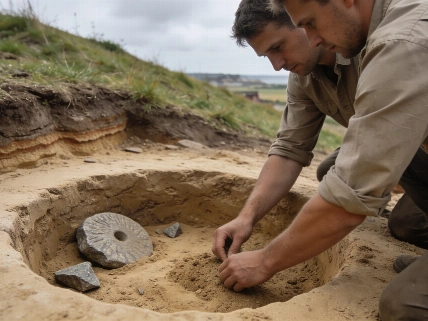
Further work must confirm whether the detected features are natural cavities connected to the known cave, determine whether people could have reached them and assess whether deposits survive inside. Any excavation would also need to protect the surrounding archaeological sequence, because removing sediment without recording its position could destroy the context needed to date and interpret future finds.
GPR and ERT are especially useful here because they measure physical contrasts without immediately disturbing the deposit. GPR reflections can arise from boundaries between soil, rock and empty space, while ERT anomalies can reflect moisture, sediment or geological variation as well as a cavity. Neither method, as reported for this survey, supplies a sample size, p-value, confidence interval or direct chronological measurement; the result is a spatial map of investigation targets.
The methods narrow the search area; they do not replace excavation, direct observation or stratigraphic recording. For Grotta delle Veneri, that makes the survey a significant archaeological prospecting result but not yet a discovery of hidden human activity. Its current status is best described as a set of geophysical targets for possible future research.