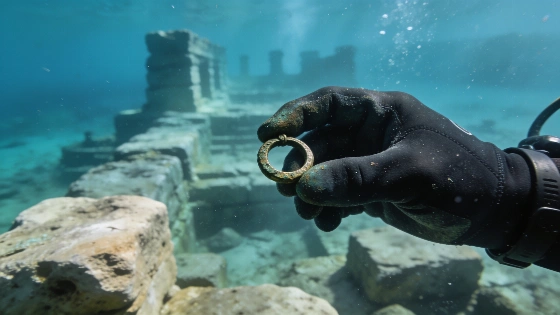
A bronze seal ring recovered from submerged Antirhodos bears an image of Alexandria's famous lighthouse. Its archaeological context may connect the royal quarter with the symbolic and administrative reach of the Pharos, although the object's date, owner and precise function remain unconfirmed.
A bronze seal ring recovered from the submerged island of Antirhodos carries an engraved image of the Lighthouse of Alexandria, giving archaeologists a rare object-level view of how the monument circulated through administrative and symbolic life. The ring was found during excavations in Alexandria's Eastern Harbour by a joint mission involving Egypt's Supreme Council of Antiquities and the European Institute for Underwater Archaeology. Egyptian authorities say the joint work in the Eastern Harbour has continued since 1992.
The find is being interpreted within a wider investigation of Alexandria's submerged royal quarter rather than as an isolated discovery. The current campaign covers four areas: the Temple of Isis, the palace and western platform on Antirhodos, the area containing fragments of a monumental sarcophagus, and the Timonium, a complex traditionally associated with Mark Antony. After work in the Eastern Harbour, the expedition plans to continue investigations in Abu Qir Bay.
The engraving shows the Lighthouse of Alexandria, also known as the Pharos. Its form resembles representations on Alexandrian coinage from the 2nd century AD, but that artistic comparison does not date the bronze ring to the 2nd century, identify its owner or establish how it was used. The Supreme Council of Antiquities has described the object as the first known seal ring reported with an engraved depiction of the lighthouse, although the full archaeological and laboratory assessment is still pending.
That distinction matters. A coin comparison can identify an artistic relationship, while excavation context, stratigraphy, associated materials and laboratory analysis are needed to establish an object's date. As of the latest reports, the ring's final dimensions, laboratory dating and functional attribution had not been publicly presented. The discovery therefore supports a visual connection with the Pharos, but not a precise manufacturing period or a specific administrative role.
Antirhodos formed part of the ancient Portus Magnus within Alexandria's royal quarter. Much of that quarter now lies beneath the Mediterranean, where archaeologists are investigating buildings and deposits that were submerged after changes to the coastline and local ground conditions. The island contained a palace described by the Greek geographer Strabo, who visited Egypt between 29 and 25 BC.
Independent reports commonly associate the submergence of Antirhodos with a combination of earthquakes and tsunamis in late antiquity. The exact date of the island's disappearance has not been established in the available material; a 4th-century AD date remains a possibility rather than a demonstrated conclusion. This uncertainty is important because the date of submergence cannot automatically be used as the date of manufacture or use for every object recovered from the site.
Researchers suggest that the palace complex may have retained an administrative role until at least the 2nd century AD. One possibility is that some activity connected with managing or representing the lighthouse took place there, although the ring alone cannot demonstrate that function. It establishes a physical association between the royal quarter and a widely recognized state monument; the administrative interpretation remains provisional.
The problem is familiar in archaeology: an object can be authentic and securely excavated while its precise function remains unresolved, as shown by this earlier excavation report concerning a structure whose purpose could not be identified from form and context alone. Comparable caution is standard in research published through journals such as Nature research, where interpretations are expected to distinguish directly observed evidence from hypotheses built around it.
Franck Goddio, president of the European Institute for Underwater Archaeology and director of the Antirhodos mission, is associated with the long-running investigation of the site. The current fieldwork combines the Egyptian General Administration of Underwater Archaeology within the Supreme Council of Antiquities with the European Institute for Underwater Archaeology. The campaign's multiple excavation areas allow researchers to compare architectural remains, movable finds and depositional conditions across the submerged quarter rather than relying on a single object.
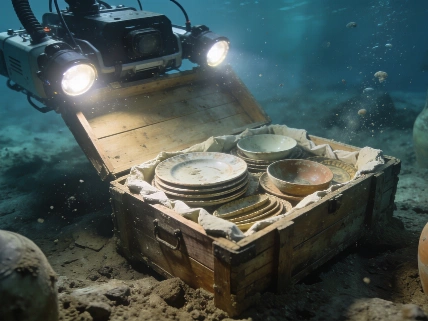
The excavations have also produced pottery spanning approximately eight centuries, from the 4th century BC to the 4th century AD. The assemblage includes everyday utensils, tableware, amphorae and other ceramic vessels, along with fragments of ancient glassware. These materials provide a broader chronological framework for activity in the harbor, but they do not automatically date every object found within the submerged remains.
Egypt's Minister of Tourism and Antiquities, Sherif Fathi, inspected the excavations, while Deputy Minister Ahmed Rahima said the programme includes two areas on the royal island of Antirhodos, the remains of an obelisk, the Timonium and the Temple of Isis area. According to the ministry, the ring is part of a broader effort to document the submerged royal quarter and Alexandria's changing role during the Ptolemaic and Roman periods.
In underwater archaeology, contextual dating means establishing an object's likely period through its deposit, associated materials and comparable forms rather than assigning an exact year from appearance alone. Here, the 2nd-century AD coin imagery offers a comparison, while the submerged palace and harbor deposits supply the archaeological setting. Further work may include detailed recording of the find layer, conservation analysis of the bronze and comparative study of the engraving, but no publicly reported sample size, statistical measurement, confidence interval or peer-reviewed laboratory result currently supports a more precise claim.
The central value of the ring is therefore not a sensational image of a lost wonder, but the possibility that a small object can connect monumental architecture with the institutions that maintained and represented it. The evidence supports a cautious link between Antirhodos and the cultural or administrative significance of the Lighthouse of Alexandria, but it cannot identify the ring's owner, prove the palace's precise bureaucratic role or establish a definitive date for the object. Its significance should be judged through that limited but solid contribution rather than inflated into a complete reconstruction of royal life.