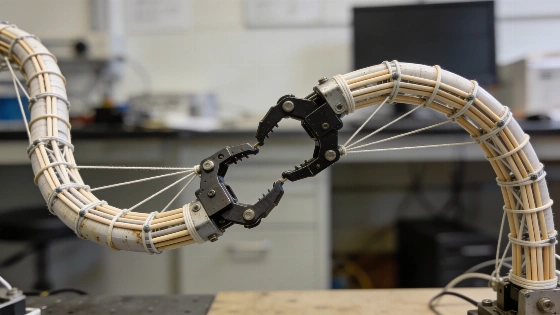
Colorado State University's tensegrity machines use flexible cable-and-rod bodies and claws at both ends to grip objects or dock with other units. Tests show coordinated transport, but most operations still need human pilots
Two units have demonstrated that they can locate one another and connect independently. Most operations still require human piloting, so the docking demonstration marks a specific capability rather than full autonomy. The robots, called Tensegrity-based Continuum Robots, or TeCoBots, were developed by Colorado State University researchers led by Zhao Jianguo, an assistant professor of mechanical engineering. The work was reported in Nature Machine Intelligence on November 11, 2026.
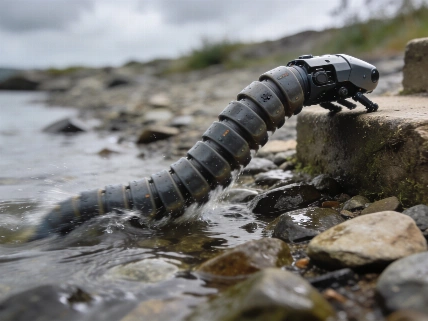
Each robot is about 587 millimeters long and weighs approximately 600 grams. Its tube-like body uses rigid rods held in place by tensioned cables rather than a conventional chain of hinged joints. In a tensegrity structure, the rods carry compression while the cables hold the structure under tension, allowing the body to bend, stretch, collapse and change shape while maintaining its overall form. The Colorado State research team describes the design as a flexible alternative to modular robots that can connect and rearrange but cannot continuously bend.
Mechanical claws at both ends let a unit grip objects or attach to another robot. The mechanical connection avoids magnets, which the team says can fail or create alignment problems. Joined units can form chains, loops and branching structures, with claws still available for handling objects or connecting additional robots. The grippers can also be changed for different tasks, including softer versions for delicate objects and heavier-duty attachments.
Individual machines demonstrated object manipulation and locomotion, while connected groups coordinated to transport objects. In an outdoor test, a remote human operator used a robot's flexible body and end claws to move over a large branch. The robots also used different movement strategies across varied environments. By combining movement with object handling, their design brings together capabilities known as loco-manipulation.
A reported heavy-duty claw uses a worm gear to clamp onto another gripper and hold the connection without continuously drawing power. The researchers identify actuator selection as a key engineering challenge: motors must fit within a compact, deformable body while providing the force and reliability needed for bending, locomotion, gripping and docking.
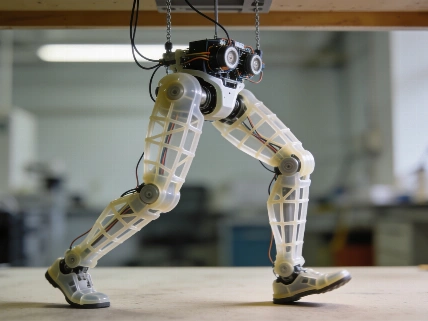
The flexible-body approach connects with other efforts to make robots that can adapt physically. A related robotics report described University of Tokyo leg components made from flexible plastic, with motors and cables driving a prototype that still relied on external support.
Colorado State University researchers are working to improve autonomy and operating speed, with the aim of reducing human supervision. They envision larger collectives of tens or hundreds of connected machines for tasks such as space exploration. Manufacturing and search-and-rescue are also among the potential applications; these remain prospective uses.