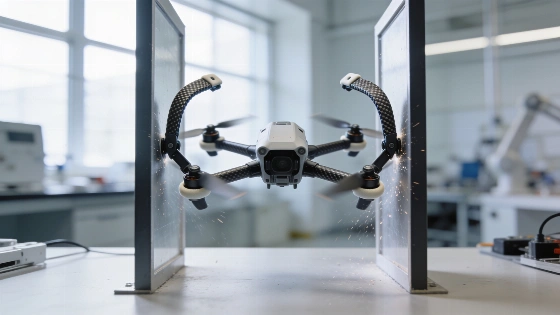
A quadrotor from NTNU and ETH Zurich crossed a 15-by-20-centimeter opening after contact folded its spring-loaded arms. Lab tests also measured a sub-1-percent power penalty in open flight
At 2 meters per second, the prototype entered a 15-by-20-centimeter opening, tilted as far as 94 degrees and lost 56 centimeters of altitude before recovering into a hover. Its arms folded when they touched the frame. No folding motors were involved. The research team is associated with NTNU's Autonomous Robots Lab, with collaborators at ETH Zurich and the University of Bonn.
The quadrotor's two side arms use elastic rolling cam joints. Each joint pairs spring-loaded cams with interlocking teeth that roll against one another; shaping their profiles sets how the arm's stiffness changes as it turns. Contact pushes the arms backward, and the elastic joints return them to position after the obstacle. The design method jointly optimizes the vehicle's geometry and how its arms bend on contact, rather than treating airframe shape and compliance as separate design problems, as IEEE Spectrum reported.
The prototype is 31.3 centimeters wide in normal flight and narrows to 14.1 centimeters when pressed against an obstacle. In the reported demonstration, it passed through a 15-centimeter opening. The researchers report that joint compliance and arm geometry optimized together let it pass through openings 52 percent narrower than its nominal span; earlier contact-folding quadrotors managed about 29 percent.
The team used a closed-loop optimizer to refine a 22-parameter model of the airframe geometry, alongside parameters governing flexible-arm behavior. In simulation, a nonlinear model predictive controller tested candidate designs against gaps from 15 to 25 centimeters, then used traversal success to guide further changes. The work was released as an arXiv preprint and demonstrated in a lab video.
Physical tests extended beyond the rectangular opening. The drone passed through a 40-centimeter-long tube that was 22.5 centimeters across, with its arms folded until it emerged. In trials approaching a 20-centimeter gap at an angle, it recovered from errors up to 30 degrees.
Adding compliant arms did little to change open-flight performance in a comparison with an identical rigid quadrotor. On a circular path at 1.5 meters per second, position-tracking error increased by 2 millimeters and electrical power use rose by less than 1 percent. A bridge-inspection drone study also reported laboratory tests without a real-bridge trial, a reminder that controlled demonstrations do not establish field performance.
The prototype's approach-angle tolerance had a limit: impacts at 35 to 40 degrees occasionally dislocated an arm. The researchers released their optimization code on GitHub.