Archaeologists have traced metallurgical waste from a Wari-period burial at Castillo de Huarmey in Peru to ore sources in present-day Bolivia, revealing long-distance movement of metal and technological knowledge across the Andes
Archaeological research at Castillo de Huarmey, a major Wari site on Peru's northern coast, has provided new evidence for the movement of metal and metallurgical expertise across the Andes more than 1,300 years ago. Scientists analyzed a fragment of metallurgical by-product recovered from the burial of a young metalworker, revealing that the material likely originated hundreds of kilometers away in the Pulacayo region of modern Bolivia.
Burial Context and Metallurgical Evidence
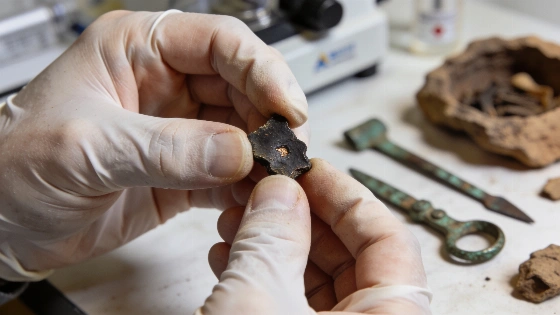
The Castillo de Huarmey necropolis, active during the Middle Horizon (c. 600-1000 CE), has yielded a series of high-status burials, including the first intact royal Wari tomb discovered at the site in 2012. Among subsequent finds was a grave containing the remains of a young adult, estimated to be around 20 years old at death, accompanied by more than a dozen bronze tools and objects. In the individual's hand, archaeologists recovered a small, dark fragment identified as speiss or matte-a by-product of metal smelting.
This fragment, though visually unremarkable, offered a rare opportunity to investigate the provenance of the metal used by Wari craftspeople. The burial context, with specialized tools and metallurgical waste, suggests the individual was engaged in metalworking, but the absence of smelting furnaces or large-scale metallurgical debris at the site leaves open the question of where primary processing occurred.
Isotopic Analysis and Source Identification
Researchers from institutions in Poland and the United States subjected the speiss fragment to lead isotope analysis, a method that compares the ratios of naturally occurring lead isotopes to those found in known ore deposits. The team compared the isotopic signature of the Huarmey sample with data from ore sources across Peru, Bolivia, Chile, and Argentina. While several potential sources were initially considered, the combination of isotopic, chemical, and mineralogical evidence pointed most strongly to the Pulacayo region in Bolivia as the likely origin.
Previous analyses of metal artifacts from Castillo de Huarmey have also indicated connections to Bolivian ore sources, supporting the interpretation that metal or semi-processed materials were transported over considerable distances. Pulacayo would later become a major mining center, especially for silver, but evidence suggests copper extraction and metallurgical activity in the region during pre-Inca periods as well.
Trade, Mobility, and Technological Networks
The movement of metal from Bolivia to the Peruvian coast implies the existence of extensive trade and exchange networks centuries before the rise of the Inca Empire. Rather than transporting heavy, low-yield ore, ancient communities likely processed metal near the mines, sending partially refined material, semi-finished products, or even completed objects northward. The most plausible routes would have involved llama caravans traversing the Andes, though maritime transport along the Pacific coast is also possible.
This long-distance movement of materials may have facilitated not only the exchange of goods but also the spread of metallurgical knowledge and specialist craftspeople. The placement of the speiss fragment in the hand of the deceased metalworker could represent a technological reference, a quality marker, or a symbol of professional identity. However, without direct evidence of primary smelting at Castillo de Huarmey, the precise organization of production and exchange remains uncertain.
Archaeological findings from other Andean sites, such as the recent mapping of ceremonial structures beneath Mexico City's historic center (see related research), highlight the complexity and reach of ancient networks in the Americas, though each region's material and social dynamics were distinct.
Material Evidence and Analytical Limits
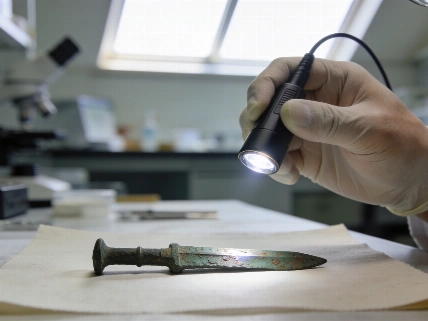
The burial at Castillo de Huarmey contained over a dozen bronze objects, including a saw, axe, knives, and chisels, alongside the metallurgical by-product. The identification of the speiss fragment as a smelting by-product was based on its mineralogical and chemical composition. Lead isotope analysis provided a geological fingerprint, but the method cannot determine the exact route or form in which the metal traveled. The absence of large-scale metallurgical waste or furnaces at the site suggests that primary smelting likely occurred elsewhere, with Huarmey serving as a center for secondary working or recycling of metal.
While the evidence supports the existence of long-distance movement of metal and knowledge, it does not establish the identities or social roles of the individuals involved beyond the burial context. The interpretation of the speiss fragment as a professional marker remains plausible but unproven, and further excavation or laboratory analysis may clarify the organization of Wari-period metallurgy in the region.
Lead isotope analysis is a scientific method used to trace the geological origin of metal artifacts and metallurgical by-products. Different ore deposits contain distinctive ratios of lead isotopes, which remain stable during smelting and working. By comparing the isotopic signature of archaeological samples to reference data from known ore sources, researchers can identify likely regions of origin. However, the method cannot determine the precise route, form, or social context of metal movement, and its accuracy depends on the completeness of comparative datasets and the preservation of the analyzed material.