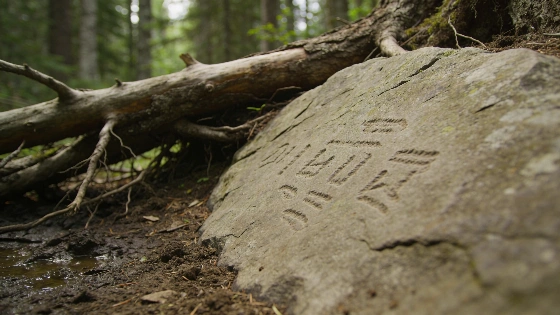
A fallen tree exposed a runic panel near Wawa with 255 symbols and an image of a boat carrying 16 people. Its Swedish prayer may connect the carving to 19th-century workers, though the circumstances of its creation remain unclear
A fallen tree exposed the bedrock panel after several inches of soil had covered it. The discovery was made in autumn 2018 in the forest near Wawa, northern Ontario. The inscription spells out the Lord's Prayer in Swedish, an interpretation made by a specialist who examined the weathered carving.
The find is near Wawa in northern Ontario. Researchers have proposed an early- to mid-19th-century date, based on the inscription's weathering and historical evidence, placing it roughly two centuries ago rather than in the Viking Age.
Reading the inscription
The panel contains 255 runic symbols across an area measuring about 1.2 metres by 1.5 metres. Beside the prayer is a boat carrying 16 people, with 14 X-shaped marks nearby. Researchers have not established what those images mean. The reported description of the carving and its features was also carried by RMF24.
Archaeologist Ryan Primrose, director of the Ontario Centre for Archaeological Education, learned of the site in 2018. After studying the markings with fellow researchers, he asked Henrik Williams, an emeritus professor at Uppsala University and a specialist in runology, to examine them. Primrose described the discovery as one of the most unexpected of his career and said it was "absolutely fascinating."
Williams spent several hours looking at the inscriptions beneath a tarpaulin in cold, wet conditions. He identified the text as a runic version of the Lord's Prayer in Swedish. The inscription was linked to a version of the prayer published by Swedish scholar Johannes Bureus in 1611 and republished during the 19th century.
That identification explains the language and religious text. It does not identify the carver or establish why the prayer was cut into this particular outcrop. The depth of the grooves suggests substantial labor; Williams estimated the work could have taken days or weeks.
Dating and purpose
The proposed date rests on the carving's weathering alongside historical context, not on a reported direct dating test. The Hudson's Bay Company employed Swedish workers at Canadian trading posts during the 19th century, including at Michipicoten, relatively close to the findspot. Primrose considers that history consistent with an early- to mid-1800s carving, but it does not name the person who made it.
A possible historical setting is not proof of an object's date or association; the same distinction matters in the Dubienka find. Here, the boat and its accompanying marks add another unresolved feature. Their connection to the prayer, or to any particular event, has not been established.
Researchers have found no accompanying artifacts that could clarify who used the location. The soil cover led them to suspect the carving may have been deliberately buried, but the available evidence does not establish how or why that happened. A place of Christian worship for Swedish workers is one possibility; a personal act of devotion by an individual is another.
Primrose has applied for a leasehold covering the site with the property owner and hopes to obtain funding for a historical attraction. Plans could include a protective structure over the bedrock. The application and proposed work do not mean that the site is open to visitors or that protection has been built.
The date of a text and the date of a carving are separate questions. The prayer's runic version can be traced to Bureus's 1611 publication, but that only identifies a textual source available to the carver; it does not show when the words were cut into the Ontario bedrock. The inscription's age is therefore an archaeological interpretation based on weathering and historical context, rather than a precise date established for the stone itself.