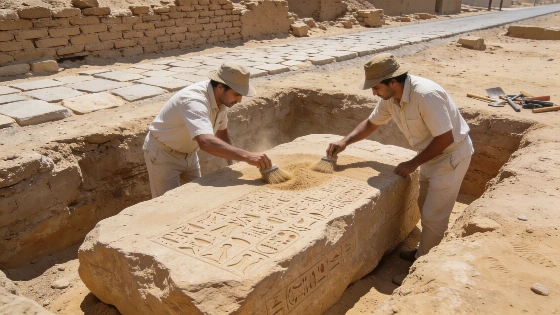
Archaeologists at Tel Abu Saify in Egypt have uncovered fortifications, roads, and inscriptions that may connect the site to the ancient city of Msen, offering new evidence for the route and function of the Horus Military Road
Recent excavations at Tel Abu Saify, located in Egypt's Ismailia Governorate near Qantara East, have produced new archaeological evidence that may clarify the ancient settlement's identity and its role along the Horus Military Road. The site, long recognized for its strategic position on Egypt's eastern frontier, has yielded architectural remains, fortifications, and inscribed artifacts spanning several historical periods. Among the most significant discoveries are sandstone fragments inscribed with the royal titles of Ramesses II and a text referencing restoration work on a statue of Horus, described as lord of the city of Msen.
Fortifications and Road Networks
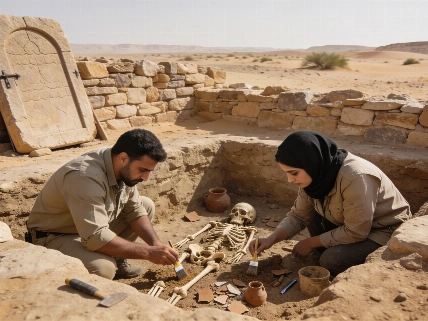
The Egyptian archaeological mission, operating under the Ministry of Tourism and Antiquities, has focused on documenting the network of settlements and defensive structures that once protected Egypt's northeastern border. At Tel Abu Saify, researchers identified a massive mud-brick wall and gateway complex. Detailed stratigraphic analysis revealed that this structure functioned as the outer enclosure wall of a temple, rather than as part of the temple itself-a revision of earlier interpretations. The team also uncovered two adjacent stone-paved roads leading from outside the fortified area toward the temple complex. One road, narrower and dating to the Roman period, suggests continued use and adaptation of the site over time.
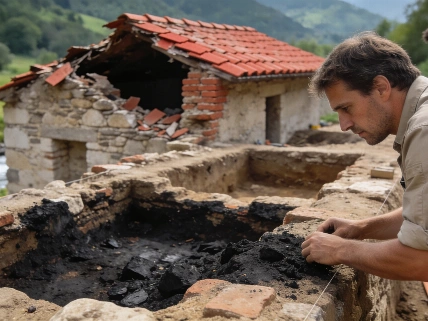
Inside the temple precinct, archaeologists documented a sequence of storage rooms in the northern sector and larger service spaces to the south. Excavations extended toward the sanctuary, or Holy of Holies, which showed evidence of extensive destruction and later reuse, particularly during the late Roman period when parts of the complex were converted for lime production. Two large circular installations containing burnt limestone were found near the sanctuary, indicating that stone from earlier buildings was processed on site.
Inscriptions and the Msen Hypothesis
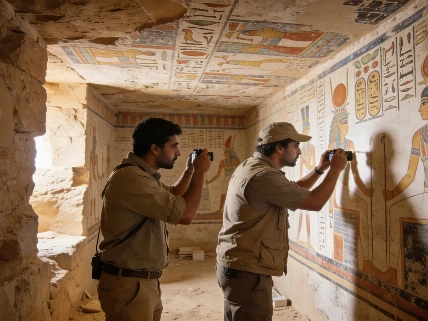
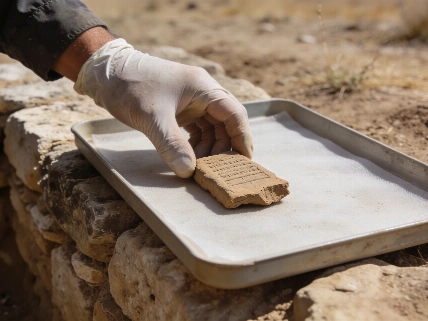
The most compelling evidence for the site's ancient identity comes from inscribed architectural elements. A large sandstone block, broken into two pieces, bears the royal titles of Ramesses II (19th Dynasty, c. 1279-1213 BCE). Another inscription references restoration work on a statue of Horus, explicitly naming him as lord of Msen. This textual link is significant because the city of Msen is known from ancient Egyptian sources but has not been securely located archaeologically. The presence of these inscriptions, combined with the architectural and defensive features, supports the hypothesis that Tel Abu Saify may correspond to the lost city of Msen. However, researchers emphasize that further evidence is needed before this identification can be considered definitive.
Material from the site spans multiple periods, including the Late Period (notably the 26th Dynasty), the Ptolemaic era, and the Roman occupation. Among the finds are sculptural fragments, including a headless and legless statue, a basalt royal torso, and additional pieces made from basalt and jasper. These remains, together with the site's fortifications, reinforce its interpretation as a settlement of both administrative and military importance.
Changing Functions Over Time
Archaeological evidence indicates that Tel Abu Saify underwent several phases of transformation. The temple complex appears to have reached its architectural peak during the Ptolemaic period, when it was expanded and reorganized. In the third century CE, parts of the site were repurposed as a Roman military barracks (castrum), reflecting the continued strategic value of the location. Later, during the late Roman era, the site was further altered for industrial use, particularly lime production, as indicated by the lime kilns and associated debris.
Excavations at Tel Abu Saify are part of a broader effort to reconstruct the course of the Horus Military Road, a fortified route that connected Egypt to the Sinai and eastern Mediterranean. Similar research strategies, including the use of remote sensing and stratigraphic analysis, have been applied at other sites in the region, such as the investigation of ancient water management systems near Egypt's Red Pyramid (see related research on ancient dams at Dahshur).
Evidence and Uncertainty
The combined evidence from recent and previous excavation seasons at Tel Abu Saify increasingly supports the possibility that the site was associated with the city of Msen. The reference to Horus as lord of Msen is particularly notable, but the identification remains provisional pending further discoveries. Archaeologists plan to continue excavating the remaining architectural features and to search for additional inscriptions or material that could confirm the site's ancient name and function. The findings at Tel Abu Saify contribute to a more detailed understanding of Egypt's eastern frontier, documenting centuries of occupation, shifting religious and military roles, and the adaptation of the site to changing historical circumstances.
During the latest fieldwork, the team documented multiple construction phases, with fortifications, temple buildings, and industrial installations reflecting at least three major periods of use. The presence of both Egyptian and Roman architectural elements, as well as reused materials, complicates the interpretation of the site's original layout and function. The ongoing research highlights the importance of stratigraphic control and careful contextual analysis in reconstructing the history of complex, multi-period sites.
Understanding the significance of inscriptions in archaeological context requires careful attention to both the physical setting and the textual content. Inscriptions can provide direct evidence for the names of rulers, deities, or settlements, but their interpretation depends on secure association with excavated structures and layers. At Tel Abu Saify, the inscriptions referencing Ramesses II and Horus as lord of Msen offer a rare opportunity to connect textual and material evidence, but the risk of later reuse or displacement of inscribed blocks means that archaeologists must corroborate such links with stratigraphic and architectural data. This approach helps ensure that proposed identifications, such as the link to Msen, rest on a robust foundation of evidence rather than on isolated finds.